What you'll learn
Key ideas from Unlocking Creativity
These ideas compress the book's argument without treating the author's view as settled fact. Use them as an orientation before reading the full work or listening in Wiseley.
Creativity is a capacity people can develop, and organizations may overlook talent they already have.
When the future is unfamiliar, early experiments and user feedback can expose assumptions that analysis alone cannot settle.
A distinctive position rests on deliberate tradeoffs and reinforcing activities, not on copying a rival’s visible feature.
Trader Joe’s shows how customer learning over time can reveal potential before a business’s eventual scale is predictable.
Psychological safety helps teams share questions, mistakes, and unfinished ideas early enough to learn from them.
Creative work benefits from alternating protected concentration with deliberate distance.
Structured dissent can expose assumptions, overlooked risks, and information held by only some team members.
Leaders build creative capacity by cultivating questions, learning from setbacks, and clearing barriers so others can solve problems.
Inside Unlocking Creativity
Read the first chapter in full here. The other 7 continue in the Wiseley app.
Chapter 1 of 8 · 7 min · Audio & text
Creativity Is a Shared Capacity
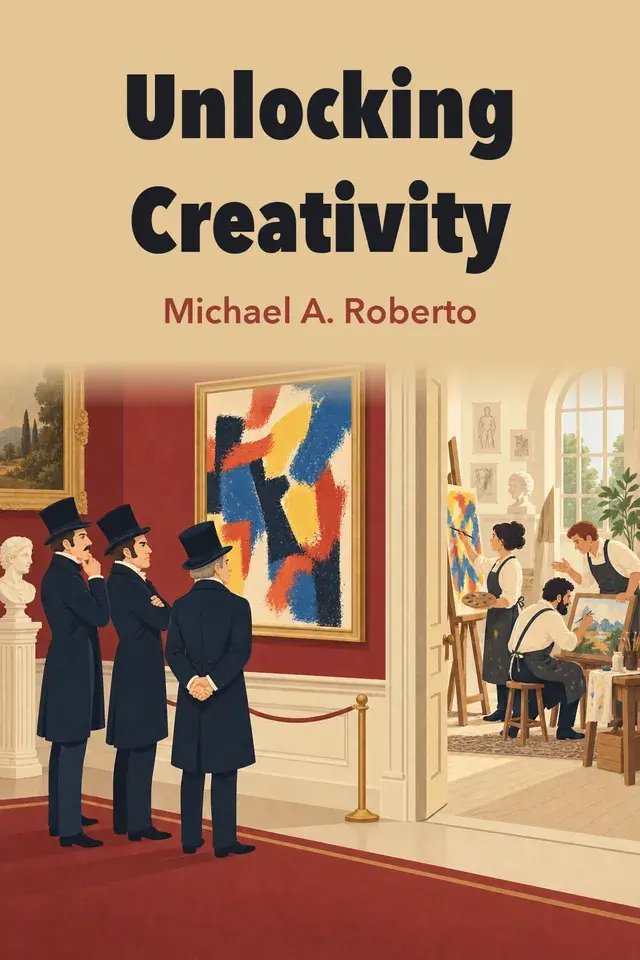
Unlocking Creativity, by Michael A. Roberto.
Many organizations say they need creativity. Leaders praise original thinking and ask people to find new solutions. Yet employees may feel discouraged when they offer ideas that depart from familiar practice. The distance between what an organization says it values and what people experience in its daily work is the problem this book sets out to examine.
Roberto argues that creativity is a capacity people can develop, not a rare gift that belongs only to a few exceptional people. He and his colleagues put that belief into practice through Bryant University’s IDEA program, a hands-on experience designed to help students build creative problem-solving skills. His argument is not that talent never matters. It is that organizations can overlook the abilities already among them when shared assumptions and everyday conditions make it hard to contribute.
The difficulty begins when people with authority judge unfamiliar work by established standards. Édouard Manet’s painting Le Bain challenged the expectations of the Paris art establishment. It showed a contemporary scene and used broad strokes and sharp contrasts instead of the polished precision critics favored. The Salon’s traditionalist jury rejected it, along with two other Manet paintings. A later exhibition for rejected works drew visitors who mocked what they saw. Some observers, however, recognized a conflict between conservative taste and new artistic approaches. Manet and other artists continued exchanging ideas, and the Impressionist movement eventually became influential.
That history does not mean that every rejected idea deserves approval. It shows that rejection by established authorities cannot, on its own, tell us whether an unfamiliar idea has merit. Gatekeepers may apply criteria that favor work they already understand, leaving valuable possibilities difficult to recognize at first.
A business example makes the same point in a different setting. Airbnb’s founders approached seven well-known investors while trying to fund their idea. Five turned them down, and two did not reply. The company later became highly valuable. The investors’ responses show how experienced authorities can misjudge a proposal when it falls outside their expectations. They do not prove that every rejected venture will succeed. They do make rejection an incomplete test of an idea’s potential.
Roberto’s account of expertise is similarly qualified. Experience and specialized knowledge matter greatly in work such as flying an aircraft, performing surgery, or designing a bridge. But being an expert in a field does not guarantee skill at predicting which original ideas will succeed. One study looked at ratings by mentors of 652 startups in the MIT Venture Mentoring Service. The mentors assessed ventures without information about the founders or in-person contact. For research-and-development-intensive ventures, expert mentors did not predict commercial success more accurately than the mentor group overall. Higher ratings still corresponded to better odds of commercialization. The result is bounded to this study and does not make expertise useless. It does caution against treating expert judgment as a reliable filter for every new idea.
The book also describes experiments suggesting that people who feel like experts can become more closed-minded. In one study, participants received false feedback that they had performed especially well on a quiz. Those led to feel more expert showed greater closed-mindedness. The finding helps explain why confidence and status can sometimes make people less receptive to challenges, even when they do not have better grounds for judging an idea.
The broader lesson is that people’s behavior depends partly on their circumstances, not just on what they say they believe. A study at Princeton Theological Seminary illustrates this. Students preparing either a talk about the Good Samaritan or a general career talk were asked to walk to another location. Along the way, they encountered a person slumped in a doorway who appeared to need help. Students who were in a hurry were less likely to stop. Preparing a talk about helping others did not make them more likely to help than preparing the career talk; some hurried students even stepped over the person.
The study does not establish that personality never matters. It shows that, in this situation, time pressure shaped behavior even among students preparing to speak about the Good Samaritan. An organization can create a similar gap. People may sincerely endorse creativity, while a hurried pace, scarce resources, familiar expectations, or leaders’ reactions make it difficult to act on that value. A public commitment alone does not create supportive conditions.
This is why Roberto recommends diagnosing the situation before deciding that a team lacks creative people. Leaders can ask whose ideas get heard, how newcomers with different perspectives are treated, and what happens after someone questions a familiar approach. They can examine whether people have time and resources to explore ideas, and whether organizational incentives make experimentation welcome or costly. These questions direct attention to the environment people work in, as well as to their individual abilities.
The book names six recurring organizational mindsets that can obstruct creativity: linear, benchmarking, prediction, structural, focus, and naysayer. These labels provide a map of shared assumptions that influence how people make and assess ideas. The chapters that follow examine each mindset and its particular effects. Here, the central point is simpler: creative potential is broadly distributed, but it will not reliably surface just because an organization says it wants new ideas. Understanding the conditions that shape people’s actions is a necessary first step toward seeing what the organization may already have.
Chapter 2 of 8 · 10 min · Audio & textIn the app
Learn Through Iterative Action
When a problem is familiar and the future is reasonably predictable, a linear plan can be useful. Research, analysis, budgeting, and execution help people coordinate work and prepare for what comes next.
Chapter 3 of 8 · 8 min · Audio & textIn the app
Benchmark Without Blending In
Organizations often learn by comparing themselves with leaders in their field. They identify a gap, study how another organization works, and adopt practices that may improve quality or productivity.
Chapter 4 of 8 · 11 min · Audio & textIn the app
Plan Under Real Uncertainty
A new business idea often faces a test no one can answer reliably: how large will it become? Leaders ask for sales, profit, market share, and return estimates before committing resources.
Chapter 5 of 8 · 11 min · Audio & textIn the app
Build Conditions for Contribution
Creative ability becomes useful to an organization only when people can contribute ideas, coordinate their work, and learn from what happens. No single organization chart guarantees those conditions.
Chapter 6 of 8 · 8 min · Audio & textIn the app
Move Between Focus and Distance
Creative work needs both closeness and distance. Concentration lets a person stay with a difficult problem long enough to understand its details.
Chapter 7 of 8 · 8 min · Audio & textIn the app
Make Dissent Useful
Disagreement can reveal what a group has overlooked, but criticism is not automatically useful. When people challenge assumptions with care, they can bring hidden risks and information into a decision.
Chapter 8 of 8 · 7 min · Audio & textIn the app
Lead as a Teacher of Creativity
Roberto closes by redefining the leader’s job: not to be the person with the best answer, but to help others learn to find answers. Expertise still matters.
Chapter 1 of 8 · 7 min · Audio & text: Creativity Is a Shared Capacity
Wiseley supports reading and listening to summaries in the app.
Continue in WiseleyAbout Michael A. Roberto

Michael A. Roberto is a professor of management at Bryant University. “Unlocking Creativity” explores why organizations praise creativity yet reject unfamiliar ideas.
Explore more books by Michael A. Roberto