What you'll learn
Key ideas from Unlimited Memory
These ideas compress the book's argument without treating the author's view as settled fact. Use them as an orientation before reading the full work or listening in Wiseley.
The four Cs combine concentration, creating imagery, connecting concepts, and continuous use as the book’s organizing framework.
SEE gives an imagined cue sensory richness, distinctive exaggeration, and movement or other energizing action.
Journey routes depend on familiar, ordered, varied, nearby, and distinct markers.
Visual chains preserve order, while branching maps reveal relationships between a subject and its details.
Effective study combines preparation, PIC, breaks, organized memory systems, and reviewing the systems to ensure the material is remembered.
Durable memory rests on repeated retrieval, correction, and sustained use after initial encoding.
Inside Unlimited Memory
Read the first chapter in full here. The other 7 continue in the Wiseley app.
Chapter 1 of 8 · 7 min · Audio & text
Attention Makes Memory Training Possible
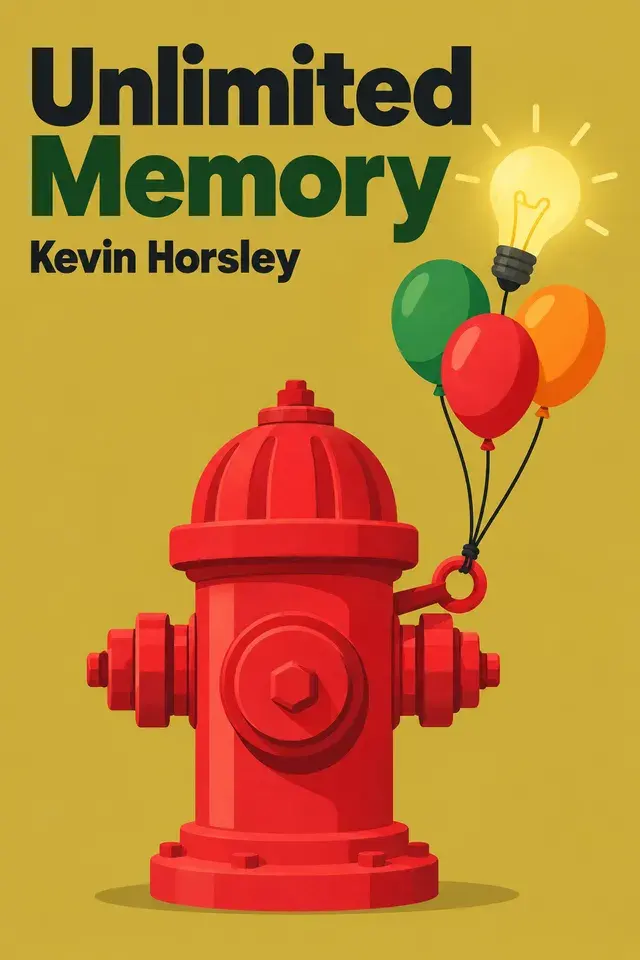
Unlimited Memory, by Kevin Horsley.
Memory training starts before any mnemonic technique. It starts with attention and with the assumptions you bring to learning. Horsley presents memory as the store of experience that supports identity, understanding, judgment, and action. He makes an important distinction: recognizing information is not the same as retrieving it when needed. A fact can look familiar on a page while remaining unavailable in a conversation or decision. His response to the Google-era objection is qualified. External information remains useful, but knowledge held in mind is available at the moment judgment is required. The aim is not to reject references. It is to make learning usable rather than merely recognizable.
His framework is the four Cs: concentration, creating imagery, connecting concepts, and continuous use. Concentration directs the mind. Imagery gives bland information a meaningful form. Connection relates one idea to another. Continuous use makes memory part of ordinary action rather than an isolated trick. The later memory systems depend on these conditions, but this chapter begins with the first: deciding what attention will serve.
Horsley uses his own history as testimony for the possibility of change. He says that, at eight, he was told he might have brain damage and should enter a special class. He describes himself as dyslexic and unable to concentrate. After discovering books on memory and learning, he studied psychology, research on the brain and mind, and the methods used by exceptional memorizers. He reports placing fifth overall and second in the written-word event at the 1995 World Memory Championships, receiving the title International Grandmaster of Memory, and later memorizing the first ten thousand digits of pi. These are his personal reports, not controlled evidence or a promise that every learner will reproduce them. In his argument, they show what became possible when he changed his approach and practiced deliberately.
The book then turns to excuses because explanations can become decisions not to engage. Blame, stress, and repeated claims that a person cannot change can consume the attention that learning requires. Horsley treats such patterns as mental habits that preserve the old result. That does not mean every lapse is chosen or that difficulty proves insufficient effort. His more useful point is that an unsatisfactory result can be treated as feedback about the approach, rather than as a final verdict on ability.
To show how expectations enter this loop, Horsley imagines Mr. A and Mr. B with the same environment, education, brains, and nervous systems, but different beliefs about memory. Mr. A carries a negative expectation about memory. Mr. B expects improvement, wants to remember names, and trains his mind. The contrast is an illustration, not an experiment. Its value is explanatory: beliefs influence what each person notices, how much effort seems worthwhile, and which experiences are interpreted as confirmation. Belief alone does not erase learning difficulties, but it can make deliberate practice more or less likely.
Changing a limiting belief therefore requires more than repeating a positive sentence. The book suggests asking what the old belief costs, whether it is actually true, and what evidence could support a better one. The proposed alternatives include seeing concentration and memory as developable, treating improvement as important, using mistakes as feedback, and remaining open to what is not yet known. These ideas are meant to be practiced until they guide behavior, not merely agreed with in theory.
That practice includes directing inner speech. The internal voice is presented as a constant interpreter and controller of attention. Learners are encouraged to notice not only mistakes but also moments when they concentrate well or do something correctly. A harsh thought can feel like a fact, yet the book treats it as a thought or command that can be changed. Deliberate inner speech asks the learner to replace self-attack with useful instructions and to use successful moments as evidence that attention is not fixed.
Concentration also depends on single-tasking. Horsley calls multitasking a myth because the mind switches between competing tasks instead of giving both full attention. Phones, messages, worry, and repeated channel-switching can train that fragmented pattern. The remedy is consecutive attention: return to one task, stay present in the setting you are in, and reduce the inner conflict that pulls the mind in several directions. The book portrays concentration as many small choices, not a magical trait. When attention wanders, the relevant response is to notice the movement and redirect it.
PIC gives that directed attention a reason to stay. Purpose means approaching information with a specific aim, rather than a vague intention to learn. A clear purpose tells the mind what matters and helps organize what it encounters. Interest acts as a filter. When material seems dull, Horsley recommends connecting it with existing interests, practical uses, future goals, or a problem the learner genuinely wants to solve. Curiosity completes the sequence through energizing questions: How is this relevant? Where could it be applied? What might it make possible? Questions that express resistance can keep attention closed; questions about meaning and use invite it in.
Worry is another form of misdirected mental activity. Horsley describes it as a learned process built from repeated hypothetical questions. “What if?” can generate vivid loops about possible disasters without producing a response. He proposes replacing that question with “What would I do?” The first rehearses uncertainty; the second searches for a procedure and an action. This shift does not guarantee control over events, but it returns attention to the learner’s own choices.
Together, these ideas establish the conditions for the four Cs. Memory training begins when beliefs make practice plausible, inner speech supports attention, and single-tasking keeps the mind available. Purpose, interest, and curiosity then give learning direction, while action-focused thinking helps keep worry from occupying the whole field. Later methods can build on that foundation, but no encoding system can replace the initial decision to be present.
Chapter 2 of 8 · 7 min · Audio & textIn the app
Turn Information Into Memorable Images
Kevin Horsley presents memory as a creative skill, not a photographic gift. He rejects the idea that remembering means taking a perfect mental snapshot.
Chapter 3 of 8 · 7 min · Audio & textIn the app
Build Reliable Places for Recall
Vivid images become more useful when they have an address. A picture can be striking yet difficult to find if it floats among unrelated memories.
Chapter 4 of 8 · 7 min · Audio & textIn the app
Connect Sequences and Organize Meaning
Once a keyword has been turned into a vivid image, the next challenge is holding several items together. Linking solves that by making one image cue the next image.
Chapter 5 of 8 · 5 min · Audio & textIn the app
Remember Names Through Personal Connections
A name becomes retrievable when deliberate hearing is followed by a meaningful connection to its owner and continued use. Horsley presents name recall as a strategy, not a fixed division between people who are naturally good or bad at names.
Chapter 6 of 8 · 7 min · Audio & textIn the app
Give Numbers a Spoken Image Code
Numbers are difficult to retain when they remain bare symbols. A string of digits may be clear, but it does not automatically call up a concrete scene.
Chapter 7 of 8 · 5 min · Audio & textIn the app
Use Memory Systems in Daily Work
Memory methods become useful when their structure matches the practical task and the kind of recall it requires. A presentation, a demanding course, and a misplaced set of keys create different memory problems.
Chapter 8 of 8 · 5 min · Audio & textIn the app
Make Recall Last Through Review
Memory techniques can create a strong first impression, but that is only the beginning. Recall becomes durable when the learner keeps returning to the material, retrieves it, corrects weak cues, and uses it again.
Chapter 1 of 8 · 7 min · Audio & text: Attention Makes Memory Training Possible
Wiseley supports reading and listening to summaries in the app.
Continue in WiseleyWhat Unlimited Memory is about
How can information become easier to recall and use? Kevin Horsley presents memory as a trainable skill, combining focused attention, vivid imagery, familiar locations, and repeated retrieval. This summary explains how those methods apply to names, numbers, studying, and presentations, and why lasting recall requires practice.