What you'll learn
Key ideas from University of Berkshire Hathaway
These ideas compress the book's argument without treating the author's view as settled fact. Use them as an orientation before reading the full work or listening in Wiseley.
Intrinsic value estimates a business’s future cash generation, while price is the amount required to buy an ownership interest.
A margin of safety leaves room for an estimate to be wrong; a small discount to estimated value may not provide enough.
Liquidity and freedom from forced selling preserve the ability to assess opportunities during a panic.
Float is money held before claims are paid; underwriting results determine whether that financing is cheap or costly.
Pricing power shows up when customers accept a higher price without leaving in numbers that damage the business.
Berkshire compares every use of cash with its alternatives, seeking the strongest long-term, risk-adjusted purpose.
Reported earnings and book values can omit customer value, investment marks, and long-term obligations, so accounting figures require context.
Liquidity, conservative debt, aggregated exposure reviews, and senior risk oversight support survival through shocks whose timing is unknown.
Inside University of Berkshire Hathaway
Read the first chapter in full here. The other 8 continue in the Wiseley app.
Chapter 1 of 9 · 7 min · Audio & text
From Textile Mill to Learning Record
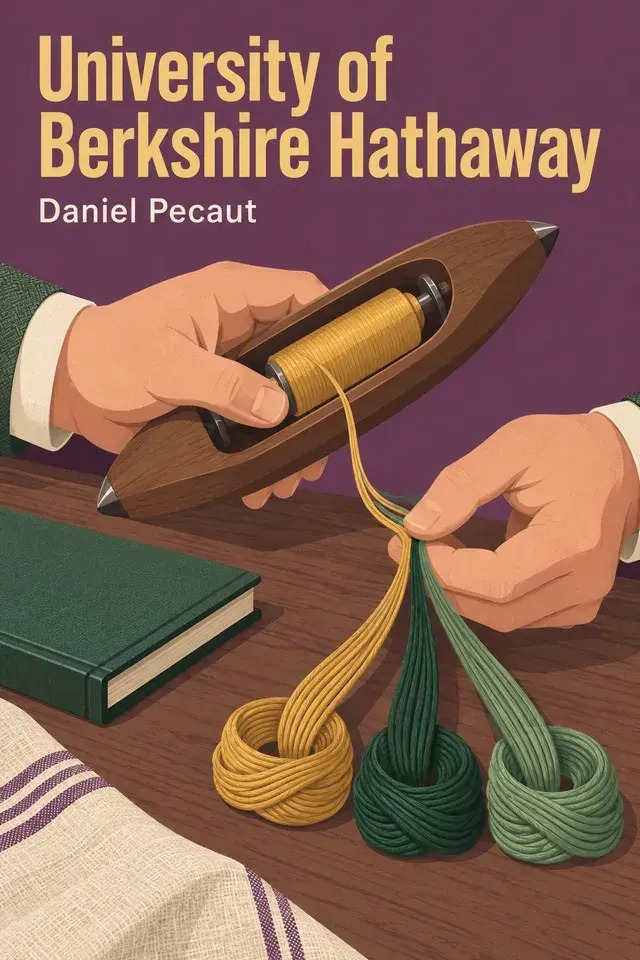
University of Berkshire Hathaway, by Daniel Pecaut.
Berkshire Hathaway’s later identity can make its beginnings look more deliberate than they were. The company did not start as a carefully designed home for a collection of strong businesses. It was a struggling textile manufacturer, and Warren Buffett’s decision to take control was driven in part by irritation. That beginning matters because the book presents Berkshire not as a flawless plan, but as a record of judgment, error, and later adaptation.
Buffett began buying Berkshire shares in 1962. The company had been formed from two New England textile businesses, but the combined operation was losing money, closing plants, and shrinking. Its problems were not a temporary surprise that appeared only after Buffett arrived. The authors point to a long record of difficulty in the textile business. Buffett was attracted to the shares partly because they seemed inexpensive relative to the company’s assets, but owning a cheap-looking company is not the same as owning a healthy one.
The decisive moment came in 1964, when Berkshire offered to repurchase Buffett’s shares. He had told the company’s head, Seabury Stanton, that he would tender them at eleven dollars and fifty cents a share. The written offer came in lower, at eleven dollars and thirty-seven and a half cents. Buffett could have accepted the offer, taken his gain, and moved on. Instead, he felt Stanton had gone back on their understanding. He refused to tender and bought more shares. By April 1965, his partnership held enough stock to take control of Berkshire.
Buffett later described the episode as a foolish decision shaped by resentment over a small price difference. In the authors’ account, he said that taking the cash would have been the smarter choice. He also characterized the conflict as childish behavior on both sides. The outcome was not simply that he owned more of the company. More than a quarter of his partnership’s capital was now tied up in a business he considered poor and understood only imperfectly. His irritation had turned a possible exit into control of the very company he had initially approached as a bargain.
The textile operation continued to consume attention and money. By fiscal year-end 1964, Berkshire’s net worth had fallen substantially from its level after the 1955 merger. The textile business required the company’s resources, and Berkshire also owed money to its bank. Buffett kept trying to make the operation work, but later said those efforts continued for many years without success. The business was finally closed in 1985. The long delay is part of the lesson: recognizing a weak business does not automatically make it easy to leave, especially when an earlier decision has tied one’s fortunes to it.
At the same time, Berkshire’s future was not confined to textiles. The company’s resources were gradually redirected toward securities and other businesses. Buffett reduced assets and operating costs to make funds available, and Berkshire acquired National Indemnity in 1967. It later added a bank and other investments. By 1969, the company’s earning sources had shifted significantly toward insurance, banking, and investments rather than textile production. The textile business had not become a success; Berkshire was changing what it owned and where its earning power came from.
That distinction keeps the story honest. Berkshire’s eventual transformation does not make the original takeover decision wise in retrospect. The authors present the acquisition and the later development as different judgments: first, a control decision partly prompted by anger; then, a gradual reorientation of the company toward other assets and businesses. The useful history lies in seeing both. A mistake can be followed by better decisions, but later success does not erase the mistake or prove that the original motive was sound.
This longer view is also the book’s way of teaching. Pecaut and Wrenn assembled material across roughly three decades of Berkshire meetings and related newsletters. Their aim is to let readers follow decisions and explanations as circumstances change, rather than drawing a rule from one isolated success. The episodes are presented as part of a developing record: what Buffett and Charlie Munger considered, what they got wrong, and how their views or Berkshire’s position evolved. The authors invite readers to study that reasoning, not to imitate every purchase. Berkshire’s opportunities and resources were not identical to those available to ordinary investors.
The meeting accounts have an important limit. They are not verbatim transcripts. The authors say their notes began as hurried records, which they later expanded, edited, and combined with their own analysis. They sometimes interpret what they believe was implied or left unsaid. The book is therefore a curated account, not an electronic record of exactly what each speaker said. Buffett valued recorded interviews partly because they preserve a speaker’s words; the authors distinguish their work from that kind of record and acknowledge that their notes may contain inaccuracies. A reader should not treat every sentence in the book as a direct quotation or every interpretation as Buffett’s own stated conclusion.
The book is also not a step-by-step manual or a promise that Berkshire’s results can be repeated. Its historical performance belongs to the periods described, and the authors’ summaries of past returns do not establish what future returns will be. The point is not that one decision sequence guarantees the same outcome. It is that a long record makes it possible to examine choices alongside their context, consequences, and later reassessment.
Berkshire’s textile origin gives the book a useful starting point precisely because it is untidy. Buffett took control for a reason he later regretted; the company then moved beyond the business that first brought him there. The meeting notes, in turn, offer an edited lens on that history rather than a perfect transcript. Read in that spirit, Berkshire’s story is neither a script to copy nor proof of inevitable success. It is a record of how judgment can fail, change, and continue.
Chapter 2 of 9 · 10 min · Audio & textIn the app
What a Business Is Worth
A share of stock represents part ownership in a business. So the central question is not what other investors may pay tomorrow, but what the business itself is likely to produce for its owners over time.
Chapter 3 of 9 · 7 min · Audio & textIn the app
Temperament, Price, and Opportunity
A market quotation is information about what someone will pay now. It is not a command, and it is not a complete account of what a business is worth.
Chapter 4 of 9 · 6 min · Audio & textIn the app
Float, Underwriting, and Compounding
Insurance has an unusual financial rhythm. Policyholders pay premiums in advance in exchange for a promise of coverage if a future loss occurs.
Chapter 5 of 9 · 8 min · Audio & textIn the app
Where Durable Advantages Come From
Chapter Two made business quality part of judging how dependable future cash might be. Here the question is what makes a business’s economics dependable.
Chapter 6 of 9 · 9 min · Audio & textIn the app
Allocating Capital Through a Culture
Berkshire’s capital-allocation story is not simply a catalogue of stocks Buffett chose. The deeper question is where the company sends cash after its businesses earn it, and whether that process can keep working beyond one investor’s next idea.
Chapter 7 of 9 · 9 min · Audio & textIn the app
Incentives, Accounting, and Stewardship
Good stewardship begins with treating a share as ownership in a business. Managers and directors make decisions that shape what owners receive, so their incentives and reports need to keep attention on the business’s real economics over time.
Chapter 8 of 9 · 8 min · Audio & textIn the app
Surviving Leverage and Systemic Shocks
Financial risk can become larger than any one company when borrowing, complex contracts, and shared exposures connect many institutions. A firm may make a poor decision and absorb the loss.
Chapter 9 of 9 · 7 min · Audio & textIn the app
Learning, Scale, and Realistic Expectations
The point of studying Buffett and Munger is to see a judgment process that can change as its owners learn. Munger credits Buffett’s rationality and capacity to learn with Berkshire’s success.
Chapter 1 of 9 · 7 min · Audio & text: From Textile Mill to Learning Record
Wiseley supports reading and listening to summaries in the app.
Continue in Wiseley