What you'll learn
Key ideas from Understanding Artificial Intelligence
These ideas compress the book's argument without treating the author's view as settled fact. Use them as an orientation before reading the full work or listening in Wiseley.
Machine learning builds or changes a processing rule from data, but its result remains bounded by the starting procedure and data.
Combinatorial growth makes exhaustive search impractical even on fast computers with finite time and memory.
Unsupervised classification finds structure within a representation; it does not reveal one natural division inherent in the objects.
Deep learning became practical when backpropagation, layered architectures, GPU parallelism, and large training collections reinforced one another.
High accuracy does not guarantee explanations or robustness: small adversarial changes can reverse a network’s classification.
Reinforcement learning adjusts action preferences from final rewards without requiring a labeled correct move at every state.
General intelligence concerns broad adaptation, while consciousness concerns awareness; strong performance alone establishes neither.
Responsible evaluation connects purpose, representation, performance evidence, tolerable mistakes, explanation, and stakeholder accountability.
Inside Understanding Artificial Intelligence
Read the first chapter in full here. The other 10 continue in the Wiseley app.
Chapter 1 of 11 · 7 min · Audio & text
What an Intelligent Machine Actually Does
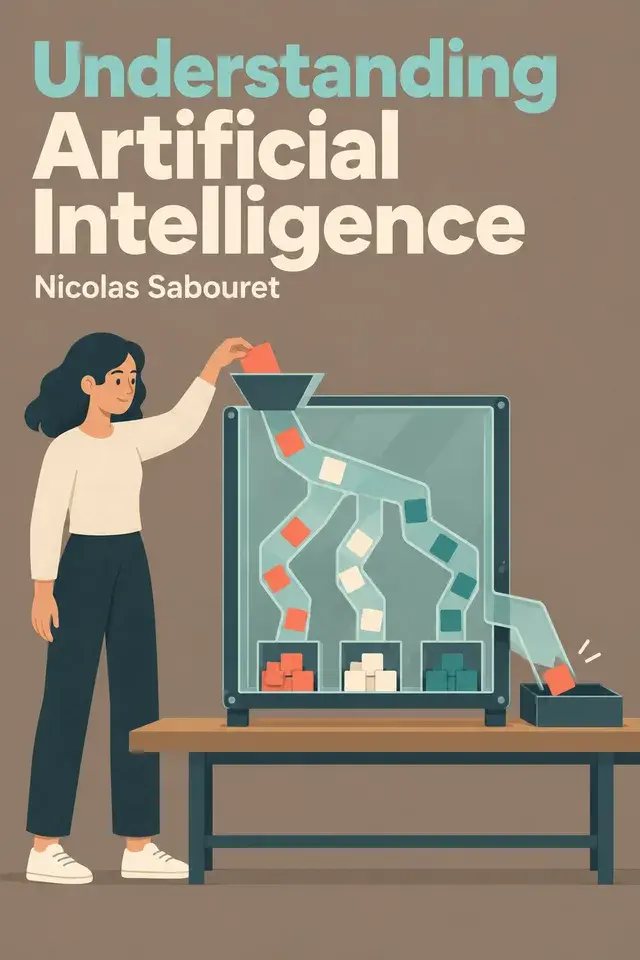
Understanding Artificial Intelligence, by Nicolas Sabouret.
When a machine appears intelligent, first ask not whether it has a mind, but what procedure produces the appearance. The book presents AI as computer programs that automate tasks people currently perform more satisfactorily because they involve perception, learning, memory organization, or critical reasoning. Calling it an AI program is deliberate: apparent intelligence belongs to a human-designed algorithm, while the computer executes it. This demystifies AI without denying its power or the need to guard against misuse.
To see the underlying vocabulary, think of a recipe. A recipe does not merely name a dish; it orders actions. The book uses elementary-school addition similarly: align digits, add from one column, carry when necessary, and continue. That ordered method is an algorithm. It can be represented as information and given to a general-purpose machine, so the same hardware can add or multiply depending on the algorithm it receives.
That distinction separates instructions from data. Data are numbers, words, images, sounds, or spoken input being processed; instructions specify how processing happens. A computer follows instructions recorded in machine-readable form and applies them to data. A program is an algorithm written in such a language; when executed, it is running. The machine may branch according to rules, like a choose-your-own-adventure book, but its branches are prescribed rather than independently chosen.
Machine learning changes how much of the processing rule is written in advance. A learning program uses data and prescribed operations to extract an answer or construct a processing program, rather than requiring someone to hand-write every detail. Programs and data can be manipulated by other programs, but the result still depends on the starting operations and supplied data. Poor instructions or data can produce errors or an ineffective rule. Learning builds or changes a procedure within a designed framework; it does not create arbitrary intelligence.
This is why the source resists the idea of one all-purpose AI. There is no single program that solves every problem; a task needs a suitable procedure and matching data. AlphaGo is a compact illustration. The source says it needed one program to observe Go positions and another to select moves, and adapting the result to chess or checkers would require new human analysis, rule descriptions, and modifications. The example matters here only because it shows specialization, not the system's internal mechanics.
Then why use the word intelligence? Computers are good at storing information and calculating. A calculator can outperform a person at arithmetic without thereby becoming intelligent. The book describes human intelligence more broadly, as using knowledge, drawing on experience in ordinary contexts, learning from examples, forming concepts, imagining tools, and communicating abstract ideas. IQ tests measure selected abilities and yield comparative, not absolute, scores. Adapting such a test to a machine also requires human choices about the questions, their translation, the algorithm, and the data. A machine score would not cleanly measure an independent mental capacity.
Alan Turing's proposal takes a different route. Instead of defining intelligence, it asks whether an evaluator can distinguish a machine from a human through conversation. In the setup described by the source, the evaluator communicates through separate keyboards and screens with a hidden human and a hidden program. Both answer within the same time constraint, so the comparison concerns the content of responses rather than typing speed. The test became a reference point for chatbots. The book reports that no program has fully met all of Turing's requirements, despite periodic claims and competitions designed to expose conversational systems.
ELIZA makes the issue concrete. According to the book, Joseph Weizenbaum's 1966 program had a catalog of topics and sentence patterns. It looked for keywords, including family terms, then selected a formulaic response connected to the topic. If no suitable response was available, it redirected the user's words by reflecting the question back. The user supplied much of the subject matter and coherence. ELIZA shows how keyword matching and conversational redirection can create an impression of understanding without requiring a rich model of the speaker.
The Chinese room turns that caution into a thought experiment. John Searle imagines a person who does not know Chinese sitting in a room with a rulebook and Chinese-character symbols. By following formal instructions, the person returns answers that an outside Chinese speaker judges appropriate. The outputs look as though the room understands Chinese, while the person manipulating the symbols understands none of it. The experiment challenges the assumption that correct symbol manipulation is sufficient for understanding. It is not a settled proof, but it exposes the gap between observable performance and a mental state inferred from it. The Turing test asks whether behavior is indistinguishable from a human's; the Chinese room asks whether successful behavior warrants attributing understanding.
Together, these examples establish the chapter's discipline. Strong performance on an apparently intelligent task shows that a procedure can produce useful outputs under defined conditions. It does not, by itself, demonstrate human-like understanding, a will, or general intelligence. Machines may calculate, remember, search, or classify in ways people cannot match, without imitating human thought. To evaluate an AI claim, ask what task was defined, what data and instructions shaped the result, and what the observed performance actually proves. This vocabulary lets the following chapters examine particular methods without confusing their outputs with a machine's mental life.
Chapter 2 of 11 · 9 min · Audio & textIn the app
Finding Paths Within Computational Limits
Fast computers change what can be attempted, but they do not abolish limits. A computer may perform billions of additions per second, yet a large operation count still creates delay.
Chapter 3 of 11 · 6 min · Audio & textIn the app
Choosing Moves Against an Opponent
When a computer searches for a route, it can compare possible continuations against a fixed goal. A game introduces another decision-maker.
Chapter 4 of 11 · 10 min · Audio & textIn the app
Improving Solutions Through Repeated Search
Improving a solution does not always mean finding a direct path to the answer. The traveling-salesman problem makes the issue concrete.
Chapter 5 of 11 · 6 min · Audio & textIn the app
How Data Becomes a Classification
Earlier chapters considered systems that search among actions or routes. This chapter changes the question: how can a system represent objects, compare them, and discover useful structure in examples?
Chapter 6 of 11 · 9 min · Audio & textIn the app
Learning Rules and Decision Boundaries
Supervised learning begins with a pairing: an input and the result it is supposed to produce. For a voice assistant, the inputs can be utterances, and the labels can be operations such as telling the time or switching on a light.
Chapter 7 of 11 · 8 min · Audio & textIn the app
Training Networks by Correcting Errors
An artificial neural network becomes less mysterious once neural is separated from biological. Early network ideas drew on attempts to imitate neurons, including Hebb’s proposal that simultaneous activity could strengthen a connection.
Chapter 8 of 11 · 8 min · Audio & textIn the app
Why Deep Learning Became Practical
Deep learning became practical when an older idea—adjustable neural networks—met several enabling conditions at once. Layered calculations could represent complex transformations.
Chapter 9 of 11 · 8 min · Audio & textIn the app
Learning Actions From Their Consequences
Go makes the limits of exhaustive game search unusually visible. Its board has 361 intersections, so the number of possible positions expands too quickly for conventional minimax.
Chapter 10 of 11 · 5 min · Audio & textIn the app
Specialized Skill and General Intelligence
A machine can be extraordinarily good at one task without being generally intelligent, and general intelligence would still be different from consciousness. The book uses these distinctions to put impressive AI achievements in proportion: success proves something about a system’s performance, but not everything people may want to infer from it.
Chapter 11 of 11 · 9 min · Audio & textIn the app
Human Responsibility for Machine Decisions
After explaining how AI searches, classifies, learns, and acts, the book turns to a question those mechanisms cannot answer by themselves: when should such a system be used, and who is answerable for its effects? The author’s emphasis moves away from imagining a machine that spontaneously forms intentions.
Chapter 1 of 11 · 7 min · Audio & text: What an Intelligent Machine Actually Does
Wiseley supports reading and listening to summaries in the app.
Continue in WiseleyWhat Understanding Artificial Intelligence is about
How do AI systems find routes, recognize patterns, and learn to play games? Nicolas Sabouret explains the algorithms, representations, and human choices behind these abilities. This summary connects search and machine learning with their practical limits, then examines the unresolved questions of intelligence, consciousness, and responsible use.