What you'll learn
Key ideas from Thinking 101
These ideas compress the book's argument without treating the author's view as settled fact. Use them as an orientation before reading the full work or listening in Wiseley.
Physical rehearsal and step-by-step explanation expose gaps that imagination and recognition can hide.
Confirmation bias gives supporting examples extra weight, so plausible beliefs can harden without a fair test.
Recency and controllability can concentrate blame on visible or chosen events, including when they do not establish responsibility.
Bayesian reasoning combines test accuracy with base rates and keeps P(A|B) distinct from P(B|A).
Loss aversion gives an equal-sized loss more psychological weight than a gain, while the endowment effect raises an item’s value through ownership.
Direct questions and clear statements provide information that imagination alone cannot supply.
Immediate rewards can outweigh larger delayed ones because a wait feels more costly when it begins in the present.
Inside Thinking 101
Read the first chapter in full here. The other 7 continue in the Wiseley app.
Chapter 1 of 8 · 9 min · Audio & text
When Ease Masquerades as Ability
Thinking 101, by Woo-kyoung Ahn.
Thinking 101 begins with a practical question: can cognitive psychology help people make better decisions in ordinary life? Ahn’s approach is to examine why familiar habits of thought are useful, where they distort judgment, and what people can do to compensate. This chapter focuses on fluency: how easily an idea, explanation, or imagined action comes to mind. Ease is often a helpful clue about what we know. It becomes misleading when the feeling of knowing or being able to do something is treated as proof.
Judging what we know or can do is part of metacognition. Those judgments guide what we attempt, avoid, or decide to learn. Familiarity and ease offer quick cues, which can be useful when checking something directly would take too much effort. Ahn does not argue that people should reject those cues. The problem comes when a feeling of familiarity substitutes for evidence of skill or knowledge.
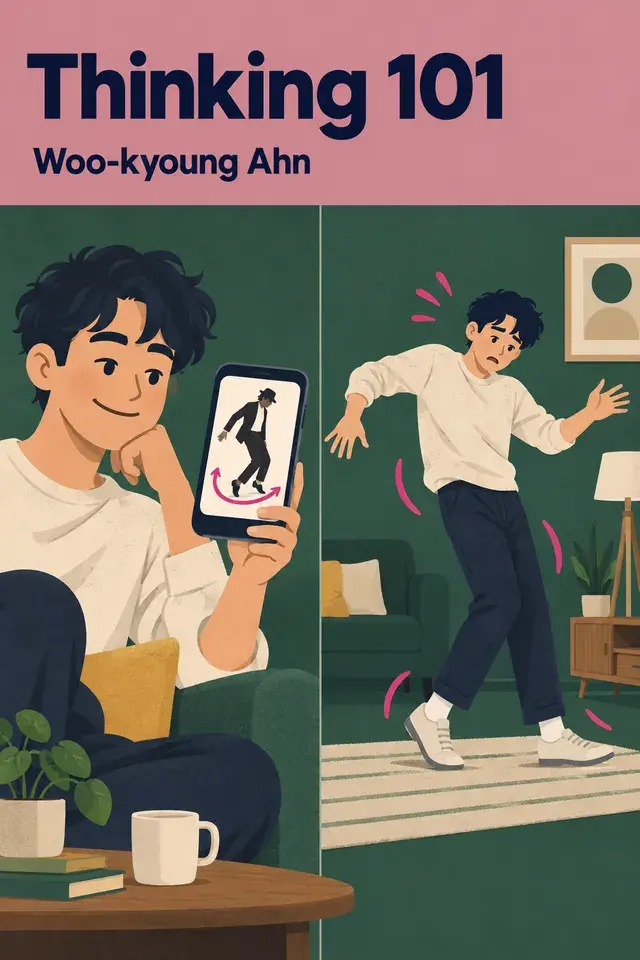
Watching someone perform can create that substitution. In a study Ahn describes, people who watched Michael Jackson moonwalk twenty times felt more confident that they could do it than people who watched once. Yet the groups performed no differently. Repeated viewing made the movements easier to imagine, but had not trained anyone’s body to perform them. Confidence rose without a corresponding change in ability.
A polished result can hide the work that produced it. From the outside, a performance may look smooth because we do not see the practice, revisions, mistakes, and effort behind it. The same is true of other finished products, from a carefully prepared talk to a difficult piece of writing. Seeing a result, or following it easily, does not show that producing it would be easy for us.
A fluent explanation can also feel like knowledge. Ahn discusses studies in which duct tape removed warts as well as, or sometimes better than, liquid nitrogen. The proposed explanation that covering a wart deprives the virus of air and sunlight can make the treatment sound more convincing. But a plausible mechanism is not proof that the mechanism is correct. The explanation adds a smooth story; it does not change the underlying evidence. When we can easily picture how something might work, we may mistake that ease for stronger support.
Ease can influence judgments even when it has little to do with the thing being judged. In studies Ahn describes, people rated pronounceable invented stock names as more likely to rise in value than harder-to-pronounce names. Real stocks with easier names also performed better over the periods examined. Researchers looked at ticker codes as well, and found that companies with more pronounceable codes performed better in the markets studied. Pronounceability should not reveal a company’s quality, so these findings show how an arbitrary ease cue can enter an evaluation. They do not make easy-to-pronounce names a reliable investment rule.
Ahn also describes an internet-search study. One group searched for answers to an initial set of questions; another group did not. Later, when both groups answered unrelated questions, the searchers had no information advantage. Still, they rated themselves as more knowledgeable. Finding information on one subject seemed to spill over into a broader feeling of being informed. The cue was ease of access to knowledge, not knowledge of the later subject.
These examples show why fluency can mislead, but they do not make it useless. Familiarity can help us make quick judgments about what we recognize or can do, and Ahn suggests it persists because metacognition has real benefits. The aim is better calibration: notice when confidence rests on familiarity or a smooth mental picture, then compare it with what you can actually do or explain.
For a skill, Ahn recommends replacing imagined practice with physical rehearsal. Speak a presentation aloud, make a dish before serving it, or perform the dance movements you expect to do. Mental rehearsal often flows smoothly because the mind skips over the moments where a movement fails or a step becomes unclear. Using your body and voice makes those gaps harder to glide past. You can discover them before the performance matters, without waiting for someone else to point them out.
The same idea applies to knowledge. People may feel they understand familiar objects, such as toilets, sewing machines, or helicopters, until asked to explain how they work step by step. In a study Ahn describes, participants initially rated their knowledge around the midpoint of a seven-point scale. As they explained an object, most became less certain; follow-up questions reduced their confidence further. Recognition had felt like understanding. Trying to lay out the details revealed what they could not yet explain. Talking or writing through an idea can make that gap visible before it matters in a conversation, presentation, or decision.
Fluency also helps explain the planning fallacy: the tendency to underestimate how much time and effort a task will take. When people picture a task, the steps can play out like a smooth montage, with each part leading neatly to the next. In one Christmas-shopping study, participants expected to finish around December twentieth, but finished around December twenty-second or twenty-third on average. Those who made detailed step-by-step plans expected to finish about seven and a half days before Christmas, roughly three days earlier than those without such plans. The plan made the work seem smoother than it was.
That does not mean detailed planning is always harmful. Breaking a complicated task into smaller parts can reveal work that was easy to overlook, and one study found that dividing a task somewhat reduced the planning fallacy. Deadlines and subtasks can help people organize their work. But a plan can also create a misleading sense of control if it makes every step look easy and leaves little room for friction. Its effect depends partly on whether it exposes complexity or smooths it away.
A more realistic estimate accounts for both familiar obstacles and disruptions that are harder to predict. A shopper might anticipate traffic or an item being sold out. Illness, a home repair, or a family emergency is harder to put on a schedule, because there are so many possibilities. Ahn’s point is that planners can allow for interruptions even when they cannot name them in advance.
Ahn has a personal rule of adding fifty percent to an initial time estimate. For example, if he expects a manuscript review to take two days, he tells a collaborator it will take three. He explicitly presents this as a rule drawn from personal experience, not a scientifically established formula. The broader lesson is to leave room for what a mental simulation tends to omit, while treating any particular buffer as a judgment call.
Optimism can add to the problem when it directs attention away from setbacks, but Ahn does not treat optimism as inherently harmful. He credits it with benefits such as reducing stress, supporting health and happiness, and helping people pursue goals. He distinguishes realistic optimism, which acknowledges difficulty while retaining hope, from blind optimism, which denies risks or the situation itself. He uses early expectations that COVID-19 would disappear with spring as an example of the latter. To keep hope from becoming denial, he recommends taking comparable past cases seriously rather than dismissing them as irrelevant, and favoring data-based predictions over wishful intuition.
The chapter’s practical lens is to treat ease as a useful signal, then check what it is signaling. Watching, imagining, recognizing, and planning can all make a task or idea feel more familiar than it is. Trying the skill and explaining the idea can test what we know; allowing for disruptions can make plans less vulnerable to a smooth mental simulation.
Chapter 2 of 8 · 9 min · Audio & textIn the app
Test the Belief You Hold
A plausible explanation can start to feel certain when we keep finding examples that fit it. The crucial question is what we test: do we look for evidence that could make us revise the belief, or only for more support?
Chapter 3 of 8 · 9 min · Audio & textIn the app
How We Assign Causes and Blame
At the 1919 Paris Peace Conference, President Woodrow Wilson opposed harsh punishment of Germany. He became ill with the flu and neurological symptoms, and afterward lacked the strength to press his agenda.
Chapter 4 of 8 · 9 min · Audio & textIn the app
From Anecdotes to Better Evidence
Vivid stories do useful work: concrete examples can make an abstract idea easier to grasp and remember. But memorability is not the same as representativeness.
Chapter 5 of 8 · 7 min · Audio & textIn the app
Why Losses Loom Larger
Negative information often receives more weight than positive information of similar strength. That pattern is called negativity bias.
Chapter 6 of 8 · 9 min · Audio & textIn the app
Beliefs Shape What Facts Mean
Evidence can be present and still fail to change a belief. Earlier, Ahn examined how people look for confirming information.
Chapter 7 of 8 · 8 min · Audio & textIn the app
The Limits of Taking Perspectives
A message can feel perfectly clear to the person sending it because that person already knows what it is meant to say. The listener receives only the words, sounds, or gestures.
Chapter 8 of 8 · 12 min · Audio & textIn the app
Now, Later, and Knowing When to Persist
Ahn begins with an apparent contradiction in her own habits. At twenty-five, after moving from South Korea to the United States, she had a year to finish her psychology Ph.D. and join her adviser in a postdoctoral job she wanted.
Chapter 1 of 8 · 9 min · Audio & text: When Ease Masquerades as Ability
Wiseley supports reading and listening to summaries in the app.
Continue in Wiseley