What you'll learn
Key ideas from Things No One Else Can Teach Us
These ideas compress the book's argument without treating the author's view as settled fact. Use them as an orientation before reading the full work or listening in Wiseley.
The Boomerang story turns regret into concrete care: the author began scheduling contact and making time for friends.
A fitting life takes shape through trying paths and reflecting on what experience reveals about personal values.
Playful practice can build skill because challenge and progress reward the work itself, while quotas can drain creative effort.
Forgiveness, as the author describes it, releases the burden of hurt without requiring an apology or approval.
Pausing, gathering context, describing behavior, and keeping boundaries can bring compassion and accountability together.
Social-media highlights could make the author feel inadequate even after demanding, meaningful work, while scheduled access reduced comparison without requiring him to quit.
Regret can reveal how fear shaped a choice and help inform a future decision.
Inside Things No One Else Can Teach Us
Read the first chapter in full here. The other 8 continue in the Wiseley app.
Chapter 1 of 9 · 13 min · Audio & text
Let Impermanence Clarify What Matters
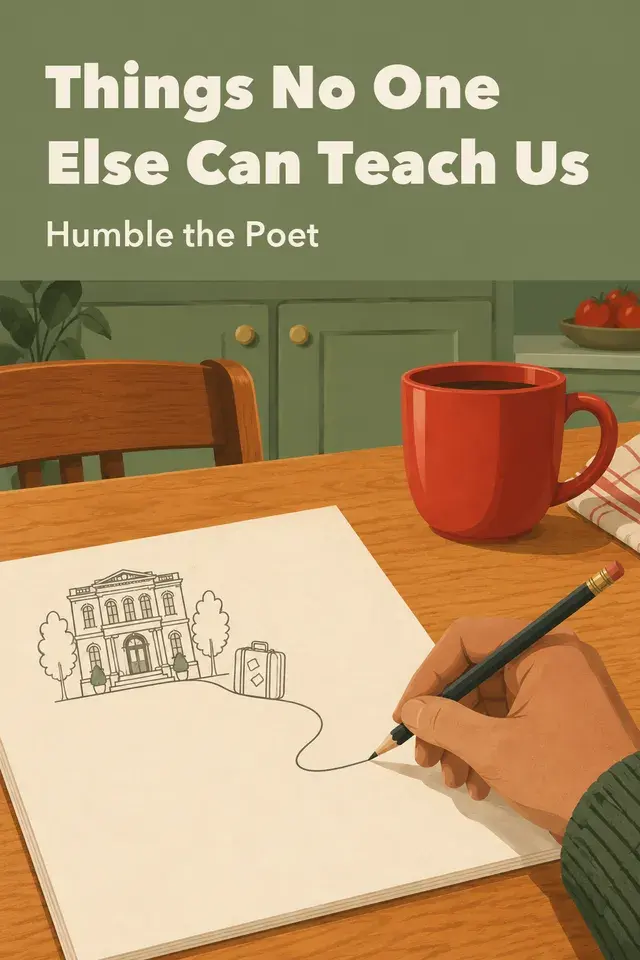
Things No One Else Can Teach Us, by Humble the Poet.
The author once imagined that becoming a writer would bring a particular kind of life: a major publisher, travel, solitude, inspiration, and a celebrated novel. The reality was less romantic. He wrote much of his book at his mother’s dining table in Toronto, after a summer of free writing and a difficult rewrite. Creative work also meant ordinary frustrations: his back hurt, and ideas that came late at night could disappear or become unreadable by morning. The distance between the life he expected and the work he was doing left him feeling disappointed, even betrayed.
He says he felt better when he let go of those expectations and noticed what was worthwhile in the life he actually had. That shift did not make him a writer through a grand setting or public recognition. He came to think of writing as the work he kept doing despite insecurity, low energy, and distraction. The gap between the imagined life and the actual one prompted him to look again at how expectations shape what people can appreciate.
He offers his experiences as stories readers can test against their own lives, not as a universal fix. Another person’s advice might prompt a new question, but it cannot do the personal work of seeing differently. People’s circumstances and experiences are their own, and no one else can say exactly where they will find meaning. The author’s stories are invitations to revisit good, bad, and ordinary moments, including painful ones, and consider what those moments might show. That reflection can be uncomfortable. He does not promise that a change in outlook will prevent future hardship or solve a reader’s problems.
One idea that changes how he reads experience is impermanence. Feelings, circumstances, possessions, and relationships do not stay as they are. A new outfit can age into something embarrassing or become a playful reminder of who a person used to be. Happiness and hope pass, but so do fear, pain, sorrow, victories, and defeats. That fact can frighten us when we want good moments to continue. It can also offer some relief when a difficult wait, argument, or period of pain seems as though it will go on forever.
The same truth applies to mortality, which is harder to hold in mind. The end of a painful experience may console us, while the thought that cherished people and life itself will end can be deeply difficult. The author does not resolve the question of why to act if everything ends, or offer an easy answer to the fear of death. Instead, he suggests that remembering life is finite can loosen the pressure to secure a perfect future before engaging with the present. It can make room for appreciation and connection now, even while people continue to plan and meet their responsibilities. Impermanence is a reason to notice life, not evidence that it is pointless or a command to feel cheerful.
His regret about Boomerang gives this idea a personal cost. During a period of financial and creative strain, the author tried to manage his life by clearing away distractions and focusing on ambition. He began judging relationships by whether people might help his goals. Boomerang was a kind friend who supported his creative events and repeatedly asked to meet. The author often said he was busy or would follow up, then failed to do so. On one brief visit, he enjoyed their conversation and understood that Boomerang simply wanted time with friends. Still, he believed he could not spare time for people who did not advance his plans.
After releasing a music video, the author received another congratulatory message from Boomerang, who again asked to meet. The author said he would get in touch after returning to town, but never did. It was their last contact. Boomerang collapsed, entered intensive care, and died after a short coma. The author was left with the knowledge that he had not made time for someone whose company made him happy. He takes responsibility for that choice, while acknowledging that the transactional atmosphere around him influenced his thinking. He does not treat that atmosphere as an excuse.
His response was not simply to express regret. He made a list of people who nourished his spirit, set phone reminders to contact them every fifty days, listened to what they said, and arranged time together. These steps made relationships part of his actual schedule rather than an intention for some less busy future. Making time slowed his output somewhat, but helped him focus more deeply on what excited him. It also changed the question he brought to relationships: from what others could do for him to what he could offer and how they might share time. He knows that people can forget mortality and take one another for granted again. The reminders gave his reflection a practical form.
A different experience shows how patience can create room for connection without erasing fear. After a violent robbery in New York, the author’s physical injuries healed, but he still tensed or froze when people came close. He felt anxious, relived what had happened, and found many things triggering. Years later, after a sold-out performance in Manhattan, he was riding the subway when a stranger began speaking to him about angels and demons. The author was uncomfortable and guarded at first. He gradually chose to answer honestly and ask the stranger a question. When the man asked to sit beside him and hold his hand, the author agreed, despite an anxious inner voice telling him to be cautious.
The stranger prayed for his protection and spoke about his light. The author felt unexpectedly calm and safe. He allows that the stranger may have genuinely believed what he said, may have reminded him of his grandmother, or may have been wrong about the supernatural explanation. He cannot settle that question. What mattered to him was the effect: the encounter showed he had healed enough to reach beyond his habitual vigilance and be open to another person. He does not turn that moment into a rule to trust everyone. Time had helped him, but it did not erase what happened. He describes scars as possible signs of resilience, and sees trusting himself to respond as different from assuming every stranger is safe.
Anne Marie’s story offers another way to understand attention to the present. While making a music video, the author met four women living with cancer who agreed to show their battle scars on camera. Anne Marie told him that, since her diagnosis, she had begun noticing puddles and their reflections. Before, she said, she had been too occupied by other concerns to see them. The possibility of losing life had made simple beauty visible. The author is careful not to claim he knows what cancer or its treatment feels like, or to compare ordinary hardship with that experience.
Her image stayed with him when he considered how he was spending an overloaded schedule. He had kept postponing important things to an undefined “after,” as if life would become available once his demands were finished. Anne Marie’s attention to a puddle made him ask whether those demands would matter if that day were his last, and whether they mattered more than ordinary beauty. He did not conclude that planning or ambition had no place. Anne Marie continued her ordinary responsibilities and pursued larger goals. The point, for him, was that being alive now should not be postponed until a vacation, a milestone, or perfect security arrives.
Noticing beauty does not cure stress or permanently change a person’s circumstances. The author says that a puddle does not solve his problems; remembering it can help him respond when stress builds. Anne Marie’s story becomes a prompt to interrupt routine and notice what daily pressure has pushed out of view. Her illness made the possibility of loss immediate, but the author extends the question of mortality to everyone without pretending that everyone shares her experience. The reflection is modest: attention can return, then fade, and need to be renewed.
His grief for Himmatt makes clear why impermanence cannot be reduced to appreciation. The author and his family had the dog for eleven years. As Himmatt’s hip problems worsened, he became unable to walk and live independently. The family faced the difficult decision to euthanize him. The author remembers taking him to the veterinary clinic, where Himmatt was frightened and whimpering on a cold table. He wishes he had considered an at-home option that might have made the final moments easier. He held Himmatt and apologized as he said goodbye.
The author still tears up when he remembers him and does not know whether the decision came too early or too late. Repeating the question cannot give him certainty. He also does not know whether he will be ready to open his heart to another dog. Those doubts remain alongside his belief that the years with Himmatt were worth the pain of losing him. That conclusion does not cancel grief or make the goodbye easy. It allows both truths to stand: the relationship mattered, and its ending hurt.
Across these stories, remembering that life and relationships end does not promise safety, quick healing, or clear answers. It can sharpen attention to what is happening while it is happening: making time for a friend, becoming gradually open again after trauma, or seeing beauty that routine has hidden. Patience may change what a person can face, but it is not forgetting. Grief remains real. The author’s invitation is to let that reality inform how we meet the life we have, without waiting for certainty about how it will end.
Chapter 2 of 9 · 10 min · Audio & textIn the app
Choose a Path Through Experience
A life that fits is not usually discovered by following a universal map. People often inherit a sequence of expected steps: study, find secure work, marry, raise a family, and retire.
Chapter 3 of 9 · 10 min · Audio & textIn the app
Make the Journey Worthwhile
Goals can give a person direction. The author does not dismiss milestones: he says having an end goal helps him continue when writing gets difficult.
Chapter 4 of 9 · 12 min · Audio & textIn the app
Understand Before You Condemn
A quick judgment can make another person’s choices seem impossible to understand. The author describes how pausing and looking beyond his immediate position helped him see fears and needs that snap conclusions had hidden.
Chapter 5 of 9 · 7 min · Audio & textIn the app
Use Perspective Without Surrendering Agency
The author describes himself as someone who can turn a small uncertainty into a chain of imagined worst cases. While preparing a poem for a televised ceremony, he worried about making the event stop for a reshoot and dreaded performing before celebrated guests.
Chapter 6 of 9 · 9 min · Audio & textIn the app
Separate People From Their Choices
The previous chapter steps back to put pressure and fear in perspective. This chapter turns toward the details.
Chapter 7 of 9 · 11 min · Audio & textIn the app
Interrupt the Self-Pity Cycle
Self-pity can feel like quick company when you are hurting. Turning inward is familiar and easy, and a story about being singled out can bring attention or sympathy for a while.
Chapter 8 of 9 · 13 min · Audio & textIn the app
Let Loss Teach Without Defining You
A setback can feel like a verdict on who we are. The author’s approach is to treat it as information about what happened, what mattered, and what might be changed.
Chapter 9 of 9 · 8 min · Audio & textIn the app
Use Regret to Prepare for Next Time
Regret can take up a lot of attention without showing us what to do next. The author’s invitation is to treat it as information: look back long enough to notice what shaped a choice, what can still be repaired, and what you might do differently next time.
Chapter 1 of 9 · 13 min · Audio & text: Let Impermanence Clarify What Matters
Wiseley supports reading and listening to summaries in the app.
Continue in WiseleyWhat Things No One Else Can Teach Us is about
Humble the Poet examines how lived experience teaches what advice cannot, tracing lessons from impermanence, ambition, heartbreak, and conflict. The book asks how to meet change without being ruled by fear, comparison, or regret. Its stories offer ways to choose meaningful effort, learn from setbacks, and respond to others with greater understanding.
About Humble the Poet

Humble the Poet is a Canadian writer and spoken-word artist. “How to be Love(d)” explores how to give and receive love without making approval or a relationship the measure of personal worth.
Explore more books by Humble the Poet