What you'll learn
Key ideas from The Work-Life Balance Myth
These ideas compress the book's argument without treating the author's view as settled fact. Use them as an orientation before reading the full work or listening in Wiseley.
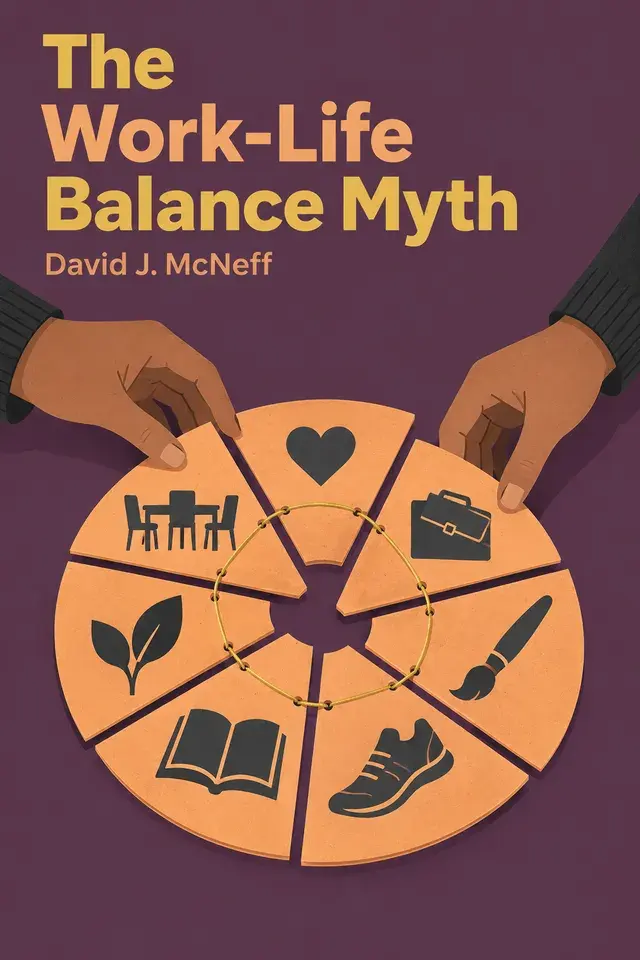
McNeff replaces equal work-and-family balance with harmony across seven interconnected areas of life.
The method maps current time across seven Slices, requires percentages totaling 100, and treats the result as behavior rather than a measure of worth.
Useful action is small, repeatable, individualized, and protected by boundaries, with activities sometimes serving more than one Slice.
Prioritization, delegation, and realistic commitments help work remain part of life rather than its sole organizing force.
The Physical Slice covers movement, sleep, nutrition, and medical care as bodily maintenance that supports participation in every other area of life.
A pause can separate a feeling’s legitimate presence from the proportionality and consequences of the response it prompts.
Ongoing harmony depends on reviewing actual engagement, adjusting emphasis, and accepting encouragement without turning life management into competition.
Inside The Work-Life Balance Myth
Read the first chapter in full here. The other 8 continue in the Wiseley app.
Chapter 1 of 9 · 7 min · Audio & text
From Competing Demands to Harmony
The Work-Life Balance Myth, by David J. McNeff.
Most people describe their strain as a work-life problem. McNeff argues that this frame is too narrow. It makes balance sound like an equal, mathematical split between two domains, often implying that stress will fall if Professional time decreases and Family time increases. But work remains necessary for many people, family obligations remain, and changing the ratio does not make stress disappear. Harmony names a different aim: coordinating several parts of life so they can support one another, even when they do not receive equal attention.
Stress can accumulate until a person cannot absorb one more call, delay, meeting, or conflict. The final trigger may be small because earlier demands have already exhausted the capacity to cope. When Family and Professional concerns occupy nearly the whole field of attention, the other five Slices can wither. McNeff says that brief engagement with those neglected areas can provide respite, restore perspective, and interrupt the stress spiral. This does not mean abandoning responsibilities or assuming that circumstances will change on their own.
It also matters whether a person is engaging another part of life or merely escaping the present pressure. People can switch among selected Slices for years without integrating them. That temporary compartmentalization may help someone function for a while, but McNeff says it can eventually compound stress and produce disconnection. His model grew from his own prolonged crisis, when divorce, business slowdown, financial strain, and children in college made standard, one-size-fits-all advice feel inadequate. He began separating the affected parts of life and considering them as a whole.
The seven Slices are not seven equal boxes or seven required time quotas. They are a way to notice the whole person. Family includes the family someone comes from and current roles such as child, sibling, parent, partner, or grandparent. It can provide support, but it can also be emotionally demanding and time-intensive. Professional covers work, livelihood, achievement, and the development of skills. It often takes substantial time and can influence every other area.
Personal refers to private interests, hobbies, pursuits, and forms of self-care that matter beyond public roles. It is important, yet commonly pushed aside. Physical concerns care for the body through health habits, movement, exercise, diet, and medical attention. Bodily well-being supports mental well-being and makes other demands easier to handle. Intellectual means curiosity, learning, reading, and mental stimulation. Its value does not depend on credentials, achievement, or anyone else’s judgment.
Emotional concerns feelings, self-perception, reactions, and behavior. Avoiding a painful feeling may postpone the problem, but the book argues that unresolved emotions tend to return. Spiritual concerns faith, values, beliefs, philosophies, and the larger context that gives daily life perspective. McNeff presents this Slice as nonsectarian, so it does not require religious affiliation. Together, the seven areas form an inventory of what a person neglects, overuses, or fails to connect with the rest of life.
Richard’s story shows why changing work alone may leave the larger strain intact. After a demanding executive role, he moved into a family investment-advisory business. The move initially seemed promising, but client losses, employee departures, debt, and succession pressure created new professional difficulties. At the same time, family responsibilities, parenting, grief, health concerns, and caregiving pressures continued. The setting of his work changed, but the simultaneous demands did not become a simple work-versus-family equation.
Richard adopted the method while the turmoil was still unfolding. The author says he remained stable enough to support his business and family, and later restructured the business and helped his children. Richard described an internal sense of harmony that allowed him to be present for other people. McNeff emphasizes that this was a positive outcome, not a fairy-tale ending: the problems continued for a substantial period, and the method did not remove them.
This distinction also clarifies coping. Exercise, meditation, psychotherapy, and self-care can help someone re-enter life with more capacity. Food, alcohol, substances, gambling, pornography, sex, or workaholism may offer immediate relief, but they can become excessive or create another disorder. McNeff treats the issue nonjudgmentally. The useful question is what the response does. Restorative engagement reconnects a neglected part of the person and broadens perspective. Escape only numbs the immediate pressure or keeps someone trapped inside the Slice that is already causing harm.
Harmony, then, is not the same as permanent calm or guaranteed happiness. The book describes it as greater integration, connection, peace, lightness, and an improved ability to see solutions. It can clarify what contributes to happiness and make meaningful pursuits more possible, but it cannot make every area feel good at once. The standard for the practices that follow is more modest and more durable: whether they increase a person’s capacity to meet continuing pressures. The cases are fictionalized accounts based on client experiences, and the reported benefits come from the author’s observations and client reports, not controlled causal evidence. The central shift is from dividing time between work and family to attending to the whole person those demands are asking us to carry.
Chapter 2 of 9 · 9 min · Audio & textIn the app
Map Your Life Without Judgment
The Seven-Slice Method becomes practical through three phases: assessment, reflection, and action. First, describe where your time goes now.
Chapter 3 of 9 · 14 min · Audio & textIn the app
Untangle Family and Work Pressures
Family and Professional pressures rarely stay in their assigned rooms. A conflict at home can consume concentration at work, while a demanding job can reduce patience and presence at home.
Chapter 4 of 9 · 10 min · Audio & textIn the app
Recover Choice and Personal Freedom
The Personal Slice is the part of life reserved for personal freedom. The author describes it as controlled by the individual, even when responsibilities make freedom feel unavailable.
Chapter 5 of 9 · 7 min · Audio & textIn the app
Build Capacity Through Physical Care
McNeff presents the Physical Slice as the body’s capacity for participating in the rest of life. It includes movement, sleep, nutrition, medical care, and attention to short-term illness, injury, or chronic conditions.
Chapter 6 of 9 · 7 min · Audio & textIn the app
Let Curiosity Reopen Your World
Intellectual renewal begins with a distinction: learning is not automatically renewing because it is useful, advanced, or educational. The book’s Intellectual Slice is the realm of curiosity, interests, and questions that expand thinking.
Chapter 7 of 9 · 7 min · Audio & textIn the app
Understand Feelings and Improve Responses
The Emotional Slice begins with a simple fact: everyone has emotions. The author narrows the discussion to noticing and managing them, not making difficult feelings disappear.
Chapter 8 of 9 · 6 min · Audio & textIn the app
Find Meaning Beyond Immediate Demands
Immediate demands can become so loud that they leave no room for asking what those demands are for. The Spiritual Slice addresses that question.
Chapter 9 of 9 · 11 min · Audio & textIn the app
Adapt the Whole Life Over Time
Sustained harmony is tested when several demands become urgent together. McNeff presents it as changing coordination, not an even distribution that stays fixed.
Chapter 1 of 9 · 7 min · Audio & text: From Competing Demands to Harmony
Wiseley supports reading and listening to summaries in the app.
Continue in WiseleyWhat The Work-Life Balance Myth is about
What if dividing life between work and family leaves out much of what sustains us? David J. McNeff’s Seven-Slice Method reframes balance as harmony across seven areas of life. Reflective exercises and client stories show how small, deliberate changes can help people manage stress, reconnect with neglected interests, and reconsider commitments.