What you'll learn
Key ideas from The Wisdom of the Bullfrog
These ideas compress the book's argument without treating the author's view as settled fact. Use them as an orientation before reading the full work or listening in Wiseley.
Durable trust grows when honorable conduct and dependable competence reinforce each other through repeated work.
Command means choosing amid incomplete intelligence and accepting responsibility for the consequences.
Coordinated initiative depends on shared goals, values, and intent reaching the lowest level, returning through feedback, and changing with conditions.
Vision says what to pursue, strategy explains how, and a detailed plan assigns responsibility, resources, milestones, and measures.
Demanding standards become culture when leaders define them, verify performance, and respond consistently.
Direct contact gives leaders information that reports may miss and shows employees that their work and conditions matter.
A trusted swim buddy combines practical protection, honest criticism, emotional support, and pressure to return to responsibility.
Inside The Wisdom of the Bullfrog
Read the first chapter in full here. The other 6 continue in the Wiseley app.
Chapter 1 of 7 · 8 min · Audio & text
Earn Trust Through Character and Competence
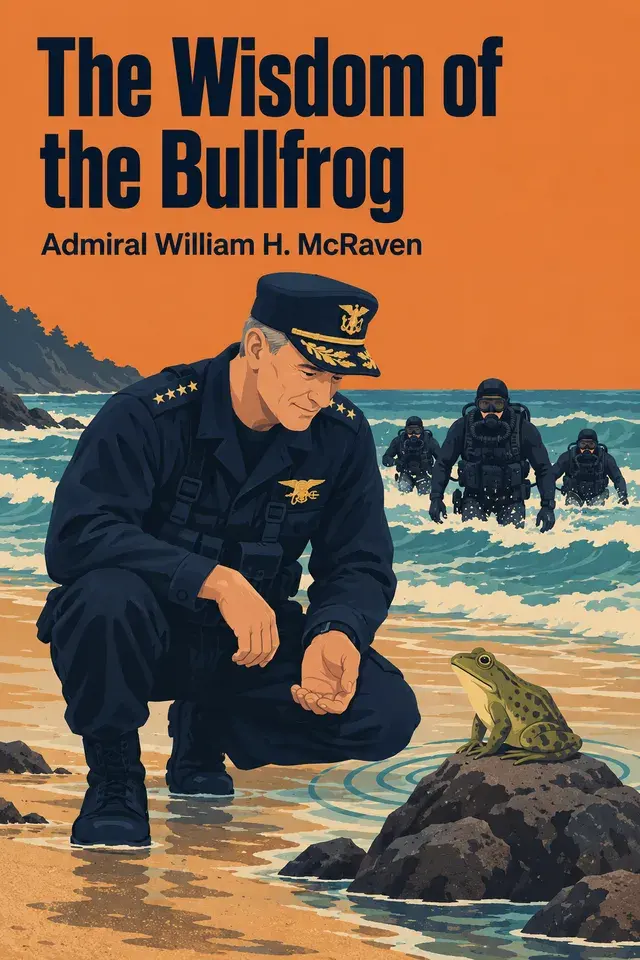
The Wisdom of the Bullfrog, by Admiral William H. McRaven.
Leadership principles can be simple without being easy. McRaven’s central problem is the gap between understanding a rule and executing it when people are imperfect, pressure is high, and resources are limited. A leader must inspire people, complete the task, and protect the institution’s reputation and integrity. A result achieved through cheating or illegality is not success. The hard part is applying ideals when the right choice costs something.
His brief Afghanistan road-building anecdote makes this distinction concrete. Outsiders could describe a road as a simple answer, but building one under fire required people to turn an attractive idea into difficult action. The idea was easy to state; execution was not. Leadership works the same way. A principle can point in the right direction, yet only conduct shows whether it can survive real conditions.
For McRaven, the first condition of that conduct is honor. Honor means doing what is right for the right reasons, not merely protecting one’s reputation or achieving a visible result. It gives leadership lasting value because people are more willing to endure hardship for someone whose motives they trust. Without it, even impressive accomplishments can lose their meaning and damage the leader’s legacy.
A personal code helps make honor usable. West Point’s Honor Code, military creeds, and comparable professional traditions give people language for refusing to lie, cheat, steal, or tolerate those acts. Such a code becomes an anchor when cynicism, pressure, or examples of hypocrisy make ideals seem naïve. It also becomes organizational culture through repetition. People watch what leaders permit, reward, excuse, and model. A leader’s daily conduct therefore shapes the standards employees experience and the standards future leaders inherit.
Honorable language, however, does not guarantee honorable conduct. McRaven acknowledges that some unscrupulous people achieve material success. He also warns that leaders can hide misconduct behind narrow legal arguments or claims that an institution benefited. Corporate corruption and university compromises can be rationalized in precisely this way. Success, legality in isolation, or institutional advantage cannot by themselves settle whether a decision was right. A code matters only when it limits what a leader is willing to do for profit, approval, or expediency.
Character is the foundation of trust, but it is not the whole of it. Competence makes ethical intentions dependable. Followers judge a leader through personal behavior, professional demeanor, problem-solving, and consistency. Someone may initially appear trustworthy yet lose that trust by mishandling responsibilities or repeatedly failing to deliver. Employees who do not trust a leader will not reliably follow that leader, regardless of the authority attached to the position.
Trust therefore accumulates through repeated personal and professional encounters. It cannot be created suddenly when a crisis begins. Practical habits make the process visible: promise only what people and resources can realistically support, then deliver consistently. Show up prepared, work hard, share difficult conditions when appropriate, and demonstrate care for the people carrying the work. When judgment fails, admit the mistake, correct the problem, and return to sound conduct. These actions do not create a perfect leader. They create evidence that intentions can be trusted because performance repeatedly supports them.
McRaven illustrates this accumulated trust through the relationship between special operations and the CIA. When Leon Panetta introduced him to senior CIA leaders, many already knew him from years of work in places such as Baghdad, Afghanistan, Yemen, and Somalia. The agencies had experienced disputes, but disagreement had occurred within a history of cooperation. That history helped the CIA choose McRaven’s forces for the bin Laden operation. The trust did not come from constant agreement or from a promise made at the moment of danger. It came from seeing one another perform over time. Shared work had created enough confidence to cooperate when the stakes were unusually high.
Trust and integrity are tested especially sharply when institutional approval conflicts with personal conviction. McRaven presents Billy Mitchell as an illustration of moral courage. Mitchell argued for air power and a unified air force. When the Navy used demonstrations designed to favor battleship survivability, he exposed the deception and insisted on a legitimate test. His accusations against senior Army and Navy leaders led to a court-martial. He was convicted, although Douglas MacArthur was the only one of thirteen jurors to vote for acquittal. The later creation of the Air Force and Mitchell’s historical reputation are presented as signs that his dissent was eventually vindicated.
That story is not a simple rule that dissent is always right. Opposition to superiors, later vindication, or personal confidence does not automatically make a decision sound. The lesson is that integrity sometimes requires a leader to examine a choice independently and accept consequences when approval conflicts with what the leader believes to be right. Moral courage needs judgment, evidence, and responsibility, not merely the willingness to oppose authority.
McRaven’s long-green-table test supplies a discipline for that judgment. Before acting, a leader should ask whether reasonable people could regard the decision as moral, legal, and ethical. The broader test also asks whether it serves the organization’s legitimate objectives. If the decision cannot withstand that examination, the leader should reconsider. If it can, the leader should be prepared to stand by it despite anger, lost friendships, short-term sacrifice, or professional cost. The test is meant to expose rationalization, because people who make bad choices often sense that something is wrong and then search for language that permits them to proceed.
Durable trust begins before authority is exercised. Character tells followers that a leader will not sacrifice principle for convenience. Competence shows that the leader can turn good intentions into reliable action. Over time, realistic promises, care, accountability for mistakes, and consistent delivery allow those two qualities to reinforce each other. That is how a personal code becomes a culture and how followers grant credibility: not because leadership principles are complicated, but because living them faithfully is difficult.
Chapter 2 of 7 · 8 min · Audio & textIn the app
Accept Command and Face the Problem
Leadership changes character when authority arrives. A person in command must accept that a decision belongs to them even when evidence is incomplete and consequences are frightening.
Chapter 3 of 7 · 7 min · Audio & textIn the app
Make Initiative a Coordinated Effort
McRaven uses initiative to mean doing the right thing without waiting to be told. It is not independence for its own sake.
Chapter 4 of 7 · 10 min · Audio & textIn the app
Turn Bold Intent Into Adaptable Plans
A bold idea is only the beginning of responsible leadership. Vision gives people a future worth pursuing, and hope can make that future feel possible.
Chapter 5 of 7 · 6 min · Audio & textIn the app
Make Standards Visible Through Follow-Through
Standards shape behavior only when leaders make them visible in daily work. A value or rule can be stated clearly and still remain a statement of intent.
Chapter 6 of 7 · 6 min · Audio & textIn the app
Learn Where the Work Happens
Leadership becomes more abstract as a person moves upward in an organization. Reports and plans can describe priorities, but they cannot fully convey how those priorities affect people doing the work.
Chapter 7 of 7 · 8 min · Audio & textIn the app
Sustain Effort With Trusted Support
Leadership does not become sustainable because one hard phase has been survived. McRaven uses the SEAL saying, “The Only Easy Day Was Yesterday,” to reject the belief that yesterday’s hardship purchases an easier tomorrow.
Chapter 1 of 7 · 8 min · Audio & text: Earn Trust Through Character and Competence
Wiseley supports reading and listening to summaries in the app.
Continue in WiseleyWhat The Wisdom of the Bullfrog is about
How do leaders earn trust and guide people through uncertainty? Drawing on military experience, William H. McRaven connects integrity with the daily work of leadership: making decisions, communicating intent, preparing for disruption, maintaining standards, and supporting people. His stories offer practical ways to turn these principles into consistent action.
About William H. McRaven

William H. McRaven is a retired United States Navy admiral. “Make Your Bed” explores lessons about discipline, teamwork, and resilience drawn from military experience.
Explore more books by William H. McRaven