What you'll learn
Key ideas from The Way of Excellence
These ideas compress the book's argument without treating the author's view as settled fact. Use them as an orientation before reading the full work or listening in Wiseley.
Excellence is sustained, values-guided growth, not flawlessness, obsession, mechanical optimization, happiness, or flow alone.
Fit is discovered through exploration, curiosity, values, ability, and room to grow—not instant certainty.
Goals give effort direction, while much of the skill and meaning develops through the pursuit itself.
Consistency means scaling effort to the day and returning after setbacks, so one difficult moment does not dictate the whole week.
The attention economy rewards interruption, while task switching makes sustained, meaningful work harder to do well.
Effort creates demands; recovery gives the body and mind room to adapt and grow.
People develop and peak on different timelines, and persistence is sound only while a viable path and acceptable costs remain.
Communities of practice join shared standards and skill-building with belonging, contribution, and mutual support.
Inside The Way of Excellence
Read the first chapter in full here. The other 11 continue in the Wiseley app.
Chapter 1 of 12 · 9 min · Audio & text
Mastery, Mattering, and Feeling
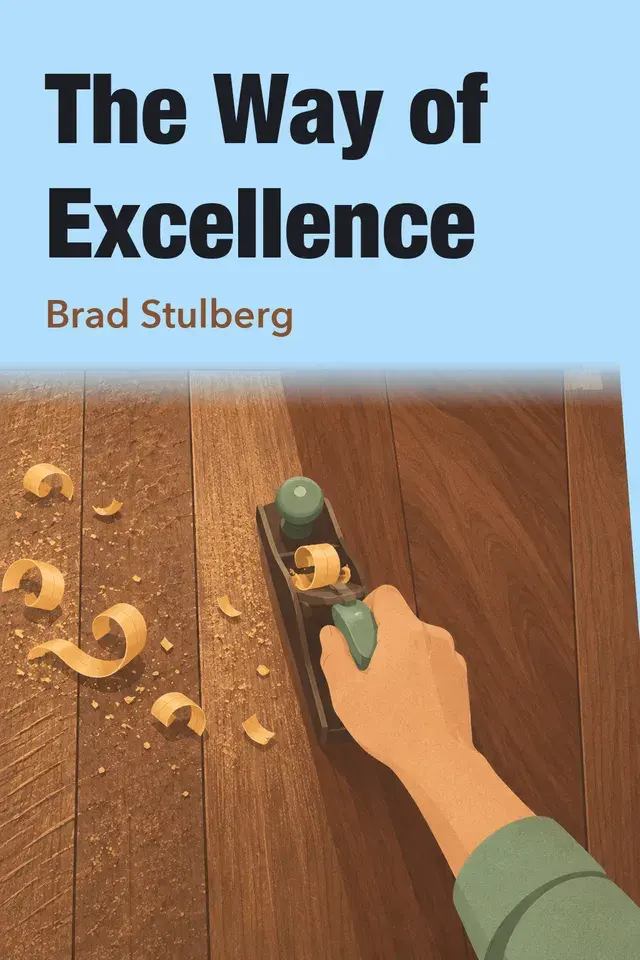
The Way of Excellence, by Brad Stulberg.
People often hear “excellence” and think of elite athletes, celebrated artists, flawless work, or winning. But when people describe being at their best, they also talk about focused effort on work that matters, creating something, contributing, meeting a challenge, using their skills, and connecting with others. They describe not just what they did, but how it felt: alive, ready, peaceful, satisfied, or inspired. Excellence names a quality of engagement that can appear in many kinds of life, not a rank reserved for a few.
The author defines it as involved engagement in worthwhile activity that supports a person’s values and goals. It brings together mastery and mattering. Mastery is the growth of skill: learning to write, lift, build, make art, play an instrument, or do a trade with increasing capability. Mattering is the sense that the work, contribution, or progress has significance. The two belong together: developing a skill in work that feels pointless is not the whole of excellence, and caring about a pursuit does not by itself make someone skilled at it. Excellence joins the effort to become more capable with a reason to care about what that capability serves.
That definition also makes excellence available in ordinary pursuits as well as professional ones. A person need not be famous, paid, or the best in a field. Craft, conversation, movement, leadership, and other forms of work can all involve it when they are worthwhile to the person and invite them to contribute and grow. The standard is not public recognition. It is sustained, values-guided development in something worth doing. A remarkable performance may make excellence visible, but it is not the entire process. The work leading up to it, and the continued practice afterward, matter too.
This is different from perfectionism, which demands flawlessness everywhere and can turn effort into stress. Excellence allows rough beginnings and uneven progress. It asks for commitment to what matters, not perfect execution in every area. It is also different from obsession. Dedication takes effort, but excellence does not make one pursuit all-consuming or tie a person’s whole self-worth to it. The author’s contrast is between a steady relationship with the work and a pattern of burning intensely and burning out.
Excellence is not simply mechanical optimization, either. Optimization seeks predictability and efficiency; excellence also needs curiosity and responsiveness to what a situation calls for. Nor is it the same as happiness if happiness means pleasure and avoiding pain. Pursuing worthwhile work can involve many emotions, including difficult ones. Flow, the state of effortless absorption, may accompany meaningful work, but it can also occur in activity that does not matter. It is a momentary experience, not a measure of whether a pursuit is worthwhile over time. These distinctions keep excellence from becoming another demand to feel good, perform flawlessly, or maximize every moment.
To explain why feeling belongs in this account, the author turns to biology. In his description, life begins with organisms sensing conditions and responding in ways that support survival. As organisms become more complex, nervous systems make possible feelings about internal states and the surrounding world. The author argues that these feelings serve as useful signals: negative feelings can indicate a need to change something, neutral feelings can suggest stability, and positive feelings can encourage continuation. He sees this orientation toward conditions that support life as a foundation for human striving toward worthwhile activity and growth.
This account helps explain the author’s story about encountering a bear. He moved to safety before consciously registering the danger, and only afterward understood his response as aligned with survival. The point is not that he reasoned through a list of options in that moment. His body had already sensed what the situation required. The author connects that capacity for rapid response to the way people can sense what is fitting or valuable in other settings, including skilled performance and the appreciation of beauty. Feeling, in this view, is not an obstacle to thought. It is one way a person registers value and responds when there is no time for verbal analysis.
The author also invokes the idea of somatic markers: emotional signals that assign value to possible choices and help guide decisions under uncertainty. He points to cases in which people retained the ability to reason on tests but had trouble making ordinary real-world decisions after damage affecting emotional processing. He uses this contrast to argue that abstract reasoning alone may not tell someone what matters in a situation. Feelings can help supply that evaluation. But they are signals, not guarantees that an impulse is wise. The biological account explains their usefulness without making every feeling an unquestionable guide.
Feeling also changes its role as a person learns. The book describes four phases of competence. In unconscious incompetence, a beginner does not yet know what they lack. The first task is to get oriented and learn the basics. In conscious incompetence, mistakes become visible; deliberate attention and effort can then help the learner improve. In conscious competence, the person can perform correctly but must still think through the steps and monitor what is happening. Feedback, including tracking, can help confirm progress or reveal a problem at this stage.
With practice, someone may reach unconscious competence: a level at which the skill no longer depends on conscious instructions for every move. The person can respond to what is happening as it happens. This does not mean that thought was useless, or that every activity should be approached by intuition from the start. The earlier phases depend on instruction, deliberate effort, and feedback. The difficulty comes when a person keeps trying to control a well-learned performance through the same effortful analysis that helped build it. That strategy can become a barrier instead of a support.
The reason is that skill is not only a set of rules stored in the mind. It is also an ability to sense and respond in context: a relationship between the person, the activity, and the environment. A musician has to respond to the music as it unfolds; a craftsperson has to respond to the material and the work in progress. Learning involves feeling what is working and what is not, then refining that response. With growing proficiency, the person can draw on a wider, more immediate awareness of the activity instead of treating each moment as a problem to solve verbally.
The violinist Hilary Hahn describes this shift in her own performance. When she analyzes her technique in words while playing, she says, she falls behind the music. Staying present with each note allows her to respond to events too quickly for conscious verbal thought. Her account illustrates why skilled performance can depend on feeling one’s way through an activity. It is not a rejection of technique; it is what technique can make possible after learning has become sufficiently integrated.
The same principle applies beyond music. In many kinds of skilled work, thinking remains part of preparation, learning, and reflection. But during fluent execution, too much self-monitoring can make a person stiff or disrupt a response that practice has made more adaptive. The author’s claim is not that feeling always outperforms reason. It is that excellence needs both: deliberate thought and feedback while competence is developing, and attention to the felt demands of the activity as skill matures.
So excellence is neither a perfect result nor a peak feeling to chase. It is a continuing process in which practice grows competence and feeling helps a person stay responsive to the work. Its scope includes ordinary as well as professional pursuits, whenever skill and significance come together. The work may contain effort, mistakes, and stretches that feel unremarkable. What defines it is the ongoing relationship between becoming more capable and contributing through something that matters.
Chapter 2 of 12 · 11 min · Audio & textIn the app
Meaning, Flourishing, and the Good Life
Once excellence is understood as sustained involvement in worthwhile work, a further question follows: how can we tell what is worth our involvement? Immediate feelings matter, but they do not settle the question.
Chapter 3 of 12 · 7 min · Audio & textIn the app
Care, Fit, and Courage
Care gives effort a reason to continue, but it rarely arrives as instant certainty. People can feel pressured to discover one perfect calling and mistake hesitation for proof they have chosen badly.
Chapter 4 of 12 · 7 min · Audio & textIn the app
Goals in Service of Growth
A goal gives effort a direction. It can act like a distant mountain: without a destination, it is easy to wander; with one, the next steps have a purpose.
Chapter 5 of 12 · 7 min · Audio & textIn the app
Consistency, Trade-Offs, and Fundamentals
Consistency is easy to confuse with producing a strong day again and again. But excellence is built through a body of work.
Chapter 6 of 12 · 7 min · Audio & textIn the app
Protecting Attention and Starting
Meaningful work needs attention that can stay with one thing long enough to engage it. Yet the digital environment is built to capture attention in brief bursts, then offer another interruption.
Chapter 7 of 12 · 7 min · Audio & textIn the app
Renewal as Part of the Work
Excellence requires effort, but effort alone does not produce growth. A demanding pursuit asks the body and mind to adapt; recovery gives them a chance to do so.
Chapter 8 of 12 · 7 min · Audio & textIn the app
Confidence and Patience Over Time
Excellence requires living with what cannot be known. You may not know whether a project will succeed, whether today’s effort will lead to visible progress, or whether you are fully ready.
Chapter 9 of 12 · 5 min · Audio & textIn the app
Routines That Fit Real Life
Routines are useful not because every hour must be controlled, but because a few repeated practices make it easier to begin valued work. When an action has a familiar time, place, or sequence, a person spends less effort deciding whether and how to start.
Chapter 10 of 12 · 8 min · Audio & textIn the app
Gumption, Curiosity, and Adaptation
Gumption is the energy to keep moving with a pursuit: not a guarantee that work will feel easy, but a sense that difficulties can be met. Stulberg describes it as forward momentum and measured enthusiasm, something a person can build through attention and action.
Chapter 11 of 12 · 7 min · Audio & textIn the app
Failure, Belonging, and Love
Failure hurts. On a long pursuit, it is not a sign that a person has missed some secret technique for excellence; it is part of striving, and sometimes the loss is deeply painful.
Chapter 12 of 12 · 6 min · Audio & textIn the app
Joy, Completion, and Continuation
Long pursuits can become strangely thin when every day is treated only as a step toward the next result. A finish line can matter, but it cannot carry the whole meaning of the work.
Chapter 1 of 12 · 9 min · Audio & text: Mastery, Mattering, and Feeling
Wiseley supports reading and listening to summaries in the app.
Continue in WiseleyAbout Brad Stulberg

Brad Stulberg is the author of “The Way of Excellence”. The book explores excellence as developing competence in a pursuit that matters and how to sustain that work over time.
Explore more books by Brad Stulberg