What you'll learn
Key ideas from The Watchman's Rattle
These ideas compress the book's argument without treating the author's view as settled fact. Use them as an orientation before reading the full work or listening in Wiseley.
Social change can outpace biological adaptation, leaving societies with problems beyond familiar problem-solving capacities.
Analysis narrows explicit options, synthesis connects implicit clues, and insight can reveal a sudden connection beyond both.
Supermemes can make complexity feel manageable while filtering which beliefs and alternatives seem acceptable.
Personalized blame offers a clear culprit when interacting causes are hard to understand, but can divert attention from systemic failures.
Correlation shows that two things change together; it does not establish that one caused the other.
Institutional silos isolate information, expertise, authority, and resources, making shared problems harder to understand and address.
Extreme economics turns cost, risk, and return into a general test for relationships, public choices, and institutions.
Mitigations can reduce harm and buy time, but treating them as cures can delay lasting solutions.
Inside The Watchman's Rattle
Read the first chapter in full here. The other 11 continue in the Wiseley app.
Chapter 1 of 12 · 8 min · Audio & text
When Complexity Outruns Cognition
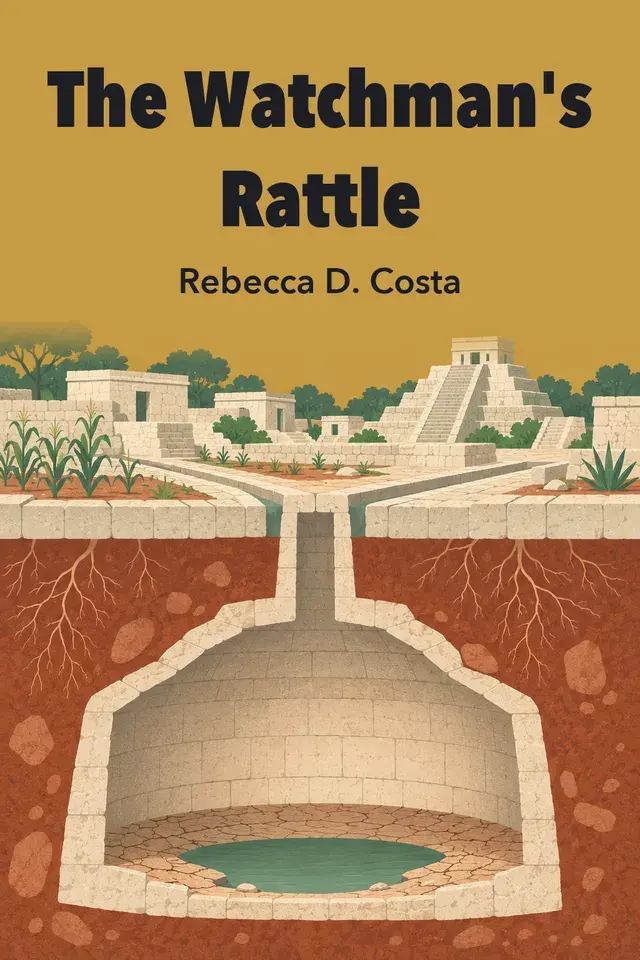
The Watchman's Rattle, by Rebecca D. Costa.
Costa begins with familiar signs of overload: a crowded car, complicated finances, and the effort to judge public policy or global problems. Each involves systems and information that are difficult to see all at once. Technologies, laws, financial products, and scientific discoveries change quickly, while biological adaptation takes far longer. Costa describes complexity as a setting where many choices interact and success depends on finding the right options among many wrong ones. Her question is whether people and institutions can keep up as the problems around them grow harder to understand and manage.
She calls the point where a society can no longer think its way out of its problems a cognitive threshold. A society may recognize danger and still fail to resolve it. It can keep applying methods that worked for smaller, simpler problems even when those methods no longer work. Unresolved problems then pass from one generation to the next, adding to the burdens that follow. In Costa’s account, recurring problems can signal an impasse: greater effort along the same path does not necessarily produce progress.
Costa uses the Maya to give this pattern historical depth. They built a sophisticated civilization, with calendars, astronomical charts, writing, mathematics, and hydraulic works. Explanations for their decline include drought and resource strain, but also disease, food shortages, warfare, political tensions, and environmental change. Costa does not try to settle among these accounts. She asks what made the society vulnerable before its final events. The Maya understood their dependence on rainfall. Their responses included regulating crops and public water, rationing food, and building underground reservoirs and cisterns to collect rain. These were serious efforts. Yet rainfall declined as population and water needs rose. Conservation could limit use and store available water, but it could not replace water that was no longer there. As practical measures failed, some communities turned to sacrifice in response to drought, disease, and unrest.
Lamanai shows how practical measures could extend resilience without removing the underlying danger. In present-day Belize, its cistern network stored groundwater, reduced evaporation, and helped preserve food. Its people kept working on these systems during severe drought and continued pursuing practical and ritual responses together. Costa reports that Lamanai outlasted many Maya cities by as much as three centuries. She considers it probable that the community might have survived the wider collapse if the drought had not continued. Even there, the cisterns eventually dried, and the account describes their use as sacrifice chambers. The example shows both the value and the limits of sustained preparation under worsening conditions.
Costa makes a related point through her account of California water debates. In Monterey County, discussions about desalination, wells, and diverting water had continued for decades, while seasonal conservation, restrictions, and rationing addressed immediate shortages. She recounts reducing her own water use and receiving a higher bill, yet she thought suggestions such as replacing lawns could not solve the larger supply problem. In her view, conservation could buy time but could also delay a lasting response if easing the immediate strain made the problem seem solved. She concluded that California needed additional water supplies, while describing complex proposals as politically difficult and prone to delay.
Costa links this delay to people’s preference for immediate threats. A snake nearby calls for an urgent response; a warning about future climate damage offers no comparable, direct cue. She extends the contrast to resource use, debt, and nuclear waste. Her argument is that people respond more readily to dangers that are visible and immediate than to distant threats. In her account, this tendency reflects inherited responses shaped by conditions where quick action mattered, while social problems now often require attention over longer periods.
Rome illustrates how a temporary remedy can become more costly as a system expands. Drawing on Joseph Tainter, Costa treats invasions, migration, economic strain, crop failures, and plague as pressures on an already vulnerable society, rather than as a complete explanation by themselves. Conquest temporarily supplied grain, metals, enslaved people, and other resources. But as the empire grew, so did the costs of communication, garrisons, and government. With agricultural output and energy per person under strain, further expansion could not keep offsetting those costs. In Tainter’s account, investments in complexity eventually brought diminishing returns, and the empire fragmented.
The Khmer example centers on an elaborate water system built to manage both monsoon floods and seasonal drought. Canals, moats, ponds, and reservoirs supported harvests and food surpluses. One proposed account says a dam built too low diverted floodwater into abandoned canals, damaging the wider network. Generations of repair followed, while later droughts and exceptionally heavy monsoons added further strain. The account connects water trouble with food shortages, disease, a weakened army, and political unrest. It does not identify one certain final trigger for the Khmer collapse. The system’s scale shows how an impressive solution can also become difficult to maintain as conditions change.
Costa’s distinction is between a society’s deeper vulnerability and the event that may finally precipitate collapse. Drought, disease, invasion, conflict, crop failure, or engineering breakdown may act as an immediate trigger. Her argument is that these events strike a society already struggling to manage complexity and resolve accumulated problems. The examples do not establish one identical cause for every collapse. They illustrate her proposed recurring pattern: social demands grow, familiar responses prove insufficient, and unresolved pressures accumulate until the society is less able to absorb another shock.
Across the Maya, Rome, and the Khmer, Costa shifts attention from the final crisis to the long period of growing strain before it. Successful systems can extend a society’s reach, but their maintenance and the problems they must address can grow too. The cognitive threshold names the widening gap between what a society needs to manage and what its people and institutions can understand and do.
Chapter 2 of 12 · 7 min · Audio & textIn the app
Insight Beyond Familiar Methods
Some problems can be approached by narrowing explicit choices. Others demand a connection among clues that are hard to name.
Chapter 3 of 12 · 7 min · Audio & textIn the app
Belief Systems Under Pressure
Rebecca D. Costa turns from the limits of human problem-solving to the beliefs that shape how people use knowledge.
Chapter 4 of 12 · 7 min · Audio & textIn the app
When Opposition Blocks Solutions
Opposition can help create change, and Costa does not treat disagreement itself as a problem. Her concern is a shift from questioning a proposal to rejecting proposals as a habit.
Chapter 5 of 12 · 9 min · Audio & textIn the app
Blame Hides Systemic Causes
When a public failure has many causes, blame can offer a story with a single face. A person can be named, judged, removed, and treated as the reason a troubling event occurred.
Chapter 6 of 12 · 7 min · Audio & textIn the app
Testing Causal Stories
When a problem is difficult to understand, a simple association can feel like an explanation. Costa calls this counterfeit correlation, or Clavinism, and describes it as a supermeme: a way of reasoning that appears empirical but can lead to false conclusions.
Chapter 7 of 12 · 7 min · Audio & textIn the app
Breaking Institutional Silos
Even when a problem is understood more accurately, the knowledge needed to address it may sit in separate institutions. Costa calls this silo thinking: departments or organizations protect information, authority, budgets, and capabilities within their own boundaries.
Chapter 8 of 12 · 10 min · Audio & textIn the app
When Money Becomes the Measure
Costa calls it extreme economics when business calculations become a general test for choices. People begin asking what something costs, what risks it carries, what return it will bring, and whether it can help achieve another goal.
Chapter 9 of 12 · 6 min · Audio & textIn the app
Challenging Entrenched Assumptions
Costa’s case for challenging entrenched beliefs is Muhammad Yunus and Grameen Bank. The point is not that one lending design can solve every social problem.
Chapter 10 of 12 · 10 min · Audio & textIn the app
Mitigation and Long-Term Action
After describing how societies can become stuck, Costa turns to a strategy for acting under pressure. She argues that large threats call for two horizons: immediate tactics that reduce harm, and a longer plan aimed at a lasting solution.
Chapter 11 of 12 · 9 min · Audio & textIn the app
Building the Bridge to Insight
The earlier argument has shown why familiar responses can reach their limits. Here Costa asks what might let people move beyond them.
Chapter 12 of 12 · 9 min · Audio & textIn the app
Creating Conditions for Insight
The preceding argument leaves a practical question: if insight might help when familiar thinking reaches its limit, how can people improve its odds? Costa’s suggestions are conditions to encourage, not a formula.
Chapter 1 of 12 · 8 min · Audio & text: When Complexity Outruns Cognition
Wiseley supports reading and listening to summaries in the app.
Continue in WiseleyWhat The Watchman's Rattle is about
Why do societies become stuck when their problems grow more complex than people can manage? Costa traces how cognitive overload can make belief-driven habits block solutions, from opposition and scapegoating to false causal stories, institutional silos, and profit-first thinking. She then explores coordinated action and ways to make room for insight.
About Rebecca D. Costa

Rebecca D. Costa is an American sociobiologist, futurist and author. “The Watchman's Rattle” explores why societies become stuck when their problems grow more complex than people can manage.
Explore more books by Rebecca D. Costa