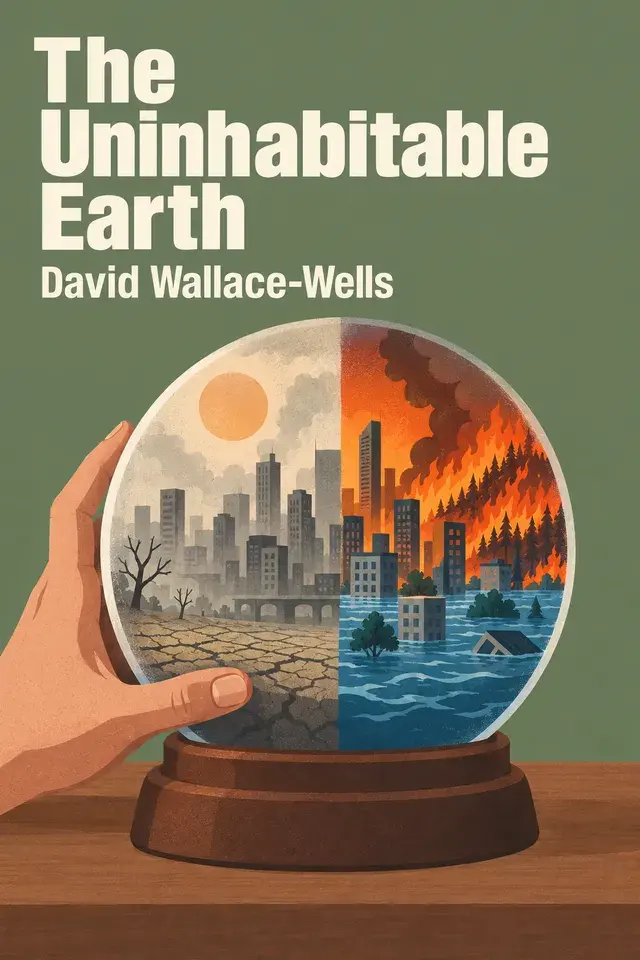
What you'll learn
Key ideas from The Uninhabitable Earth
These ideas compress the book's argument without treating the author's view as settled fact. Use them as an orientation before reading the full work or listening in Wiseley.
Climate harms can cascade through infrastructure and communities, and unequal resources shape exposure and recovery.
Heat and humidity can overwhelm the body’s cooling ability, causing harm before the wet-bulb survival threshold is reached.
Today’s water shortages often reflect infrastructure, contamination, governance, and unequal access; warming adds drought and meltwater pressure.
Climate stress can raise conflict risk through food insecurity, displacement, instability, and weakened institutions, while interacting with existing conditions.
Limiting warming requires deploying replacements across energy, transport, production, agriculture, and infrastructure; carbon removal remains uncertain at scale.
Private purchases can express ecological values, while voting and public policy have greater reach over collective emissions.
Human-caused warming is established, while the precise severity and pattern of future harms remain uncertain and depend partly on human choices.
Inside The Uninhabitable Earth
Read the first chapter in full here. The other 12 continue in the Wiseley app.
Chapter 1 of 13 · 7 min · Audio & text
Cascades Beyond the Old Baseline
The Uninhabitable Earth, by David Wallace-Wells.
Wallace-Wells begins by resisting familiar boundaries: climate change is not slow, distant, or confined to coastlines and the natural world. He asks readers to see it as a change in the conditions that shape human life. In the book’s title, “uninhabitable” refers to risks that may make large regions unlivable by present standards. It does not predict that the whole planet will become lifeless. The question is how far those risks spread and how much they intensify.
The scale of the shift becomes easier to grasp across one human life. Wallace-Wells’s father was born in 1938, when the climate seemed steady to most people, despite scientific understanding of the greenhouse effect. He died in 2016, after the atmosphere passed the long-discussed threshold of 400 parts per million of carbon dioxide. Two years later, the monthly average reached 411 parts per million. A climate that once appeared stable had changed markedly within a generation.
This contrast is not simply a story about a distant industrial past. Wallace-Wells emphasizes that more than half of fossil-fuel carbon emissions occurred in the three decades before his account, and about 85 percent came after the Second World War. He argues that treating climate damage as the legacy of eighteenth-century industrialization can obscure how much happened within living memory. The carbon already added to the atmosphere also means that stopping emissions would not immediately restore earlier conditions. Some additional warming is already in motion.
That accumulated change makes the recent past a poor guide to what counts as ordinary. In 2017, major hurricanes, flooding across South Asia, and California wildfires arrived in the same season. In 2018, record heat affected cities across North America, Europe, and Asia, while heavy rain and fires brought further emergencies. These events did not all have the same cause, and their clustering does not by itself prove that climate change caused each one. Their value here is as a reminder that the familiar baseline is receding, not as a complete forecast of what comes next.
It helps to separate two questions. Event attribution asks how much climate change influenced a particular storm, fire, or flood. That can be useful for understanding an event. The broader question is how warming changes the conditions in which many events occur. Wallace-Wells argues that focusing only on whether one disaster was “climate-caused” can hide that wider shift. A local ignition or storm trigger can matter, while the altered climate still affects the likelihood or severity of the resulting harm.
The distinction also changes how to read labels such as “thousand-year flood.” Such labels refer to estimates based on a climate record that is no longer a dependable description of the present. Wallace-Wells makes this point through Houston, which suffered repeated major flooding within a short span; he notes that Harvey’s extraordinary rainfall was described using return-period language. The lesson is not that a label proves climate causation. It is that measurements drawn from an earlier climate may become less useful as a guide to current risk.
Warming can also make harm cascade beyond the event that starts it. A disaster may damage homes and infrastructure, interrupt services, and make it harder for people to reach supplies or assistance. Those secondary effects can deepen the original loss and complicate recovery. The book’s broad frame therefore joins changes in the physical world to the systems people depend on. The consequences are not confined to a weather report or a damaged landscape; they travel through ordinary social life.
Those consequences are unequal. People with fewer resources may be more exposed and have less capacity to protect themselves or recover. Wallace-Wells describes vulnerable communities within wealthy countries as well as poorer countries facing greater warming and fewer resources. The crisis cannot be kept at a distance by imagining it belongs only to poorer regions. Exposure and recovery capacity differ, but climate disruption does not respect that boundary.
Projections, meanwhile, should be read as conditional scenarios rather than fixed appointments with the future. They ask what may happen under different emissions paths. Some further warming is committed by past emissions, but Wallace-Wells argues that choices made now will strongly shape how far warming proceeds. The trajectory is continuous: the world does not cross one threshold and then settle into a single, stable damaged state. Higher warming brings greater risks, while lower paths still carry consequences.
There is uncertainty both about future human emissions and about how the climate system will respond. Feedbacks may intensify warming, but some may moderate it, and their interactions are not fully predictable. Wallace-Wells presents climate evidence as clear while treating precise outcomes as uncertain. He also describes major scientific assessments as conservative, since they rely on findings that meet a high standard of confidence. Uncertainty changes the range and precision of projections; it does not make every possible outcome equally likely or erase the human role in shaping them.
The opening frame holds these ideas together: accumulated warming has displaced the old baseline, and its effects can spread through both natural and human systems. The recent past cannot promise a return to stability, and no single projection guarantees one endpoint. Scenarios describe consequences along different human paths. The chapters that follow can examine particular hazards within that shared frame: long timescales, human exposure, cascading effects, and choices that still influence the scale of harm.
Chapter 2 of 13 · 7 min · Audio & textIn the app
Heat and Food Under Pressure
Heat tests the body’s ability to release its own warmth. When the surrounding air is too hot, and humidity limits cooling, that exchange can fail.
Chapter 3 of 13 · 6 min · Audio & textIn the app
Floods, Fires, and Exposure
Floods and fires reveal climate danger on different clocks. Sea-level rise unfolds over generations and longer spans; a storm, flood, or burn season can turn exposure into an emergency within days.
Chapter 4 of 13 · 7 min · Audio & textIn the app
Freshwater and Ocean Disruption
Water covers much of the planet, but the share people can use is tiny. The book says water covers 71 percent of Earth, while only a little more than 2 percent is fresh, and at most 1 percent of that is accessible.
Chapter 5 of 13 · 7 min · Audio & textIn the app
Air, Disease, and Health
Beyond heat’s direct stress on the body, warming can affect health by changing the air people breathe and the conditions disease organisms encounter. The chapter distinguishes harms already observed from projected climate pathways and from uncertain claims about how pathogens may change.
Chapter 6 of 13 · 8 min · Audio & textIn the app
Economic Shocks and Climate Conflict
Climate damage reaches the economy through lost work, damaged crops, disrupted transport, and broken infrastructure. These effects can reinforce one another.
Chapter 7 of 13 · 7 min · Audio & textIn the app
The Crisis as a System
The risks described so far do not arrive one at a time. Climate change can act as a threat multiplier, adding pressure to systems already shaped by health, income, infrastructure, and social conditions.
Chapter 8 of 13 · 7 min · Audio & textIn the app
Storytelling a Diffuse Crisis
One reason climate change is difficult to tell as a story is that our culture already has many apocalypse plots. Their presence has not made climate warnings easy to recognize; scientific warnings are often received as alarm that may be crying wolf.
Chapter 9 of 13 · 7 min · Audio & textIn the app
Markets, Technology, and Transition
Climate change presses on an economic order that helped produce it. Wallace-Wells uses “fossil capitalism” to describe how fossil energy and modern growth became entangled.
Chapter 10 of 13 · 8 min · Audio & textIn the app
Consumption, Power, and Political Choice
Once the question becomes how to change carbon-intensive systems, it becomes political: who can make the change happen, and who bears its costs? David Buckel’s 2018 self-immolation in Brooklyn, a protest against fossil-fuel pollution, drew attention as a possible alarm about planetary health.
Chapter 11 of 13 · 6 min · Audio & textIn the app
Progress After the Climate Break
Modern societies often tell history as a one-way journey toward greater security and prosperity. This faith has survived wars, famines, epidemics, and other disasters.
Chapter 12 of 13 · 10 min · Audio & textIn the app
Ethics Without Surrender
Climate danger asks more than whether a forecast is frightening. It also asks what people do with fear.
Chapter 13 of 13 · 6 min · Audio & textIn the app
One Planet, Shared Responsibility
The closing argument begins with a distinction: human-caused warming is established, but the exact shape and severity of its future consequences are not. The author says the scientific case emerged through sustained work that ruled out alternatives.
Chapter 1 of 13 · 7 min · Audio & text: Cascades Beyond the Old Baseline
Wiseley supports reading and listening to summaries in the app.
Continue in WiseleyWhat The Uninhabitable Earth is about
David Wallace-Wells traces how warming can unsettle bodily safety, food and water systems, economies, politics, and belief in progress. What does it mean to live through a crisis that compounds across human systems, and which choices can still change its course? The book offers a framework for understanding connected risks and collective responses.
About David Wallace-Wells
David Wallace-Wells is an American journalist. “The Uninhabitable Earth” explores how warming can unsettle bodily safety, food and water systems, economies, and politics.
Explore more books by David Wallace-Wells