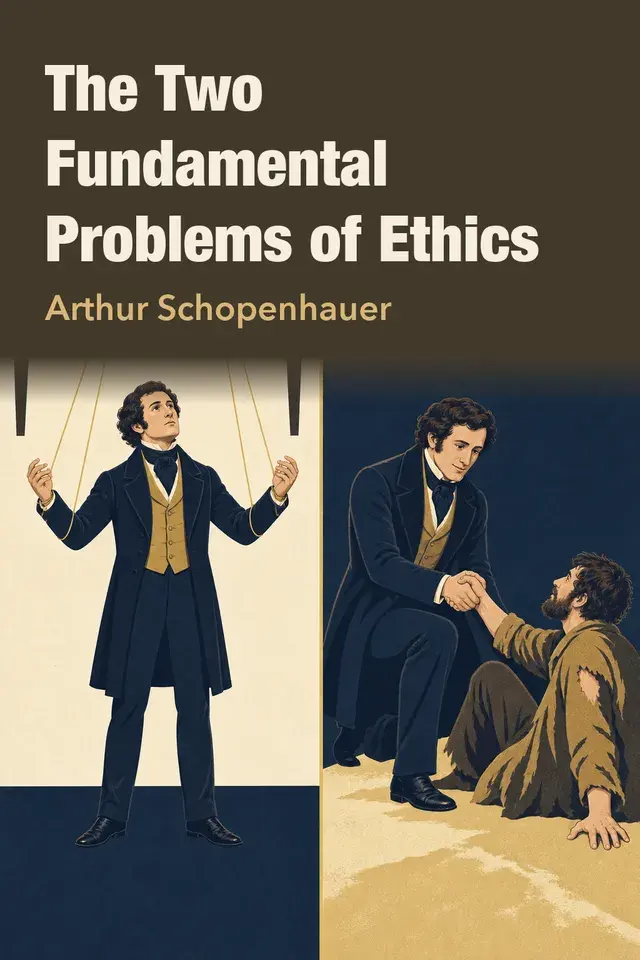
What you'll learn
Key ideas from The Two Fundamental Problems of Ethics
These ideas compress the book's argument without treating the author's view as settled fact. Use them as an orientation before reading the full work or listening in Wiseley.
Schopenhauer’s essays pair the question of free willing with the question of what grounds moral worth.
A deed follows necessarily when a motive meets individual character; apprehension also shapes means, and the strongest motive determines the decision.
Actions follow necessarily from character and motives; responsibility concerns the character they express.
An ethical foundation must explain why morally worthy actions occur, not only state what rule should be followed.
An action has genuine moral worth only when concern for another’s welfare or relief from suffering is its exclusive ultimate motive.
Justice restrains injury, while loving-kindness moves a person to relieve another’s suffering.
Compassion expresses the unity Schopenhauer says truly underlies individuals, while space and time make them appear separate.
Inside The Two Fundamental Problems of Ethics
Read the first chapter in full here. The other 9 continue in the Wiseley app.
Chapter 1 of 10 · 4 min · Audio & text
Two Problems, One Ethical Project
The Two Fundamental Problems of Ethics, by Arthur Schopenhauer.
Arnold von Winkelried’s battlefield self-sacrifice gives Schopenhauer an opening puzzle. The deed can be described as a sacrifice, but that description leaves a deeper question: what moved someone to act this way, and what, if anything, makes the action morally worthy? Schopenhauer uses Winkelried’s example to challenge the suspicion that every apparently selfless action must conceal egoism or malice. The visible act starts the inquiry; it does not settle it.
The book brings two questions together. The first asks whether the human will is free. The second asks what gives an action moral worth. They are distinct questions, but both concern how we understand human conduct. One asks about the status of willing; the other asks what makes a motive ethically good. A theory of ethics, Schopenhauer suggests, must be able to address both.
The first question matters because ethical judgments are judgments about actions people perform. To understand those actions, we must ask how a person comes to will and act. The freedom essay takes up that question directly. Its presence at the beginning of the book signals that an account of morality cannot simply assume that willing is free, or treat that issue as irrelevant. The details of Schopenhauer’s answer require a separate argument, but the problem already sets a task: explain conduct, rather than merely label it.
The second question turns from how action comes about to its moral character. A person may do something that looks generous or self-sacrificing; the outward deed alone does not reveal whether it has genuine moral worth. Schopenhauer therefore asks about motive. His ethical inquiry is not satisfied by naming a good act or prescribing a standard. It seeks to explain what makes an action morally good and what gives its motive that standing.
A useful map separates three questions that can easily blur together. First, what happened? This is description: it identifies the action, such as the battlefield sacrifice in Winkelried’s story. Second, what brought the action about? This is explanation: it asks what moved the person to act. Third, how should the action be assessed morally? This asks whether the motive that produced it gives it moral worth. These questions address the same conduct, but each asks for a different kind of answer.
The distinctions matter because an answer at one level does not automatically answer the others. Calling a deed a sacrifice tells us what it looked like, not why it was done. Identifying a cause or motive gives more than a description, but it does not by itself establish the action’s moral value. And declaring an action good does not explain how it came to be performed. In Winkelried’s case, the startling deed invites both an account of its motive and a judgment about that motive; neither can be read straight off the event.
This is why Schopenhauer’s project asks for more than a rule. A rule may state what conduct should follow, but stating it does not explain how a person is moved to act, or what makes a motive worthy. The question is not only what people ought to do. It is also what actually grounds moral goodness in human conduct. That shift makes ethics an explanatory inquiry into actions and motives, not simply a set of directions.
The two essays thus form one ethical project without collapsing into a single problem. An account of freedom does not, on its own, explain moral worth; an account of moral worth must still take seriously how people come to act. The opening example keeps that double demand concrete. We can identify a self-sacrificing deed, ask what caused it, and then ask what in its motive deserves moral regard. Keeping those questions apart gives the rest of Schopenhauer’s argument a clear starting point.
Chapter 2 of 10 · 7 min · Audio & textIn the app
Freedom and the Limits of Introspection
Freedom first needs a precise meaning. In its basic sense, it is the absence of hindrance or restraint.
Chapter 3 of 10 · 8 min · Audio & textIn the app
How Motives Meet Character
The previous chapter showed why immediate awareness cannot by itself establish that a person could will otherwise. Here Schopenhauer supplies a causal account of action.
Chapter 4 of 10 · 9 min · Audio & textIn the app
Responsibility Under Necessity
If actions follow necessarily from a person's character and the motives they encounter, responsibility can seem to disappear. Schopenhauer's answer is not to make actions exceptions to causality.
Chapter 5 of 10 · 5 min · Audio & textIn the app
What Ethical Grounding Must Explain
The ethical essay opens with a precise question: does morality begin in the immediate idea of right and wrong that conscience seems to contain, together with obligation and accountability? Or does it rest on another principle of cognition?
Chapter 6 of 10 · 9 min · Audio & textIn the app
Why Commands Fail as Foundations
Schopenhauer turns from what a moral principle says to what a command can actually explain. A civil rule can tell people what an authority requires and attach a penalty to disobedience.
Chapter 7 of 10 · 9 min · Audio & textIn the app
Testing Kant's Universal Moral Law
Having questioned whether an abstract command can ground morality, Schopenhauer now tests Kant’s specific formulas. The first says to act only on a maxim one could will as universal law for all rational beings.
Chapter 8 of 10 · 8 min · Audio & textIn the app
The Motive That Makes Morality
The test of an ethical account is not only whether it describes a worthy rule. It must explain how people come to act for another person’s sake.
Chapter 9 of 10 · 9 min · Audio & textIn the app
Justice, Kindness, and Compassion in Action
Chapter 8 identified compassion as the motive that lets another’s distress count directly in deciding what to do. Schopenhauer now asks what that motive looks like in practice.
Chapter 10 of 10 · 9 min · Audio & textIn the app
Character and the Unity of Life
The account of compassion leaves a further question: if compassion makes justice and kindness possible, why do people respond so differently to another person’s need? Schopenhauer’s answer is that people differ in character.
Chapter 1 of 10 · 4 min · Audio & text: Two Problems, One Ethical Project
Wiseley supports reading and listening to summaries in the app.
Continue in WiseleyAbout Arthur Schopenhauer
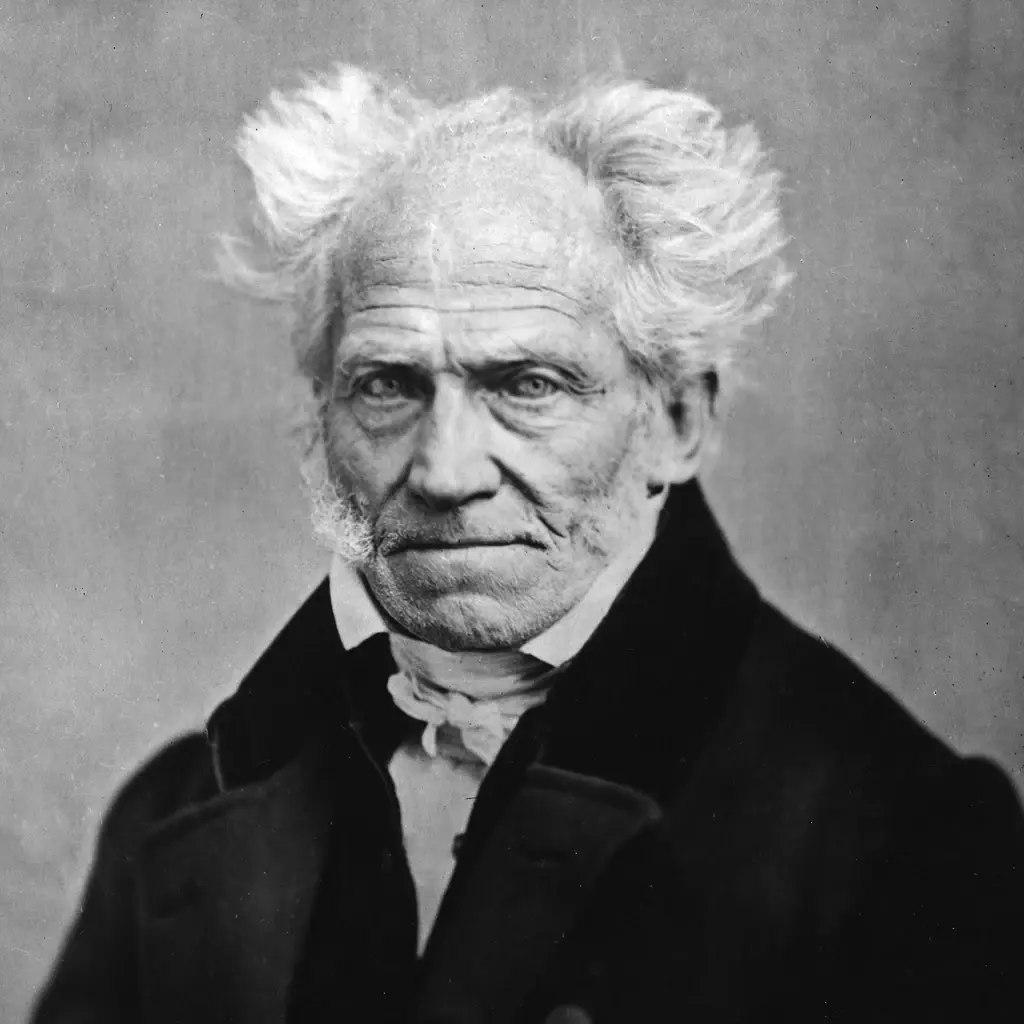
Arthur Schopenhauer was a German philosopher. “The Wisdom of Life” explores what makes a life happy when fortune and public approval are unstable.
Explore more books by Arthur Schopenhauer