What you'll learn
Key ideas from The Thinking Machine
These ideas compress the book's argument without treating the author's view as settled fact. Use them as an orientation before reading the full work or listening in Wiseley.
Nvidia treated PC gaming as an overlooked, low-margin foothold that could build expertise for larger graphics markets.
CUDA connected GeForce parallel circuits to scientific calculations through software layers, a compiler, and researcher-facing tools.
AlexNet’s ImageNet result depended on large labeled data, backpropagation, and GPU acceleration working together.
Self-attention links tokens across context, helping a transformer learn word meaning and grammatical patterns from relationships in text.
Mathematical techniques drove most speed gains; CUDA enabled GPU programming, and toolkits helped specialists. Its ecosystem discouraged switching even when code ports were easy.
Computing can improve climate modeling while its chip and data-center power use adds pressure to emissions and climate targets.
Commercial incentives and regulation disputes complicate decisions about safety and continued AI development.
Inside The Thinking Machine
Read the first chapter in full here. The other 14 continue in the Wiseley app.
Chapter 1 of 15 · 7 min · Audio & text
The Engineer Before Nvidia
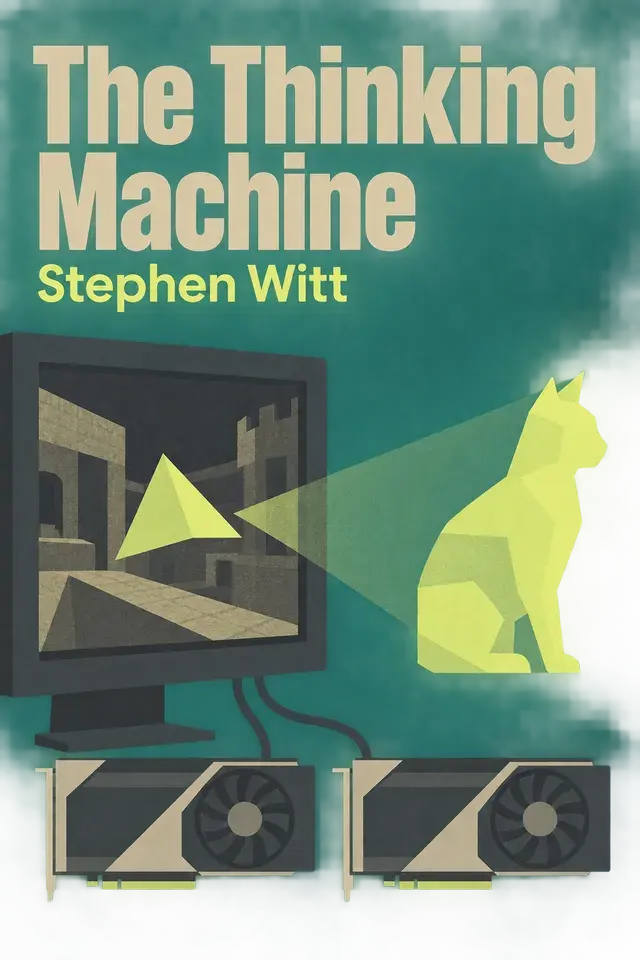
The Thinking Machine, by Stephen Witt.
Jensen Huang’s early life is often retold as a lesson in grit, but the record resists a neat origin story. Born in Taiwan and raised in Bangkok, he and his older brother were sent ahead to the United States during political unrest in Thailand in 1973. Their parents planned to follow, leaving the boys separated from them for a time. Their uncle selected Oneida Baptist Institute in Kentucky, perhaps mistaking the juvenile-reform school for a prestigious college-preparatory school. Their mother, who did not speak English, had prepared them with nightly vocabulary drills.
To reach a nearby elementary school, Huang crossed a damaged footbridge over a river. His classmate Ben Bays recalled bullies chasing Huang and swinging ropes to knock him into the water. Huang later remembered daily racial slurs and bullying. Bays said Huang seemed unaffected; the author suggests Huang’s later positive recollections may have softened the severity. Huang also joked that Bays’s memory of their fights differed from his. The accounts do not settle what Huang felt at the time. They show how memory complicates the story.
Huang excelled at school, improved his English, and graduated with highest honors. He studied electrical engineering at Oregon State, where circuit design became the foundation of his later work. At twenty, he joined AMD and spent two years sketching chip layers by hand. In 1985 he moved to LSI Logic, whose software tools addressed the limits of manually laying out chips with hundreds of thousands of transistors. The tools let engineers work at a higher level of design rather than draw every element themselves.
Huang still pursued the difficult circuit details. He used SPICE (Simulation Program with Integrated Circuit Emphasis), a command-line simulator that returned voltage readings as text, to test component arrangements for functions other designers considered impossible. He worked without a graphical interface, trying configurations and examining their results. At LSI, Huang and Horstmann did more than fulfill customer requests: as Horstmann put it, they turned customer orders into tools and those tools into methodologies.
Huang also knew when to abandon a dead end. Horstmann described him as someone who could see when a problem had grown too complex to advance and change direction. Horstmann, with Huang’s encouragement, began signing contracts with graphics customers seeking faster chips, sometimes before either knew whether LSI could deliver. Senior engineers warned them that the commitments carried career risk. Almost everything Horstmann and Huang promised was eventually delivered. Dependable execution mattered because customers brought requirements that were difficult to explain, and Huang’s team had to turn those requests into working designs.
At LSI, Huang worked with Sun Microsystems designers Chris Malachowsky and Curtis Priem. Their skills complemented one another: Priem was the circuit architect, Malachowsky the practical builder, and Huang handled production tools and coordination. The Sun designers trusted him. Their collaboration produced the Sun GX, a line of three-dimensional graphics processors introduced in 1989 for workstation users such as scientists, animators, and computer-aided-design modelers. It added textures to wire-frame objects. Its sixteen-color display looks crude in hindsight, but building it required their different strengths to meet in one product.
Huang earned trust by avoiding gossip, sharing credit, and promptly explaining delays or failures, including who was responsible and how he would address them. His candor could tip into insult. He was impatient with disagreement and seemed surprised when colleagues would not work fourteen-hour days. Priem and Malachowsky, themselves quarrelsome and driven, saw these qualities as signs of managerial fitness. That was their judgment; his reliability and his demanding style went together, with real costs for those around him.
Colleagues’ memories also complicate Huang’s later description of himself as an unambitious engineer whose rise came through coincidence. Malachowsky remembered a capable striver who wanted to run something by the age of thirty. In his twenties, Huang led an LSI division with $250 million in annual revenue. When the company appointed an Intel executive to co-manage the product line, Huang felt that work he had built was being taken from him. The author suggests that this may have helped prompt his departure.
When Priem and Malachowsky asked him to lead a venture, Huang did not commit immediately. Consumer-hardware start-ups seemed especially difficult to him, and many failed before producing a prototype. He approached the possibility as an engineering problem, researching the market, supply chain, competition, technology, product fit, and the views of customers, developers, and graphics experts. The decision also carried family stakes. Childcare had proved unreliable, and Lori had left engineering work to raise their children. Decades later, as Huang recalled first asking her to suspend her career and then asking permission to leave his job for a start-up with only six months of savings, the narrator saw discomfort in his face. Lori encouraged him to proceed. His readiness grew from technical fluency, disciplined problem-solving, and dependable work, but the move was still a risk made amid uncertainty and family obligations—not the inevitable result of one childhood episode.
Chapter 2 of 15 · 7 min · Audio & textIn the app
The First Chip Near Collapse
Nvidia entered a crowded market. Sun Microsystems and Silicon Graphics had passed on consumer PC gaming hardware, but at least thirty-five competitors were already trying to build graphics accelerators.
Chapter 3 of 15 · 7 min · Audio & textIn the app
Parallelism Finds Its First Market
In the late 1990s, Jensen Huang and technical partner David Kirk were turning Nvidia’s market position into a deliberate strategy. Their question was not simply which chip rival to copy, but which customers established companies were willing to overlook.
Chapter 4 of 15 · 6 min · Audio & textIn the app
A Neural Net Learns to Play
In 1997, two leading backgammon players, Nack Ballard and Mike Senkiewicz, met Jellyfish in a Dallas hotel room. Malcolm Davis, the program’s human agent, consulted its advice and moved the checkers.
Chapter 5 of 15 · 7 min · Audio & textIn the app
Gaming's Flywheel and Its Costs
For Johnathan Wendel, the professional player known as Fatal1ty, a fraction of a second mattered. He trained his visual reflexes until his response time reached about 140 milliseconds.
Chapter 6 of 15 · 8 min · Audio & textIn the app
CUDA's Bet on Scientists
A GPU earns its keep when it can apply the same instruction to many groups of data at once. That raises the amount of work done per clock pulse, but only when a problem can be divided into similar tasks.
Chapter 7 of 15 · 9 min · Audio & textIn the app
AlexNet Turns Compute Into AI
For years, neural networks had remained at the edge of artificial-intelligence research. The 2012 ImageNet result showed that a large network could learn to classify images with striking accuracy when it had enough labeled examples and enough computing power.
Chapter 8 of 15 · 6 min · Audio & textIn the app
AI Becomes Data Center Infrastructure
Once neural-network work showed that GPUs could accelerate machine learning, the next question became how to provide enough computing for work beyond a single lab. Cloud providers began building large GPU data centers and renting access to customers.
Chapter 9 of 15 · 6 min · Audio & textIn the app
Nvidia's Expanding Market Frontier
By 2017, Nvidia’s growth came from more than its emerging AI business. Its GPUs and CUDA software were finding uses in gaming devices, scientific research, cryptocurrency mining, cloud services, and robotics.
Chapter 10 of 15 · 7 min · Audio & textIn the app
The Transformer Changes Language
Earlier neural language models struggled to learn grammar from examples alone. Teaching rules explicitly did not scale well, while recurrent networks were finicky and difficult to program.
Chapter 11 of 15 · 6 min · Audio & textIn the app
How Nvidia's Platform Holds
A powerful GPU does not make an AI data center work by itself. Huang saw a data center as one large computer, with thousands of GPUs working on a problem together.
Chapter 12 of 15 · 6 min · Audio & textIn the app
New Worlds Meet Finite Power
Nvidia’s next frontier for graphics was a scene that could change as a person asked for it. Its cards had supported ray tracing since 2018, a method that simulates light bouncing off objects to create photorealistic effects.
Chapter 13 of 15 · 8 min · Audio & textIn the app
Valuation and Supply Chain Fragility
In February 2024, Nvidia reported annual revenue of sixty billion dollars, more than twice the previous level. Gross margins exceeded seventy percent, and net income was just under thirty billion dollars—more than the company had earned in the previous thirty years combined.
Chapter 14 of 15 · 6 min · Audio & textIn the app
Jensen Huang's Vision and Persona
As Nvidia grew, Jensen Huang became more than a chief executive in the eyes of many employees. They treated him as a prophet partly because his predictions seemed to come true as the company succeeded.
Chapter 15 of 15 · 8 min · Audio & textIn the app
Living With AI's Unresolved Risks
For Yoshua Bengio, the danger of AI takeover had once seemed almost like a comic thought experiment. ChatGPT changed his mind.
Chapter 1 of 15 · 7 min · Audio & text: The Engineer Before Nvidia
Wiseley supports reading and listening to summaries in the app.
Continue in WiseleyAbout Stephen Witt

Stephen Witt is an American journalist and writer. “The Thinking Machine” explores Nvidia’s shift from video-game graphics to the computing platform behind generative AI.
Explore more books by Stephen Witt