What you'll learn
Key ideas from The Things We Make
These ideas compress the book's argument without treating the author's view as settled fact. Use them as an orientation before reading the full work or listening in Wiseley.
Engineering uses context-specific rules of thumb and judgment to make workable changes without complete scientific explanations.
“Best” depends on the users, goals, materials, labor, and culture a design must fit.
Recorded, controlled variations make trial and error informative rather than random.
A working prototype shows possibility; an invention becomes useful when it can reliably meet users’ needs through manufacture.
Understanding technology can support public judgment and action, but people and societies must make its ethical choices.
Inside The Things We Make
Read the first chapter in full here. The other 11 continue in the Wiseley app.
Chapter 1 of 12 · 7 min · Audio & text
The Method Behind Making
The Things We Make, by Bill Hammack.
Hammack opens by invoking Cyril Stanley Smith’s view that technology is more closely related to art than to science, challenging the idea that it is simply applied science. Both involve selecting and shaping matter, and both confront complexities that cannot all be analyzed in advance. In this account, technology can make possible not only useful objects but delightful experiences and great works of art. Its creative dimension lies in shaping materials toward an effect, not simply in the equations that may help produce it.
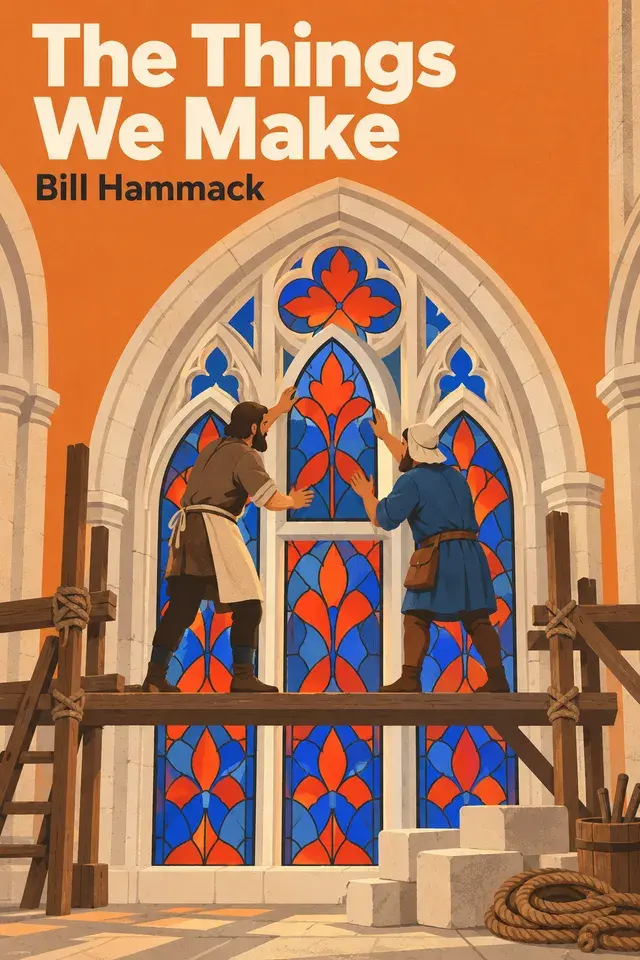
The Sainte-Chapelle in Paris makes this connection vivid. In its upper chapel, stone ceilings and walls weigh about four hundred tons, yet slender pillars support stained-glass windows. Sunlight casts red, blue, and gold across sculptures and gilded arches. Hammack describes Gothic light as a source of spiritual power. The structure is both a durable building and a setting for an artistic experience: its supports and windows shape what the chapel can be and how it feels.
That example helps distinguish engineering’s method from the knowledge and tools modern engineers use. Today, mathematics and knowledge of materials can help designers calculate structural forces and build in a safety margin. Those tools matter, but Hammack argues that they do not define engineering. Sainte-Chapelle’s builders worked without modern stress analysis, material-strength data, or standardized units. A measure called a foot could vary from place to place. Their achievement depended on practical knowledge of stone and on ways of working that could produce a lasting structure without modern explanations.
The building also shows how design choices respond to the problem at hand. A semicircular arch is half as high as it is wide, so raising a ceiling with that form also requires a wider building. Pointed arches let masons raise a ceiling without the same sprawl. But the arch still needed support. Walls that were too thin might buckle, while walls that were too thick used more stone and reduced the open interior.
Masons managed complex work with physical guides. A head mason drew the shapes of stone faces on wooden planks using tools such as a compass, straightedge, and rope. Masons then cut thousands of limestone blocks to match these templates. Much of the design lived in the head mason’s knowledge and memory rather than in written plans. The template made a design repeatable on site, giving workers a clear form to follow without requiring a modern set of drawings or measurements.
For the supporting wall, masons also used an inherited proportion: its thickness should be a little more than one fifth of the arch’s span. They could put the rule to work without calculating a ratio. The mason laid a rope along the arch, marked it into thirds, fixed the marks near the peak, and stretched the lower segments taut. He then extended one taut segment with an equal-length piece of rope, forming the hypotenuse of a right triangle; the triangle’s shortest leg gave the supporting wall’s thickness. The rule gave a quick starting point based on knowledge refined through long use and passed on among masons.
The proportion did not settle every decision. Masons inspected stones for weak seams, cracks, crumbling, or water damage, then adjusted the wall thickness by about three inches in either direction according to the stone’s quality. They also responded to what happened during construction: movement could prompt them to replace stones, and cracks in dried mortar could lead them to reinforce the work. A useful proportion guided the design, while observation and judgment adapted it to the actual materials and structure.
Hammack calls such practical shortcuts rules of thumb, or heuristics. A heuristic can narrow the search for a solution and improve the chance of success, but it cannot guarantee a correct result. Several rules may work together, or they may conflict, leaving the engineer to judge which fits. Their value depends on context. A proportion suited to a medieval stone arch cannot simply be transferred to a modern steel skyscraper; the materials and conditions have changed. A rule is useful when it fits the problem it was developed to address.
This is also the basic contrast Hammack draws between engineering and science. Science seeks truths and tests explanations against evidence. Engineering begins with a desired result and searches for a workable way to achieve it; it has no single required sequence. A practical engineering rule may remain useful without being scientifically proved, then lose its value when the materials or problem change. Scientific knowledge can support engineering, but a maker can sometimes find a reliable design before understanding exactly why it works.
Niels Christensen’s work on brakes shows this goal-directed method. After witnessing a fatal streetcar collision caused by electrically powered brakes failing when the car lost power, Christensen sought a system that could brake without depending on the car’s electricity. He designed a pneumatic brake that mechanically stored compressed air, keeping braking pressure available if electrical power failed. Nearly every electric streetcar used his system for forty years.
Later, Christensen worked on a simpler pneumatic seal. Earlier synthetic-rubber rings wore out quickly, so he placed a ring in a groove in a piston and varied the groove’s dimensions. He repeatedly moved the piston and inspected the ring for wear. He found that a groove about one and a half times the O-ring’s radius produced a seal that lasted nearly three million tests without leaking. Repeated trials established a durable design before Christensen had a correct explanation for its behavior.
Christensen believed the ring grew stronger through repeated use, but that account was wrong. Later photographs showed that the wider groove let the ring roll as the piston moved, leaving a thin lubricating film between the rubber and cylinder wall. The rolling and lubrication helped explain why the seal lasted. The mechanism became clearer after the practical design had already been found.
Together, the cathedral and Christensen’s seal establish the book’s starting framework: engineering uses judgment, practical rules, observation, and revision to make workable changes with available resources. That method can support durable structures and useful devices without complete scientific understanding, while its rules remain provisional and tied to their circumstances.
Chapter 2 of 12 · 8 min · Audio & textIn the app
Best for Whom, and Why
When we call a design “best,” we mean best at doing something for particular people under particular conditions. The judgment depends on what counts as success, and on the culture, materials, labor, and technologies available.
Chapter 3 of 12 · 7 min · Audio & textIn the app
Working Beyond Full Understanding
An engineer can act before a phenomenon has a complete explanation. A model can still be tested and useful if it organizes observations well enough to guide a practical choice.
Chapter 4 of 12 · 5 min · Audio & textIn the app
Evolution as an Engineering Search
Enzymes are proteins that help chemical reactions happen without being used up themselves. They support thousands of reactions in living cells, from breaking down sugars to other essential processes.
Chapter 5 of 12 · 6 min · Audio & textIn the app
Materials and Energy Shape Design
A design is shaped by what materials are available, where they can be obtained, and how energy can be supplied and controlled. To see how these conditions organize a whole system, follow a wine shipment down the Euphrates, then examine a clock powered by a candle and a falling weight.
Chapter 6 of 12 · 5 min · Audio & textIn the app
Knowledge, Opportunity, and Time
Engineering depends on knowledge as surely as on materials or energy. Some knowledge is inherited, built from practices refined over time.
Chapter 7 of 12 · 8 min · Audio & textIn the app
Learning Through Structured Trials
Engineering often begins before anyone knows which design will work. The practical task is to explore possibilities in a way that makes each result useful.
Chapter 8 of 12 · 6 min · Audio & textIn the app
Science Narrows the Design Space
A steam engine already drove ships by pushing a piston back and forth, then converting that motion into rotation. A turbine promised to turn steam’s force into rotation directly.
Chapter 9 of 12 · 7 min · Audio & textIn the app
Mathematics for Rare Risks
Averages are useful for describing ordinary conditions, but they can miss the events that test a design. A building engineer needs to know how strong a wind might become, not only how fast the wind usually blows.
Chapter 10 of 12 · 9 min · Audio & textIn the app
Invention Becomes Manufacturable
A prototype that works once proves that something can be made to work. It does not yet show that it can be made reliably, in useful numbers, or in a form that meets people’s needs.
Chapter 11 of 12 · 8 min · Audio & textIn the app
The Microwave’s Many Paths
The familiar story says Percy Spencer noticed a candy bar melting near a radar unit and immediately imagined a kitchen appliance. Bill Hammack says that candy-bar episode was fabricated; its details came from a 1950s Reader’s Digest writer.
Chapter 12 of 12 · 6 min · Audio & textIn the app
Who Guides Technology’s Consequences
A technology’s story does not end when it works. Once a device enters daily life, the question shifts from how it was made to whose needs it serves, who gains, and who bears its costs.
Chapter 1 of 12 · 7 min · Audio & text: The Method Behind Making
Wiseley supports reading and listening to summaries in the app.
Continue in WiseleyAbout Bill Hammack

Bill Hammack is an American chemical engineer. “The Things We Make” explores how engineers turn uncertain problems into workable things through practical rules, experiments, and trade-offs.
Explore more books by Bill Hammack