What you'll learn
Key ideas from The Tale of the Dueling Neurosurgeons
These ideas compress the book's argument without treating the author's view as settled fact. Use them as an orientation before reading the full work or listening in Wiseley.
Repeated signaling can strengthen synapses and make familiar neural routes easier to activate.
The brain can retain a body representation after amputation, and phantom limbs can occur even without a history of having the missing limb.
Emotional signals help assign value to choices, so abstract reasoning can remain intact while practical judgment fails.
Alien-hand cases separate bodily movement from the feeling of initiating and owning an action.
H.M. improved at mirror-star tracing without remembering practice, showing procedural skill learning can survive severe declarative-memory loss.
Split-brain tests showed that information reaching the right hemisphere could guide the left hand while remaining unavailable to spoken report.
Selfhood draws on interacting capacities for memory, agency, embodiment, personality, and social connection.
Inside The Tale of the Dueling Neurosurgeons
Read the first chapter in full here. The other 10 continue in the Wiseley app.
Chapter 1 of 11 · 9 min · Audio & text
From Brain Injury to Signal
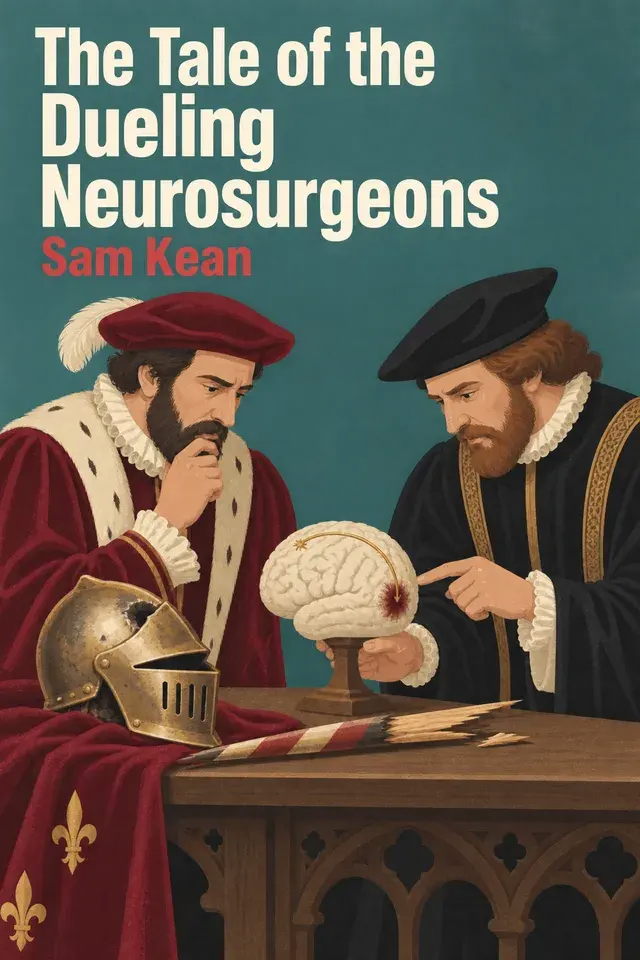
The Tale of the Dueling Neurosurgeons, by Sam Kean.
A skull can look unbroken while the brain inside is badly injured. To understand what the brain does, Sam Kean follows a trail from symptoms and autopsies to cells and experiments. The cases show how careful comparisons reveal hidden structure, while also showing why physical evidence cannot answer every question about a person’s mind or actions.
In 1559, a jousting blow struck Henri the Second in the face and eye. His skull was not visibly fractured, yet his condition worsened over the next eleven days. He suffered headaches, confusion, seizures, paralysis on one side, and changes in vision. These shifting symptoms suggested that the injury was inside the head, even though the most obvious damage was external.
Ambroise Paré had learned to question familiar treatments by comparing what happened to patients. During a campaign, he ran out of boiling oil, then treated some wounded soldiers with a paste of egg yolk, rose water, and turpentine. The soldiers treated with the paste recovered better than those treated with oil. This was not a controlled modern experiment, but it gave Paré a reason to change his practice: observed outcomes could challenge inherited medical authority.
Paré brought that habit of comparison to Henri’s injury. He had seen soldiers who initially appeared little hurt later decline, with autopsies revealing damaged brain tissue. He concluded that Henri could have a fatal concussion despite the intact skull. He also predicted injury at the rear of the brain, opposite the blow. The term for this pattern is contrecoup: the brain moves within the skull, and tissue can be damaged on the side away from impact.
After Henri died, Paré and the anatomist Andreas Vesalius examined his brain. The front and sides appeared normal. At the rear, they found dark fluid beneath the membranes and a yellow, damaged mass. The lance fragments had not entered the brain. The autopsy supported their central conclusion: the impact had caused lethal internal damage without breaking the skull. Paré and Vesalius did not have modern ideas about neurons or brain localization, but they had connected symptoms to a specific internal injury and checked their prediction against the body itself.
The mechanics of concussion are not a simple rule. A blow can damage tissue near the impact, opposite it, or both; the way the head and brain move matters. Henri’s head was already moving when the lance struck, adding uncertainty to any precise reconstruction. Kean also cautions against attributing every later difficulty in retired athletes to concussion. Retirement can bring a loss of routine, public attention, companionship, and income, all of which may contribute to depression. Some postmortem findings suggest serious brain damage in some athletes, but social changes still belong in the explanation. The evidence supports concern about repeated blows without making every individual outcome inevitable or simple.
Autopsy became a method for comparing what a person could do with what was damaged inside the brain. That approach raised a new question: could a brain look normal to the naked eye yet still be seriously diseased? The case of Charles Guiteau, who assassinated President James Garfield, made the question urgent. At his trial, most psychiatric witnesses said Guiteau understood right from wrong. Edward Spitzka argued that religious delusions and uneven control of Guiteau’s face pointed to insanity. The jury rejected that view.
Guiteau’s brain looked nearly ordinary from the outside. Under a microscope, however, examiners found a severely thinned cortex, dead neurons, holes in the tissue, damaged blood vessels, and chronic disease. This evidence complicated a judgment based mostly on behavior and courtroom answers. Kean’s retrospective account suggests Guiteau probably had schizophrenia, with neurosyphilis also damaging his brain. That interpretation does not by itself decide what Guiteau intended or how responsible he was. It does show why gross appearance and visible behavior can miss important evidence.
To make sense of microscopic damage, neuroscientists first had to understand what brain tissue was made of. Many believed the nervous system was one continuous mesh, with signals moving through a connected net. Camillo Golgi developed a stain that made some brain cells visible in extraordinary detail. He saw the cells’ tangled fibers as evidence for that continuous network. Santiago Ramón y Cajal used the same stain but interpreted the images differently. He saw separate cells, with boundaries between them.
Cajal’s neuron doctrine proposed that neurons are distinct units. Each has a cell body, branching dendrites that receive signals, and a long axon that carries signals onward. The axon affects the next neuron’s dendrites, giving communication a general direction. Glial cells support and nourish neurons. The disagreement between Golgi and Cajal persisted, even when they shared the Nobel Prize. The neuron doctrine prevailed because it explained more of what researchers observed, including how injury to cells and their support could disrupt function.
The idea of separate neurons created another puzzle. If cells were separated by tiny gaps, how did a message get from one to the next? Some researchers emphasized electrical currents, or “sparks.” Others argued for chemical messengers, or “soups.” Electrical activity could be measured inside firing neurons, and nerve stimulation could change a frog heart’s rate. Chemicals could also change the rate, but some scientists dismissed them as artificial or too slow to account for thought.
In 1920, Otto Loewi tested whether a stimulated nerve released a chemical. He stimulated a nerve attached to one frog heart, then transferred the surrounding saline to a second heart. The second heart’s rate changed too. Something released by the first nerve had traveled in the liquid and affected the second heart. The result gave strong evidence for chemical communication, while leaving the electrical findings intact.
The two modes work together. An electrical impulse travels down a neuron’s axon. At its end, chemical messengers called neurotransmitters are released into the synapse, the gap between neurons. They act on a neighboring neuron, which can then produce another electrical impulse. Researchers eventually found chemical signaling in the brain as well as in the peripheral nervous system. More than a hundred neurotransmitters provide different effects: glutamate can excite neurons, while GABA can inhibit them. Electricity carries signals within a neuron; chemical transmission helps shape what happens across the gap.
The limits of brain evidence appear again in the case of Leon Czolgosz, who killed President William McKinley. His brain looked ordinary when Edward Anthony Spitzka examined it after Czolgosz’s execution. The prison warden prevented microscopic study, and the brain was destroyed. Unlike Guiteau’s, it could not provide cellular evidence. The psychiatrists who assessed Czolgosz before trial called him sane, but their interviews did not deeply explore his history or motives. Their conclusions also arose amid intense hostility toward anarchists. His later isolation and troubling behavior invite questions, but the available evidence does not establish a definitive diagnosis.
Together, these cases show what neuroscience can establish and where its reach ends. Symptoms can point toward hidden injury; autopsies can test those predictions; microscopy can reveal damage invisible to the naked eye; experiments can expose how neurons communicate. But even a damaged brain does not supply a complete account of motive, diagnosis, or legal responsibility. Neural explanations matter, yet they must be weighed alongside a person’s behavior, circumstances, and the limits of the evidence.
Chapter 2 of 11 · 6 min · Audio & textIn the app
How Brains Learn New Routes
Neural circuits become easier to use through repetition. When neurons repeatedly pass signals to one another, their connections can strengthen: sending branches may enlarge or grow, and receiving cells can add more receptors.
Chapter 3 of 11 · 9 min · Audio & textIn the app
Seeing Faces, Building Identity
Vision feels like a single act: a scene arrives already arranged. The cases in this chapter show how much organization must happen first.
Chapter 4 of 11 · 7 min · Audio & textIn the app
The Body Map After Amputation
A limb can be gone and still feel present. In Silas Weir Mitchell’s fictional story about George Dedlow, an amputee feels cramps and pain in legs that are no longer there.
Chapter 5 of 11 · 8 min · Audio & textIn the app
From Kuru to Prions
Kuru’s early signs could resemble many illnesses, but involuntary, senseless laughter made the disease distinctive. Trembling and failing balance followed, then increasing difficulty controlling movement and swallowing.
Chapter 6 of 11 · 8 min · Audio & textIn the app
Emotion, Desire, and Judgment
The brain affects the body not only through signals sent along nerves. It can also issue commands through hormones, which glands secrete, linking brain activity to bodily changes that can shape feeling and behavior.
Chapter 7 of 11 · 7 min · Audio & textIn the app
Seizures and the Mapped Cortex
Epilepsy is not one kind of attack. It is a disturbance in the brain’s electrical activity: faulty membrane channels, damaged axons, or related problems can make neurons fire inappropriately.
Chapter 8 of 11 · 7 min · Audio & textIn the app
When Reality and Agency Fracture
Our sense that the world is present, familiar, and ours feels like one seamless experience. Neurological cases suggest it relies on several processes working together: noticing what is around us, recognizing people, feeling their significance, and sensing that our bodies and actions belong to us.
Chapter 9 of 11 · 8 min · Audio & textIn the app
Memory Rebuilds Its Past
Memory seems like one ability until illness or injury separates the things it lets us do. A person may learn a skill without remembering the lesson, retain facts but lose the experiences that gave them meaning, or remember so much that useful thought becomes difficult.
Chapter 10 of 11 · 6 min · Audio & textIn the app
Two Hemispheres, One Mind
Broca’s and Wernicke’s cases showed that language can break down in different ways. Speaking, understanding words, and connecting words with meaning depend on specialized regions and the pathways between them.
Chapter 11 of 11 · 6 min · Audio & textIn the app
The Distributed Self
The cases in this book return us to a difficult question: what makes a person continuous through change? The answer does not seem to be one memory, one trait, or one brain region.
Chapter 1 of 11 · 9 min · Audio & text: From Brain Injury to Signal
Wiseley supports reading and listening to summaries in the app.
Continue in WiseleyAbout Sam Kean

Sam Kean is an American writer. “The Disappearing Spoon” explores the stories of scientific discovery, rivalry, and human experience behind the periodic table.
Explore more books by Sam Kean