What you'll learn
Key ideas from The Singularity Is Nearer
These ideas compress the book's argument without treating the author's view as settled fact. Use them as an orientation before reading the full work or listening in Wiseley.
For some information technologies, feedback loops keep the costs of innovation below its benefits.
Generality is assessed across varied tasks with capable human foils, including checks of memory, common sense, social understanding, and dependence on guidance.
A separate digital duplicate and gradual neural replacement pose different questions about identity and continuity; neither settles subjective experience.
Indicators need scrutiny for what they measure, whose experience they average, how far reliable data reach, and whether gains have reversed.
Lower production costs can ease physical scarcity, while infrastructure, political distribution, provenance, and status can remain scarce.
AI can speed medical discovery, but a rapid design milestone does not establish a treatment’s safety or effectiveness.
Automation can raise output while removing livelihoods from workers and communities tied to tasks machines take over.
Alignment research, fail-safe design, human judgment, and transparency can reduce risks, but none guarantees safe superintelligent AI.
Inside The Singularity Is Nearer
Read the first chapter in full here. The other 9 continue in the Wiseley app.
Chapter 1 of 10 · 8 min · Audio & text
Why Information Accelerates
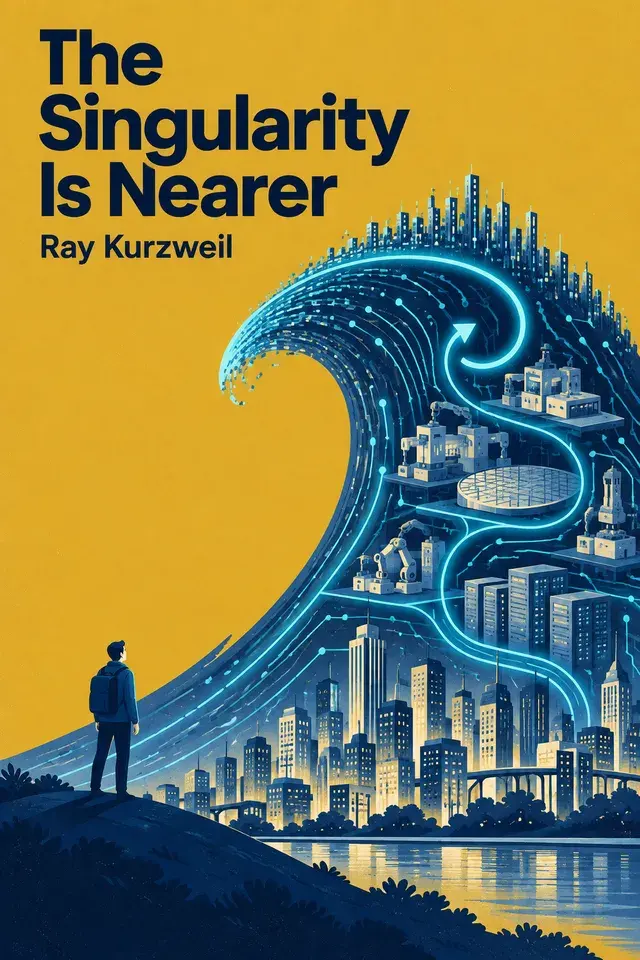
The Singularity Is Nearer, by Ray Kurzweil.
Some inventions improve one machine at a time. Others change how later inventions are made. Kurzweil calls this second pattern the law of accelerating returns: information technologies can improve exponentially when each generation helps create its successor.
The mechanism is a feedback loop. Better tools for gathering, storing, manipulating, and transmitting information make ideas easier to develop and share. Those ideas can produce improved tools, which then support further innovation. Computer-aided design, for example, helps engineers develop faster processors; those processors can make the next round of design work more powerful. The relationship runs in both directions: progress creates better tools, and those tools make more progress possible.
This is more specific than saying that technology always advances quickly. The pattern depends on a technology making further improvement easier, while its benefits continue to justify the cost. Moore’s law, the historical doubling of transistor counts through miniaturization, is one expression of the broader process. Kurzweil argues that the trend can continue through successor approaches when one hardware method reaches limits. The particular next paradigm is uncertain; the larger point is that improvement need not depend on one device or manufacturing technique.
Some technologies do not generate this kind of open-ended feedback. Transatlantic trips became dramatically faster, from the Mayflower’s sixty-six days to Concorde’s three and a half hours. After Concorde retired, the London-to-New York crossing took more than seven and a half hours again. Transport has practical and economic limits: at some point, more speed can cost more than it is worth. This example marks a boundary around the law. It describes certain self-reinforcing paths, especially in information technology, rather than every kind of change.
Kurzweil places this account of technological change inside a six-epoch history of information processing. Each epoch develops capacities that help make a more complex form possible. In the first, physical laws and chemistry allow atoms and molecules to form increasingly elaborate structures. In the second, molecules become complex enough to encode organisms in DNA, and life evolves. In the third, brains store and process information, with more complex brains supporting more capable behavior.
The fourth epoch is human technology. Human cognition and dexterity produce tools that extend the brain’s ability to perceive, remember, and evaluate patterns. Kurzweil contrasts this slow biological development with digital computation, whose price-performance has improved much faster. In his framework, the fifth epoch would bring biological cognition into direct combination with digital technology. The sixth imagines intelligence spreading through the universe and organizing matter into what he calls computronium, matter arranged for dense computation.
The six epochs are Kurzweil’s way of describing a progression in information processing, not a guarantee that every stage will arrive as predicted. The later stages are forecasts. Their role here is to show the scale of the framework: change can build on earlier forms of information processing and eventually exceed what people at an earlier stage can readily picture.
That difficulty is why Kurzweil uses the word “Singularity.” It is a metaphor for a transformation so extensive that people today may struggle to understand what follows. He does not mean that technology or any physical quantity becomes literally infinite. The term points to a limit in our ability to imagine the consequences, not to infinity in the mathematical or physical sense.
A historical computation series gives a concrete way to examine the long trend. Kurzweil compares the computing performance available for an inflation-adjusted dollar across selected machines. The series begins with the 1939 Z2, listed at about a third of a computation per second. The 1965 PDP-8 is listed at 312,500 computations per second, or about 1.81 per dollar. A 1975 Altair 8800 reaches 500,000 per second, or 144 per dollar. By 2023, the chart’s Google Cloud TPU v5e estimate is about 393 trillion computations per second, or roughly 130 billion per dollar. The individual figures differ enormously, but the series shows a large long-term rise in computing available for the price.
The plotted line should not be mistaken for a single, perfectly consistent experiment. Computing changed qualitatively, and the chart combines measures used in different eras. It uses machines’ original performance measures because measures such as instructions per second and floating-point operations per second do not scale neatly across the full range. The benchmark shifts from counting instructions toward measuring floating-point work as computing applications change. The chart also favors the best achieved performance, which is broader to compare than typical daily performance but can exceed what machines usually deliver.
Price comparisons require similar care. The figures are converted to February 2023 dollars using consumer-price data. Older computer prices could include displays and storage, while newer processors may be priced on their own; this can make the apparent improvement during some periods look larger. Cloud systems are rented rather than sold, so the chart estimates a purchase-equivalent price using an assumed period of use. Actual rental prices vary by customer and project. The chart also leaves out costs such as electricity, installation, maintenance, and labor because they differ by user.
These choices do not erase the long-term pattern, but they limit what can be claimed about any single comparison. The appendix says the overall direction of the long-span trend is not very sensitive to a different assumption for one point. That does not make each point exact or each pair of machines directly comparable. A plotted trend is strongest as evidence of a broad historical change, and weaker as a precise forecast of the next machine, price, or date.
The useful conclusion is therefore conditional and measured. Information technologies can improve exponentially when they help make their successors easier to build. Kurzweil’s six epochs place that feedback within a much larger story of increasing information-processing capacity, while the computation series makes the historical scale visible. But the pattern applies selectively, and its measurements depend on changing benchmarks, price assumptions, and technological paradigms. Reading the curve well means seeing both its long reach and its limits.
Chapter 2 of 10 · 10 min · Audio & textIn the app
Learning Through Layers
A rule-based program begins by stating how an expert should solve a defined problem. A connectionist system begins with examples instead.
Chapter 3 of 10 · 8 min · Audio & textIn the app
When Machines Generalize
The previous chapter introduced how networks learn from examples. Here the question is what happens when a learned pattern travels beyond the case that taught it.
Chapter 4 of 10 · 10 min · Audio & textIn the app
Extending Human Intelligence
Kurzweil turns from what AI can do now to how broadly capable it may become. Since 1999, he has forecast that AI will pass a carefully administered Turing test by 2029.
Chapter 5 of 10 · 10 min · Audio & textIn the app
What Makes a Mind Continuous
Before asking whether a machine thinks, Kurzweil asks what would show that it experiences anything. We can observe functional awareness: a person responds to surroundings, reports thoughts, and acts as though there is a world beyond them.
Chapter 6 of 10 · 10 min · Audio & textIn the app
Measuring Human Progress
To test optimism about technological change, Kurzweil looks beyond computers and asks whether ordinary conditions of life have improved. He points to measures of education, literacy, sanitation, health, poverty, violence, and democracy.
Chapter 7 of 10 · 9 min · Audio & textIn the app
Toward Material Abundance
Material abundance does not mean every object becomes free. It means that information technology may help produce many goods and services with less labor, energy, land, or material.
Chapter 8 of 10 · 11 min · Audio & textIn the app
Medicine Beyond Biological Limits
Kurzweil applies his acceleration argument to a stubborn medical problem: after gains against infectious disease, many of the hardest threats come from breakdown inside the body. Cancer, heart disease, diabetes, and neurodegeneration involve cells and tissues failing over time.
Chapter 9 of 10 · 10 min · Audio & textIn the app
Work, Wealth, and Purpose
Automation can increase what an economy produces while taking away a particular person’s livelihood. The gains may spread through lower costs, new services, and new industries.
Chapter 10 of 10 · 11 min · Audio & textIn the app
Governing Powerful Technologies
Kurzweil closes by putting promise and peril in the same frame. Tools that let people alter matter, organisms, and decisions can cause harm on a civilizational scale.
Chapter 1 of 10 · 8 min · Audio & text: Why Information Accelerates
Wiseley supports reading and listening to summaries in the app.
Continue in WiseleyAbout Ray Kurzweil

Ray Kurzweil is an American computer scientist, author and futurist. “The Singularity Is Near” explores the author's forecasts about technological change and the future relationship between humans and machines.
Explore more books by Ray Kurzweil