What you'll learn
Key ideas from The Shortest History of Economics
These ideas compress the book's argument without treating the author's view as settled fact. Use them as an orientation before reading the full work or listening in Wiseley.
Agricultural surplus could support cities and crafts or be extracted by leaders to enrich themselves and sustain armies; rising output did not ensure equal gains or better health.
Ideas can spread and be improved through copying, while temporary patents trade some access for stronger invention incentives.
Industrial growth followed reinforcing changes in farming, cities, commerce, technology, and institutions; invention alone did not create sustained gains.
Commons management can work when users make rules, enforce them locally, resolve disputes, and begin with modest penalties.
Keynes saw falling spending as self-reinforcing, while Hayek traced downturns to artificially low interest rates and imprudent investment.
Markets may reward efficiency without eliminating discrimination, so institutions shape who gains and who bears risk.
Education, unions, taxes, social support, employment, and health care shape how growth affects wellbeing beyond income alone.
Climate policy weighs unpriced social harm against present investment, and its answer depends partly on how future wellbeing is discounted.
Inside The Shortest History of Economics
Read the first chapter in full here. The other 10 continue in the Wiseley app.
Chapter 1 of 11 · 8 min · Audio & text
Scarcity, Surplus, and Society
The Shortest History of Economics, by Andrew Leigh.
Economics begins with scarcity: people have limited time, labor, land, and materials, so choosing one use means giving up another. The subject asks how people make those choices and how individual decisions combine into the fortunes of whole societies. It looks at both personal decisions and economy-wide patterns, and at what policy can do when markets fail.
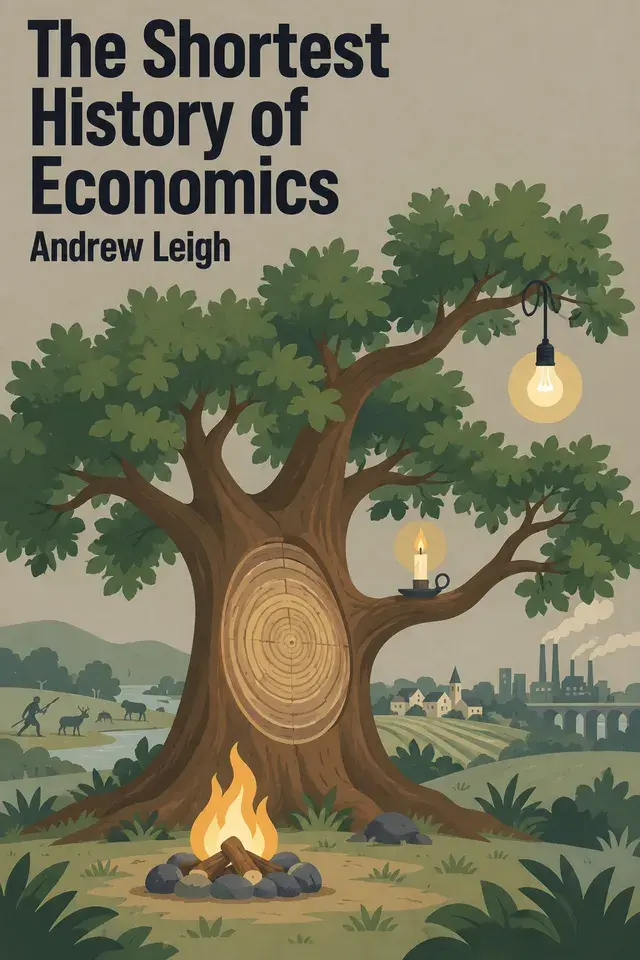
A striking way to see what rising productivity can mean is to ask how much work it takes to obtain an hour of artificial light. The author compares 58 hours of prehistoric foraging with 41 hours in Babylon. By the late seventeen hundreds, an hour of candlelight cost about five hours of work; by the early nineteen hundreds, the labor cost had fallen to minutes. Today, it is less than a second. Better lighting helped, but so did workers becoming more productive and earning more in each hour. The same basic service came to require a tiny fraction of a person’s labor.
People respond to incentives, meaning that rewards and costs can shift what they do. In one example, runners ran faster when a contest offered a much larger prize for first place than for second. Prices also give producers information: scarcity can encourage more production, while abundance can make extra production less worthwhile. Economics considers these patterns without assuming people are always selfish; cooperation can be supported by institutions and shared rules.
Specialization is another response to scarcity. Rather than making everything themselves, people can concentrate on work they do relatively well and exchange what they produce. This makes it possible to use skills more productively and to share the benefits of expertise. Trade can help even when one person is more productive at every task. The useful comparison is each person’s output per hour in different tasks, followed by how much of one product they must give up to make another.
Imagine that the best potter is also the best baker. If her advantage over other people is much greater in pottery, she can focus on pottery and trade for bread. The question is not simply who is faster overall, but where each person has the larger relative advantage. Money makes such exchange easier: it lets people compare values, carry wealth forward, and pay without finding someone who wants exactly what they offer.
Even a good match between producers may not lead to trade if moving goods costs too much. On poor roads, heavy goods with low value were especially difficult to transport. Around 300 CE, the book reports that a wagonload of wheat could double in price over a journey of 500 kilometers. That cost could make local production preferable, even when another place produced the wheat more efficiently.
Markets do not always produce results that serve society well. The introduction names cartels, congestion, unemployment, overfishing, and pollution as problems that can emerge. A cartel can restrict competition, while overfishing can exhaust a shared resource. Economics also asks what public policy can do about such failures.
Agriculture changed the scale of what people could produce and store. It had no single point of origin. In the Levant, dry periods after the last ice age encouraged experiments with crops. Between 10,000 and 8,000 BCE, farmers selected plants with larger seeds and less bitterness. Once food could be stored, people had a buffer against a poor harvest and could rely on food throughout the year. That made consumption more secure, though its benefits depended on local conditions.
The !Kung people of the Kalahari qualify any simple claim that farming always improved food security. Where mongongo nuts were abundant, they could be stored and provided substantial nutrition. The source says the !Kung ate about 300 nuts a day, supplying roughly a third of their energy. One person questioned why crops should be planted when the nuts were plentiful. This example shows that foraging could provide security in a particular environment; it does not mean all foraging groups had the same resources.
Geography shaped where farming could take hold and how its techniques spread. Eurasia had grains and legumes that could be stored, as well as goats, sheep, and cattle that could be domesticated. East-to-west travel across similar climates also made it easier for crops and farming practices to spread than travel across the varied climates on a north-to-south route. These advantages helped shape history, but geography was not the only influence on later outcomes.
The plough made cultivation more productive by breaking soil, exposing nutrients, and burying weeds; animals could provide power. Settled agriculture is estimated to have produced five or six times as much as foraging. In practical terms, compare what people can produce with the same amount of labor over the same period. Higher output can free some workers from finding food so they can build, trade, or make tools. The plough also had social effects: its physical demands made plough farming more male-dominated than cultivation with digging sticks. The source links historic plough use with less equal gender norms, while presenting this as an association rather than a complete explanation.
The Indus Valley shows how stored surplus could support settlements, crafts, and trade. At Kalibangan, crosswise furrows may indicate that people grew two crops together, though that interpretation is tentative. Across the civilization, farmers’ surplus supported grid-planned cities, standardized bricks, flush toilets, bronze tools, carts, boats, and a canal. Traders brought in jade, cedar, and lapis lazuli, while jewelry, pottery, and metal tools were made for exchange. At its peak, the population is estimated at about five million. The source presents the civilization as comparatively equal and notes its lack of conspicuous monuments. That may help explain why it left fewer visible traces and remained unknown to archaeologists until the nineteen twenties.
Agricultural production could widen what society was able to do, but greater output did not guarantee better lives. Early farming communities often ate a narrower diet. A study cited in the book estimates that average height fell by about ten centimeters after the agricultural revolution. Farming also brought malnutrition and crowded, disease-ridden settlements. At the same time, surplus could support crafts, buildings, and trade; it could also be taken by leaders to enrich their families and sustain armies. Agricultural wealth helped some societies build military power and empires.
A useful way to assess this transition is to keep two questions separate. How much more could a society produce with a given amount of labor, and who controlled or received the surplus? The Indus example shows ways surplus could sustain cities and skilled work, while early farming’s health costs and the possibility of extraction show why total production alone cannot measure human welfare. Agriculture expanded the possibilities for cooperation, but its effects varied with ecology and with control over what was produced.
Chapter 2 of 11 · 6 min · Audio & textIn the app
Trade, Ideas, and Epidemic Shocks
Trade grows when routes connect producers and buyers, but geography alone does not explain who can use those routes. Water had long carried people and goods, and moving goods by water cost less than moving them over land.
Chapter 3 of 11 · 8 min · Audio & textIn the app
Sailing, Finance, and Empire
Oceanic expansion changed the reach of commerce. European ships grew sturdier and larger; rudders, sails that could tack into the wind, improved navigational tools, and the sea astrolabe for finding latitude made long voyages more feasible.
Chapter 4 of 11 · 7 min · Audio & textIn the app
Industrialization, Factories, and Economic Ideas
For much of history, economic growth did not reliably make ordinary people richer. When farms produced more, population often expanded, absorbing much of the gain.
Chapter 5 of 11 · 9 min · Audio & textIn the app
Trade, Firms, and Social Change
Industrialization changed how much an economy could produce. The next change concerned how widely businesses could sell, how investors could fund them, and who could set the terms.
Chapter 6 of 11 · 6 min · Audio & textIn the app
Models, Markets, and the Commons
Alfred Marshall showed how a simple model can make an economic relationship easier to understand. In his influential 1890 textbook, he used mathematics as shorthand for economics in service of social wellbeing.
Chapter 7 of 11 · 8 min · Audio & textIn the app
Depression, War, and Economic Order
After the First World War, Germany was required to pay 132 billion gold marks in reparations, an amount described as roughly half its prewar wealth and beyond what its economy could support. The government printed money to meet its debts, and the mark lost value at extraordinary speed.
Chapter 8 of 11 · 9 min · Audio & textIn the app
Postwar Growth and Market Reform
In many advanced economies, the decades after the Second World War brought rising prosperity and, for a time, lower inequality. This did not come from one cause.
Chapter 9 of 11 · 11 min · Audio & textIn the app
Policy, Development, and Distribution
Policy matters because a growing economy does not automatically remain stable or share its gains widely. Public decisions influence how quickly prices rise, which industries develop, and who can use the opportunities growth creates.
Chapter 10 of 11 · 10 min · Audio & textIn the app
Behavior, Markets, and Climate
Economic models often begin with a rational decision-maker who weighs costs and benefits consistently. Behavioral economics asks how actual choices depart from that picture.
Chapter 11 of 11 · 10 min · Audio & textIn the app
Shocks, Data, and Future Economics
The pandemic showed how quickly a public-health shock can become an economic one. Lockdowns halted much tourism and migration, reduced investment and spending on services, and pushed every advanced economy into recession.
Chapter 1 of 11 · 8 min · Audio & text: Scarcity, Surplus, and Society
Wiseley supports reading and listening to summaries in the app.
Continue in WiseleyWhat The Shortest History of Economics is about
The book traces how technology, trade, institutions, and policy have shaped economies from agriculture to the pandemic era. It asks why rising productivity and exchange can lift living standards while leaving inequality, crises, and environmental harms. Its historical cases give listeners tools for thinking about incentives, market failures, public choices, and uncertainty.
About Andrew Leigh

Andrew Leigh is an Australian politician, author, and former professor of economics. “The Shortest History of Economics” explores how technology, trade, institutions, and policy have shaped economies from early agriculture to the present.
Explore more books by Andrew Leigh