What you'll learn
Key ideas from The Seven Circles
These ideas compress the book's argument without treating the author's view as settled fact. Use them as an orientation before reading the full work or listening in Wiseley.
Wellness is a voluntary, lifelong return to balance that begins with strengths and responds to changing circumstances.
Powwow, sport, dance, and running can carry gratitude, cultural continuity, artistic expression, and advocacy.
Land sustains culture and well-being as a living relation, not merely as property or a resource.
Kinship links personal wellness with reciprocal care among family, community, other living beings, and future generations.
Ceremony frames wellness as the capacity to meet hardship and return toward balance, rather than a promise of uninterrupted happiness.
Trauma-informed home-keeping treats decluttering as gradual care, not a judgment of character or household worth.
Sleep joins spiritual, emotional, mental, and physical renewal in one circle of wellness.
Indigenous foodways are flexible values that can guide gratitude, harvesting, growing, shopping, cooking, and feeding without imposing one diet.
Inside The Seven Circles
Read the first chapter in full here. The other 7 continue in the Wiseley app.
Chapter 1 of 8 · 10 min · Audio & text
Wellness as Returning Balance
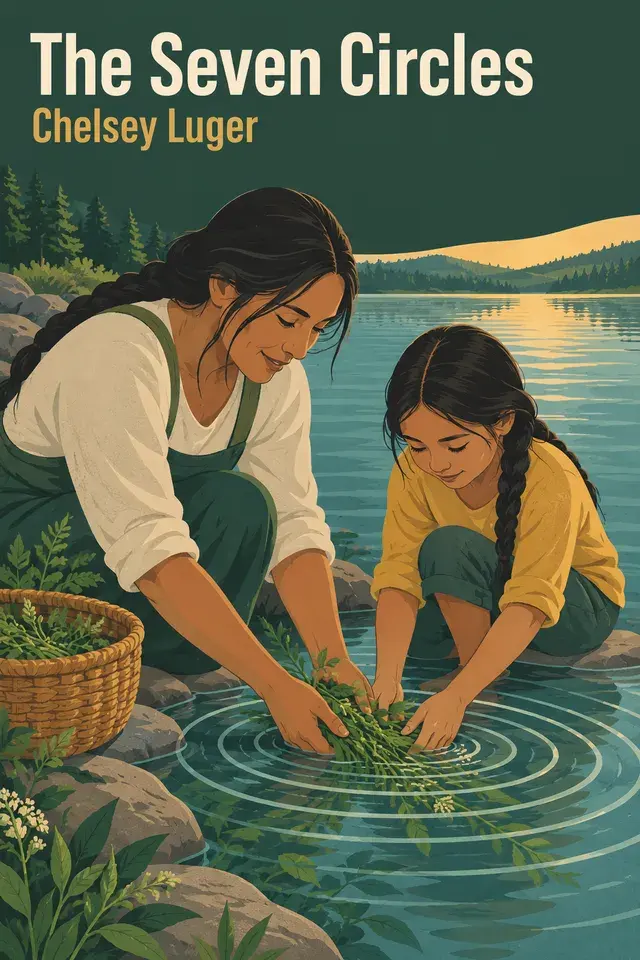
The Seven Circles, by Chelsey Luger.
The opening vignette shows a mother gathering herbs with her young daughter on Mohawk territory. As they gather, the daughter places tobacco on the shore as a medicine offering, and they wash the gathered herbs in the lake while expressing gratitude for its life-giving role. The scene presents wellness as a relationship of attention and reciprocity, woven into ordinary acts rather than set apart as a special program. It also gives a glimpse of the teachings behind the Seven Circles: health involves how people relate to themselves, their communities, and the world around them.
The Seven Circles name seven connected areas of life: movement, land, community, ceremony, sacred space, sleep, and food. The authors developed this model through years of teaching and learning. Its circles are not separate boxes to complete. They represent parts of a whole, and changes in one area can affect the others. The framework offers a way to consider what balance might mean in a person’s actual life.
The model comes from the authors’ intertribal perspectives, drawing particularly on Lakota, Ojibwe, O’odham, and Haudenosaunee teachings connected to their backgrounds. They present it as a contemporary model informed by ancestral knowledge, not as one ancient system shared by every Indigenous nation. Indigenous cultures have distinct teachings, and the Seven Circles cannot represent all Indigenous views of health. The authors invite readers to adapt and question the guidance, while treating cultural exploitation, appropriation, ignorance, and disrespect as real boundaries.
In this framework, wellness does not mean being perfectly healthy or permanently free of hardship. It means developing steadiness and resources that can help a person meet difficulties and return to balance. Life changes, and so do people’s needs. A circle that feels strong now may need attention later; losing balance is part of life, not proof of failure. The aim is an ongoing practice, with no fixed timeline for reaching a good life.
The authors begin with a short exercise called Find Your Power. It invites the reader to ground their attention, focus on their hands, remember their ancestry while recognizing their own individuality, and notice the heat their hands generate. The exercise is meant to help readers sense themselves as both rooted and distinct. Its underlying teaching is that personal power is already present and cannot simply be taken away. Like a fire, it can be strengthened and directed toward meaningful work, creativity, caregiving, movement, healing, or service.
A medicine wheel offers another way to understand balance. It is a flexible circle often divided into four parts representing mental, physical, emotional, and spiritual life. It can also be associated with directions and life-giving forces, and it has many possible interpretations. The authors use this holistic view within each of the Seven Circles: any area of wellness can involve all four parts of a person. The symbol therefore broadens the question from what someone does to how that part of life affects the whole person.
The authors also draw on the hollow-bone teaching associated with Fools Crow. In this teaching, a healer is an ordinary person who becomes open to receiving good teachings and to allowing spiritual help to work through them. Being open also brings responsibility: a person can carry good ways of living forward through service. Fools Crow’s example includes humility, sobriety, nonviolence, and service without a fee. The authors emphasize that his discipline was chosen, not imposed by a compulsory rulebook; they connect that openness and self-discipline to a way of living well.
A related teaching the authors invoke from Standing Bear describes self-mastery as measured thought, careful speech, considered decisions, and steadiness under pressure. Its focus is mastery of one’s own conduct, not dominance over others. The authors connect this kind of discipline to balance in the wider community. They also treat wellness as voluntary: other people can encourage or support someone, but they cannot impose lasting self-mastery from outside.
That emphasis on personal practice does not mean that health is only a matter of personal choice. People have unequal access to the resources and power that shape health, and their circumstances are affected by social, economic, environmental, political, and historical conditions. Violence, poverty, policy, and unequal treatment can narrow a person’s options. The authors ask readers to notice both their barriers and their advantages, without blaming themselves or judging others as if everyone had the same choices.
A trauma-informed view adds context to how people respond to hardship. The authors describe trauma as potentially arising from a single event, repeated experiences, development, history, or intergenerational harm. They mention research suggesting possible biological transmission across generations while noting that those conclusions remain debated. Their point is not to make trauma a person’s fate. Understanding what people have lived through can invite a more compassionate account of behavior and struggle.
From there, the authors favor a healing-centered view that looks for strengths as well as pain. Instead of asking only what happened to someone, it asks what is right with them and what valuable qualities they carry from family, culture, and community. This is a way to recognize gifts and sources of resilience without denying harm. The authors connect personal care to the possibility of healthier families and communities, and to breaking cycles of trauma across generations.
The book’s Learn, Engage, Optimize cycle gives readers a flexible structure for putting ideas into practice. Learning means taking in knowledge and noticing new questions. Engaging means trying things, applying ideas, and forming habits that fit a person’s life and loved ones. Optimizing means noticing what helps, refining a practice, building confidence, and sometimes sharing what one has learned. These are not levels to pass through in order. They overlap, and what a person learns through practice can start the cycle again.
The authors use changing circle maps to make the idea of balance visible. A person can draw the seven circles at different sizes to represent how life feels at a particular time. The map can change with injury, pain, parenting, aging, or other circumstances. One scenario shows injury and parenting shrinking movement or sleep while community becomes more prominent. A contrasting elderhood scenario gives more space to food, sleep, and movement while community and ceremony take less. Neither picture is a standard to meet; each helps locate a current situation.
The authors encourage readers to start with what is already working. A map can show where a person is thriving as well as where they would like to grow, so reflection does not begin as a search for personal defects. The next step can be small and attainable, chosen in light of current responsibilities and access. The purpose is to see a possible direction, not to make every circle equally large or to copy another person’s life.
The book’s guiding image is therefore not a perfect, finished chart. The authors describe reverence as seeing life as worthy of care, and they reject competition or ranking on the wellness path. People are not above, below, ahead, or behind one another. Balance is a return: a lifelong practice of learning from existing strengths, responding to changing conditions, and finding a next step that belongs to one’s own life.
Chapter 2 of 8 · 13 min · Audio & textIn the app
Movement as Living Medicine
Movement, in The Seven Circles, is more than a scheduled workout. It can be ordinary work, play, dance, sport, caregiving, or time outdoors.
Chapter 3 of 8 · 9 min · Audio & textIn the app
Land as Living Relation
People often speak of land as property: something to own, develop, or use for resources. Chelsey Luger and Thosh Collins describe a different relationship, rooted in the Indigenous perspectives they share.
Chapter 4 of 8 · 10 min · Audio & textIn the app
Kinship Beyond the Self
Personal wellness in this chapter does not end at the edge of one body. It depends on reciprocal relationships with family, community, other living beings, and generations past and future.
Chapter 5 of 8 · 13 min · Audio & textIn the app
Ceremony Through Life’s Storms
Ceremony enters this chapter where the idea of wellness is tested: in the presence of hardship. The authors recall a family encountering a desert whirlwind.
Chapter 6 of 8 · 10 min · Audio & textIn the app
Making Space for Wholeness
The spaces around us help shape how we think, feel, and move. A home, workplace, school, or online environment is part of daily wellness because we meet it while cooking, working, caring for others, and moving through ordinary life.
Chapter 7 of 8 · 12 min · Audio & textIn the app
Rest, Rhythm, and Dreams
Wellness is often described through what people do: move, learn, care for others, and meet daily responsibilities. This chapter gives rest equal weight.
Chapter 8 of 8 · 16 min · Audio & textIn the app
Foodways, Family, and Future
Food is nourishment, but it is also a relationship: to land, history, family, and other living beings. Chelsey Luger and Thosh Collins trace how that relationship changed under colonization and changing economies.
Chapter 1 of 8 · 10 min · Audio & text: Wellness as Returning Balance
Wiseley supports reading and listening to summaries in the app.
Continue in WiseleyAbout Chelsey Luger
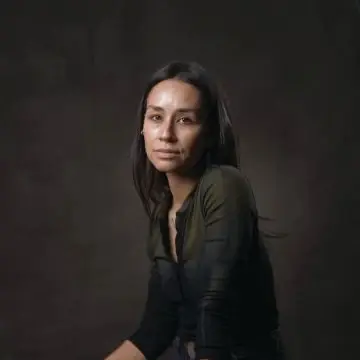
Chelsey Luger is the author of “The Seven Circles”. The book explores how wellness can restore balance while honoring Indigenous knowledge and lived circumstance.
Explore more books by Chelsey Luger