What you'll learn
Key ideas from The Self-Driven Child
These ideas compress the book's argument without treating the author's view as settled fact. Use them as an orientation before reading the full work or listening in Wiseley.
Perceived control can soften stress and support learning, judgment, motivation, and emotional well-being.
A parent can guide, advise, and help while leaving the child responsible for work that belongs to them.
Children build judgment through repeated, age-appropriate decisions and experience with their consequences.
A calm, trusted adult can help a child settle and face difficulty without carrying it alone.
Durable self-motivation is supported by autonomy, competence, relatedness, and meaningful engagement.
Learning calls for meaningful challenge in a setting where students can make mistakes without threat or humiliation.
College readiness includes self-direction, daily living, coping, social skills, and help-seeking alongside academic ability.
Inside The Self-Driven Child
Read the first chapter in full here. The other 12 continue in the Wiseley app.
Chapter 1 of 13 · 8 min · Audio & text
Control, Stress, and the Developing Brain
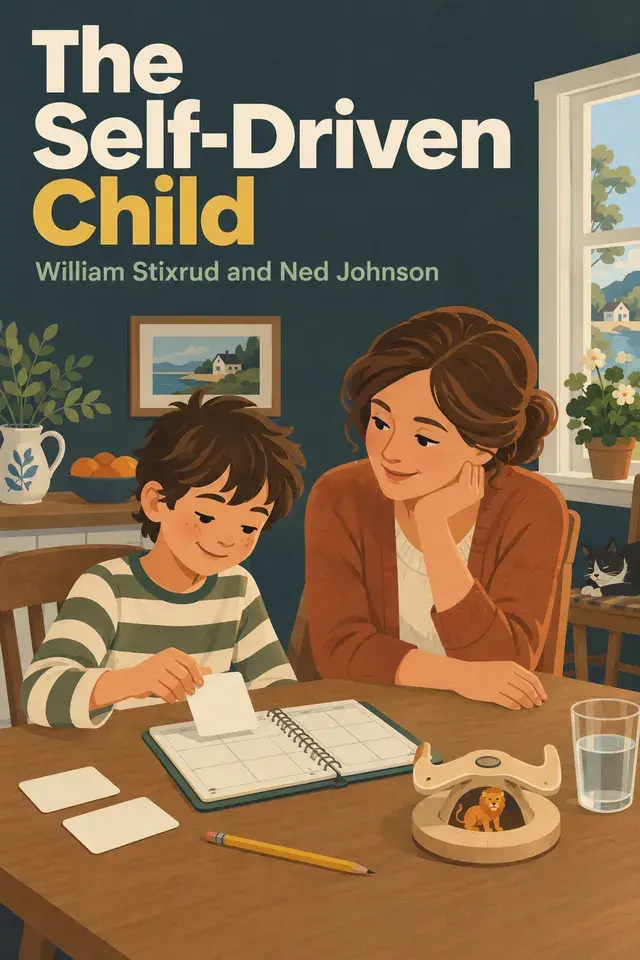
The Self-Driven Child, by William Stixrud and Ned Johnson.
The authors begin with a child’s sense of control because it shapes how stress is experienced. Control does not mean being able to dictate every outcome. It means feeling that your actions and choices can influence what happens. The authors point to novelty, unpredictability, possible harm or embarrassment, and low control as features that can make a situation stressful. Even when a person cannot change the event itself, feeling some agency can ease the stress. Children’s early insistence on doing things themselves is one sign of this need. As they grow, having meaningful influence can support their ability to learn, make decisions, and manage emotion.
That does not mean children should be protected from every difficult feeling. The authors distinguish three kinds of stress. Positive stress, such as nervousness before performing, can help a child focus, take a risk, or persist, especially when participation feels like a choice. Tolerable stress comes from harder experiences, but is limited and buffered by caring adults and time to recover. A brief episode of bullying or a bereavement, for example, may be manageable with support. Toxic stress is frequent or prolonged activation without enough support or reprieve. The difference is not simply whether something difficult happens. Duration, support, recovery, and a child’s sense of control all matter.
Adam and Zara show why stress may not look the same from the outside. Adam is grieving, sleeping poorly, struggling to concentrate, and seeing his grades fall. Zara earns high marks, but her schedule is packed; she also sleeps poorly and has become irritable and prone to headaches. The authors raise the possibility that both children are under harmful chronic stress. Falling grades are not the only warning sign, and strong performance does not prove that a child is coping well. Challenge can be part of growth, but sustained pressure without recovery may interfere with the capacities that make learning and healthy effort possible.
To explain how this happens, the authors use four memorable brain models. The Pilot is the brain’s executive control system, associated with the prefrontal cortex. It helps a person plan, organize, control impulses, and use judgment. When a child is calm and rested, the Pilot can help regulate other brain activity. Mild arousal may sharpen focus, but too much stress can overwhelm this system. Then it becomes harder to think clearly, learn, or pause before acting.
The Lion Fighter is the rapid threat-response system. It prepares the body to fight, flee, or freeze, often before conscious thought. This response is useful when danger is real. But under high stress, the Lion Fighter can crowd out the Pilot, leaving a child more reactive and less flexible. If stress continues, the body’s longer-lasting response involves cortisol. The authors describe the hippocampus as helping form memories and use past experience to restore perspective. Prolonged stress can impair this work, making learning and putting events in context harder. A student who panics and cannot think through a test problem illustrates how a response meant to protect can get in the way of reasoning when danger is not immediate.
The Cheerleader represents the brain’s reward-related motivational system, associated with dopamine. The authors connect dopamine with wanting and drive: a child needs enough interest or anticipation to get started and keep going. Chronic stress can reduce motivation, so low effort may reflect strain rather than a lack of character. The Buddha represents a network active during unfocused thought and reflection. The authors associate it with processing experience, integrating memories, gaining perspective, creativity, identity, and empathy. They also caution that scientific understanding of this resting network is still developing. Together, the four models show how stress can affect not only a child’s immediate reaction, but also learning, motivation, and reflection.
These effects deserve care because the brain is still developing through childhood and adolescence. The authors describe prolonged stress as a particular concern during these periods, when stress can interfere with development and adolescents may be slower to recover from sustained strain. Chronic stress may also leave the threat system more reactive while weakening reflective control. This can make it harder to distinguish a real threat from a manageable problem and can contribute to anxiety, depressed mood, or physical complaints. These are risks the authors describe, not inevitable outcomes for every stressed child.
A useful first step is to talk with a child about what stress feels like and what seems to trigger it. For children around ten and older, the authors suggest discussing whether a situation feels new, unpredictable, threatening, or outside their control. Parents can also name their own stressors to make the conversation easier. Then look for choices the child can genuinely manage, even small ones, while accepting that no one can control every outcome. A supportive adult and time to recover can help a child face a challenge without being left alone in it. Constantly shielding children from anxiety-provoking situations can also keep them from developing tolerance for stress, so the aim is not to remove all challenge.
If a child seems very anxious, the authors recommend discussing it with a pediatrician and considering whether professional help is needed. In everyday worries, parents can communicate that the child is safe and that support is available, while taking the child’s feelings seriously. The larger aim is to let children meet manageable challenges with some agency and room to recover. A child’s sense of control and access to support help determine whether stress can be endured and learned from, or instead overwhelms the systems needed to learn and thrive.
Chapter 2 of 13 · 7 min · Audio & textIn the app
Consulting Instead of Controlling
Parents do not have to choose between running a child’s life and leaving them alone. The authors propose a different role: be a consultant who listens, shares advice, and offers help while leaving the child responsible for work that belongs to them.
Chapter 3 of 13 · 8 min · Audio & textIn the app
Choices That Build Judgment
Good judgment comes from practice. Adults can explain how to compare options, but children need chances to make decisions and experience their ordinary results.
Chapter 4 of 13 · 7 min · Audio & textIn the app
Parents as a Calm Base
Children’s growing independence can stir a parent’s fear: they may be hurt, unhappy, or make a choice the parent would not make. The authors argue that unmanaged worry can become part of the family’s stress.
Chapter 5 of 13 · 11 min · Audio & textIn the app
How Motivation Takes Root
Parents use the word motivation for two different things: getting a child to do what needs doing today, and helping that child develop lasting inner drive. Buckling a seat belt, brushing teeth, or getting ready on time may call for cooperation.
Chapter 6 of 13 · 11 min · Audio & textIn the app
Downtime, Meditation, and Sleep
Recovery is not simply time away from work. The authors distinguish ordinary relaxation from what they call radical downtime: quiet, unstimulated time without a planned task or focused activity.
Chapter 7 of 13 · 7 min · Audio & textIn the app
Learning Without Overload
School is where the book’s ideas about control meet daily learning. The authors describe school as replacing many early choices with required tasks and external evaluation.
Chapter 8 of 13 · 8 min · Audio & textIn the app
Technology and Self-Regulation
Phones, games, messaging, and social media can make boundaries difficult for families. A phone travels with a child, connects schoolwork and friendships, and may stay within reach at night.
Chapter 9 of 13 · 8 min · Audio & textIn the app
Practicing Resilience in Daily Life
The authors treat resilience as a set of skills children can practice. The aim is not to avoid every disappointment, but to stay able to think and act when something goes wrong.
Chapter 10 of 13 · 11 min · Audio & textIn the app
Support Without Taking Over
Support for a child with a learning or developmental difference can be substantial without making the child a bystander. Adults may need to arrange instruction, accommodations, routines, or treatment.
Chapter 11 of 13 · 6 min · Audio & textIn the app
Tests Without Identity Threat
The SAT and ACT can loom large because students and families may treat a score as a verdict on college prospects or even on a young person’s future. Yet these tests sample particular knowledge and skills under particular conditions.
Chapter 12 of 13 · 7 min · Audio & textIn the app
Ready for College?
Preparing for college can absorb so much attention that families forget to ask what happens after a student arrives. Stixrud and Johnson argue that college is a major change in daily life, not simply the next school year.
Chapter 13 of 13 · 7 min · Audio & textIn the app
Many Paths to a Good Life
A child’s future does not have to follow one academic route to become worthwhile. When success is defined by grades or a narrow set of colleges, some children feel pressured to keep proving themselves, while others may decide there is no point in trying.
Chapter 1 of 13 · 8 min · Audio & text: Control, Stress, and the Developing Brain
Wiseley supports reading and listening to summaries in the app.
Continue in WiseleyWhat The Self-Driven Child is about
Why do capable children lose motivation, struggle under pressure, or resist help—and how can parents support them without taking over? Stixrud and Johnson argue that a child’s sense of control shapes stress, learning, and independence. The book offers practical ways to share decisions, reduce pressure, support motivation and rest, and prepare for school, technology, tests, and adulthood.
About William Stixrud & Ned Johnson

William Stixrud
William Stixrud is a clinical neuropsychologist and author. “The Self-Driven Child” explores why a child’s sense of control shapes stress, learning, and independence.
Explore more books by William Stixrud
Ned Johnson
Ned Johnson is an author, speaker, and founder of the tutoring company PrepMatters. “The Self-Driven Child” explores why a child’s sense of control shapes stress, learning, and independence.
Explore more books by Ned Johnson