What you'll learn
Key ideas from The Science of Getting Started
These ideas compress the book's argument without treating the author's view as settled fact. Use them as an orientation before reading the full work or listening in Wiseley.
Procrastination moves from assumptions and discomfort to excuses, substitute actions, temporary relief, and consequences that strengthen the next delay.
Procrastination can arise from immediate reward-seeking, executive-function difficulty, emotional protection, or environmental and physical triggers.
Breaking an intimidating project into one useful next action lowers the threshold without shrinking the larger goal.
Critical factors, defaults, time limits, and satisficing bound routine decisions without denying that some choices deserve deeper comparison.
An implementation intention links a recognizable cue to a predecided response, replacing a vague intention with a moment-specific behavior.
STING protects focused work through one selected task, a timed interval, distraction control, no unscheduled breaks, planned pauses, and a reward earned for timely completion.
The Eisenhower Matrix sorts demands into do, schedule, delegate, or eliminate according to importance and urgency.
Supportive routines make physical care, focus, challenge, and recovery less dependent on constant conscious effort.
Inside The Science of Getting Started
Read the first chapter in full here. The other 7 continue in the Wiseley app.
Chapter 1 of 8 · 9 min · Audio & text
How Avoidance Reinforces Itself
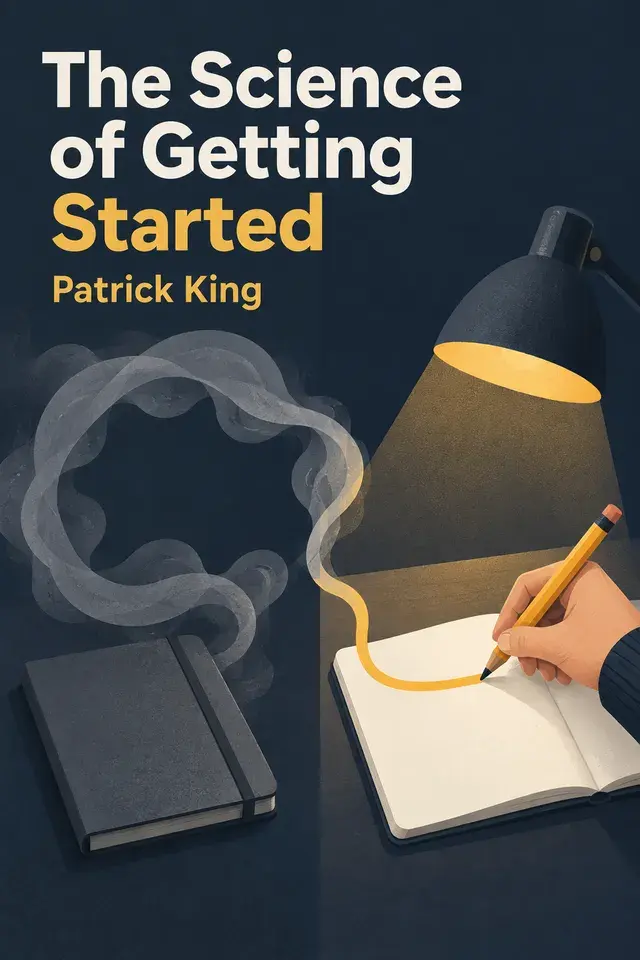
The Science of Getting Started, by Patrick King.
An intention can be sincere and still fail to become action. The book defines procrastination as delaying a needed or important task, sometimes until the last moment or until it is abandoned, while short-term gratification outweighs future consequences. This is more than laziness or a simple lack of motivation. It is a pattern in which a person recognizes what matters, then repeatedly chooses relief from the present moment.
The task does not even have to be boring. A 20,000-word paper can be displaced by a movie until the deadline brings pressure, guilt, and shame. Yet even if the subject is stimulating and the work itself is comfortable, someone may still avoid it in favor of something more immediately fun. Discomfort matters, but discomfort alone does not explain delay. Trying only to increase motivation therefore reaches only the surface of the problem.
To make the pattern predictable, the book describes a five-phase cycle. It begins with an assumption, moves through discomfort and an excuse, becomes an avoidance activity, and ends with consequences that feed the next round. These phases form a loop. They explain both how someone justifies sitting still and why the next attempt can feel even harder.
First come unhelpful assumptions, or made-up rules about when action is allowed. A person may believe that pleasure should come first, that work requires a particular mood, or that starting is impossible without enough energy, readiness, resources, or perfect conditions. Another assumption says that anything less than a perfect performance equals failure. These beliefs often operate below awareness, so they feel like facts rather than choices. They turn an ordinary task into a test that must be passed before it can begin.
When the required task conflicts with those rules, discomfort rises. The person may feel bored, frustrated, resentful, anxious, embarrassed, afraid, exhausted, or angry. The emotions are not imaginary, and the tension can be real. Awareness that the task remains undone may itself become agitating, especially when the task carries uncertainty or the possibility of judgment.
Then an excuse makes inaction appear legitimate. Tomorrow will be better. The mood is wrong. The person is too tired, lacks what is needed, or will act after another task. These explanations protect a favorable self-image. Instead of admitting unwillingness or fear, someone can remain the reasonable one, the victim of circumstances, or a person waiting for the proper opportunity. Repeated often enough, an excuse can feel true, and the distinction between a real obstacle and a convenient rationalization begins to blur.
The excuse opens the door to avoidance. Sometimes the substitute is pleasurable distraction. Sometimes it is an easier task that creates the appearance of productivity. Organizing, cleaning, or handling a lower-priority responsibility can change the feeling of the moment while leaving the important task untouched. The substitute may feel like progress, but it does not change the underlying situation.
The ice-cream-shop example shows how this works when the delayed task is a major life goal. Someone wants to open an ice-cream business, but the dream attracts catastrophic assumptions: What if it fails? What if uncertainty cannot be managed? What if acting exposes the person to disappointment or judgment? Fear then becomes evidence for delay. The person can say the timing is wrong, more preparation is needed, or action should wait until circumstances feel safer.
Instead of investigating concrete matters such as business loans, the person may discuss the dream with friends. Those conversations can be sincere and enjoyable, yet still substitute for the next difficult action. Talking about the shop creates a feeling of movement without requiring a decision. If a good location is lost while the person is still preparing, the result is practical and emotional: the opportunity narrows, and the original fear appears justified. A temporary retreat has created evidence that moving forward is dangerous.
That is the reinforcement at the center of the cycle. Avoidance brings immediate relief. The person no longer has to feel the fear, uncertainty, or pressure of the task, and may even feel briefly productive or comforted. That relief rewards avoidance, making it more likely the next time a similar feeling appears. Meanwhile, the task accumulates. Guilt, anxiety, shame, extra work, missed opportunities, and other repercussions make it more intimidating. The increased difficulty produces more discomfort, which makes the old excuses easier to believe. Short-term relief disguises long-term self-sabotage.
The practical control points follow from this structure. Discomfort cannot always be prevented, and eventual consequences cannot always be controlled. The choices available are narrower but still important: examine the assumption, test the excuse, and notice the action that replaces the intended task. Is the rule realistic, or merely a demand for perfect conditions? Is the excuse honest and necessary, or mainly fear speaking? Is the substitute genuinely urgent, or is it helping avoid something harder? Honest awareness can interrupt the movement from one phase to the next.
The book also presents a simplified brain model for why this handoff feels powerful. The limbic system, sometimes called the “lizard brain,” represents the automatic, survival-oriented side associated with basic drives, emotion, fear, anger, pleasure, and immediate impulses. The prefrontal cortex represents the slower, conscious side associated with planning, information processing, decisions, and deliberate completion. When an obligation is unpleasant, the automatic system pushes toward immediate pleasure while the deliberative system argues for the required work.
This is an explanatory contrast, not a complete account of brain function. In the book’s model, procrastination occurs when the planning system loses focus or fails to manage the impulse toward a more pleasurable alternative. Anticipated pleasure can pull attention away before the alternative begins, and the text describes dopamine as part of the pleasurable rush that reinforces the pattern. Strong procrastination is therefore not proof that someone is a hopelessly lazy person. The deliberative system can be strengthened through strategies and practice.
The cycle explains why good intentions are not enough. A person can want the result, understand the future cost, and still choose relief now. The aim is not to control every emotion or guarantee every consequence. It is to recognize the sequence early enough to question the belief, name the excuse, and see what behavior is purchasing relief. Once those points become visible, procrastination is no longer a mysterious failure of character. It is a self-reinforcing process whose assumptions, excuses, and actions can be examined.
Chapter 2 of 8 · 9 min · Audio & textIn the app
Identify Your Pattern of Delay
Once you understand how avoidance reinforces itself, the next question is more personal: what usually starts your delay? Procrastination can reflect an immediate pleasure-seeking impulse, a difficulty organizing behavior, an emotional fear, or a trigger in the surrounding situation.
Chapter 3 of 8 · 7 min · Audio & textIn the app
Start Before You Feel Ready
Once the pattern of delay has been recognized, the practical response is not to wait for a better mood. The book’s activation procedure is to choose one meaningful next action, lower the effort and quality demanded at the beginning, begin within two minutes of thinking about the task, and let engagement develop if it does.
Chapter 4 of 8 · 9 min · Audio & textIn the app
Decide Without Perfect Certainty
Procrastination does not always look like doing nothing. It can look like responsible preparation: comparing options, collecting more information, or waiting for a clearer plan.
Chapter 5 of 8 · 8 min · Audio & textIn the app
Make Future Intentions Concrete
An intention can be sincere and still too vague to govern behavior. The problem is often not that the goal lacks value, but that the future cost of postponing it has no immediate shape.
Chapter 6 of 8 · 8 min · Audio & textIn the app
Make Work Easier to Choose
Once a task has been chosen and scheduled, another problem remains: the moment when you must actually do it. This chapter focuses on engineering that immediate experience.
Chapter 7 of 8 · 10 min · Audio & textIn the app
Protect Priorities and Reclaim Attention
Learning to start a task is not enough if attention is spent on the wrong tasks. This chapter adds a system-level filter: urgent demands can crowd out important work, while improved work habits can make a person more efficient at staying busy.
Chapter 8 of 8 · 8 min · Audio & textIn the app
Sustain the Energy to Act
Procrastination can look like a problem of time, motivation, or technique. This chapter adds a prior question: do you have enough usable energy to apply any technique?
Chapter 1 of 8 · 9 min · Audio & text: How Avoidance Reinforces Itself
Wiseley supports reading and listening to summaries in the app.
Continue in WiseleyWhat The Science of Getting Started is about
Why do we postpone tasks we intend to finish? Patrick King explores the emotional, impulsive, and practical forces behind procrastination. Learn to identify your avoidance patterns, start before motivation arrives, and use clearer priorities, concrete plans, rewards, and energy management to make progress easier.
About Patrick King

Patrick King is the author of “Read People Like a Book”. The book explores how behavior can reveal another person’s motives and feelings while interpretations stay provisional.
Explore more books by Patrick King