What you'll learn
Key ideas from The School of Life
These ideas compress the book's argument without treating the author's view as settled fact. Use them as an orientation before reading the full work or listening in Wiseley.
Emotional intelligence is a collection of learnable skills, and adults continue developing without public milestones.
Present judgments can carry emotional expectations inherited from earlier relationships.
Therapy gives hidden thoughts a calm witness, which can reduce shame and isolation.
Diplomacy begins by showing understanding, then making a clear request in a way that does not needlessly intensify conflict.
Anxiety can be a reasonable response to vulnerability and uncertainty, rather than a second problem to fear.
Love can join admiration with mutual education when feedback is respectful, compassionate, and well timed.
Commerce can create employment and material abundance, but its value also depends on which human needs it helps meet.
Good-enough expectations, modest gratitude, and fallible wisdom make life more bearable without removing error or turmoil.
Inside The School of Life
Read the first chapter in full here. The other 14 continue in the Wiseley app.
Chapter 1 of 15 · 8 min · Audio & text
Emotional Education for Real Life
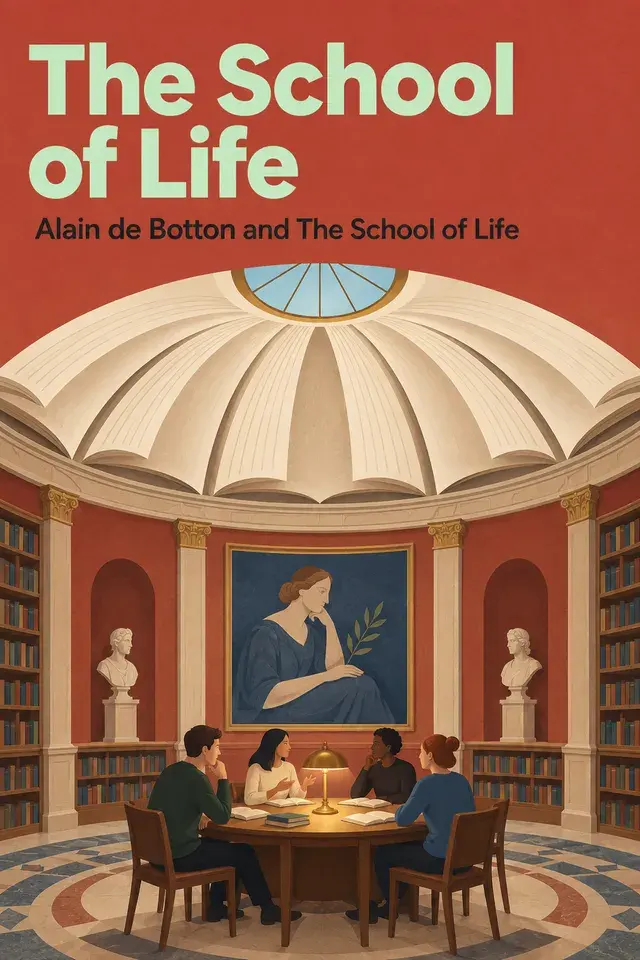
The School of Life, by Alain de Botton and The School of Life.
Modern education is careful about passing on technical knowledge. People are trained for professions and taught subjects such as alloys, yet receive far less instruction in marriage, kindness, shame, or rage. The imbalance appears in how readily adults worry about a child’s mathematics and how rarely they ask whether that child can form caring relationships. Emotional understanding is often treated as either unnecessary or impossible to teach. The book argues that this leaves essential parts of life to chance.
One reason is a Romantic faith in untrained feeling. In emotional matters, people are often told to follow attraction, choose work by listening to the heart, and avoid thinking too much. The author links this trust in impulse with a gap between technological and psychological progress: advanced tools coexist with old appetites and destructive furies. Intelligence, meanwhile, is not one all-purpose quality. Emotional intelligence names a group of skills, including introspection, communication, reading other people’s moods, patience, and the ability to build love. It also includes finding meaningful work, sustaining hope and gratitude, and seeing one’s limits. These are human capacities to learn, not a single score that credentials can guarantee.
That education should continue through adulthood. People may rethink envy after sleepless nights, understand why a compliment unsettles them, or learn to forgive themselves. Such changes can be as meaningful as an outward achievement, but they come without a title, ceremony, or public recognition. The author imagines emotional learning as a lifelong journey, with landmarks that help people see both progress and faltering.
The question of who should teach these lessons became sharper as religious belief declined in parts of Europe. Religion had offered guidance about ethics, meaning, community, and how to live, love, and die. Culture was proposed as a secular successor: paintings, plays, books, music, libraries, concert halls, and museums might offer instruction and consolation. Some institutions even took on the appearance of sacred places. The British Museum Reading Room’s dome was specified to match the circumference of St Peter’s, while the Rijksmuseum was designed by a church architect and described as resembling a place of worship.
In practice, the author argues, this cultural promise has mostly gone unrealized. Museums and libraries tend to act as repositories. Someone seeking urgent guidance about purpose, forgiveness, or charity might feel out of place there. Cultural institutions often interpret their works soberly, rather than addressing the emotional needs that art might meet. This is not an argument against culture; it is a call to take seriously what cultural teaching could do.
Self-help is often dismissed as sentimental, foolish, or commercial. The author accepts that garish presentation and exaggerated promises can deserve that criticism. But the need for emotional guidance is not therefore foolish. Ancient Greek and Roman thinkers wrote practical philosophy, while Montaigne and Proust explored self-knowledge and how to value life. The difficulty is not the idea of helping people live more wisely; it is the shallow treatment it can receive. Nor is emotional education a promise that suffering will disappear. Its more modest aim is understanding and consolation.
Even sound advice can fail to change behavior. Conventional education often assumes that the manner of teaching matters less than the information, and that once people understand an idea, it will remain available to them. But people defend themselves against painful truths, blame those who expose a weakness, become distracted, or simply forget. The author calls the gap between knowing and doing akrasia: weakness of will. An insight may be present in memory and still have little influence on the choices made later that day. Emotional learning therefore needs ways to reach people through resistance and return after forgetting.
Art can make a lesson emotionally persuasive. Historically, architecture, music, and painting helped communicate difficult religious ideas by joining instruction to beauty. In fifteenth-century Florence, the philosopher Marsilio Ficino, with support from the Medici, hoped to teach virtues such as charity, compassion, courage, and dignity. Plain prose or a monotonous lecture would not have carried the lesson as effectively. Botticelli’s Madonna of the Book offers a related example: its beauty and imagery convey maternal care, sacrifice, and sorrowful contemplation in a way blunt verbal instruction could not. Beauty here serves education by helping an idea be felt as well as understood.
Ritual addresses the other obstacle: forgetting. Its purpose is not mainly to introduce new information, but to give important, already accepted ideas a vivid form and bring them back to attention. Religious rituals can set aside time to remember the seasons and the dead, reflect, notice the passage of time, empathize with strangers, forgive, or apologize. The best rituals return people to convictions they already hold but have neglected. Secular societies, the author suggests, may have discarded this resource too quickly. A good emotional education would repeat truths that people know intellectually but often fail to practice.
The larger goal is not perfect happiness or a cure for the difficulties built into human life. Understanding cannot remove pain, but it can make suffering less bewildering. Recognizing that others, too, feel confused and regretful can bring companionship and relief. The name The School of Life holds a hope and a criticism: life currently teaches many lessons through painful experience, when people might learn some of them earlier and more systematically. Emotional maturity remains unfinished in adults as well as children. Education, in this view, should help people meet their imperfections with greater knowledge and consolation, and keep returning to what they have learned.
Chapter 2 of 15 · 7 min · Audio & textIn the app
The Past Inside the Present
We tend to treat a feeling as a clear report on the present: someone is silent, so they must be angry; a setback arrives, so disaster is certain. Yet self-knowledge often makes us less certain at first.
Chapter 3 of 15 · 7 min · Audio & textIn the app
Psychotherapy as Emotional Learning
If the past helps explain why a difficulty keeps returning, therapy asks how that understanding can become emotionally useful. The book presents psychotherapy as a tool for extending our limited capacities for self-understanding, trust, and communication.
Chapter 4 of 15 · 7 min · Audio & textIn the app
Interpreting Distress with Compassion
Philosophical reflection can begin with worries and hurts we would rather push aside. Its aim is not simply to quiet the mind, but to give its contents enough attention to become intelligible.
Chapter 5 of 15 · 6 min · Audio & textIn the app
Kindness as a Practical Discipline
Politeness is often treated as empty etiquette, or as a cover for thoughts someone is too timid to express. But the deeper disagreement is about human nature.
Chapter 6 of 15 · 6 min · Audio & textIn the app
Building Ease with Other People
Shyness can make meeting someone feel like an examination: you wonder whether you belong, whether you are interesting, and whether the other person approves. The book suggests that this discomfort can grow from treating differences in background or status as proof that people have little in common.
Chapter 7 of 15 · 5 min · Audio & textIn the app
Living with Difficult Feelings
Some difficult feelings become less mysterious when we ask what expectation they answer. Pessimism, for example, need not mean indifference or a refusal to hope.
Chapter 8 of 15 · 7 min · Audio & textIn the app
Love Beyond Romantic Ideals
Romantic love offers an attractive picture: two people recognize each other at once, understand one another without explanation, and stay absorbed in each other for life. Practical questions about money or household habits can seem to spoil the romance, while a wish for change can look like proof that love is missing.
Chapter 9 of 15 · 9 min · Audio & textIn the app
Sex, Desire, and Hidden Distance
Sexual liberation, in this account, does not make sex simple. People can speak openly about sex and still feel embarrassed by what they want, afraid to disclose it, or unsure how desire fits with love.
Chapter 10 of 15 · 5 min · Audio & textIn the app
Repair Through Honest Conversation
When a relationship feels at risk, it is tempting to watch a partner’s movements: check messages, ask about lunches, or limit time alone. De Botton argues that monitoring addresses access to other people while leaving emotional distance untouched.
Chapter 11 of 15 · 7 min · Audio & textIn the app
Finding the Need Beneath Arguments
Arguments can look like contests in which whoever has the stronger case should win. But a couple’s quarrels often carry a less obvious wish: to have one’s feelings, needs, or sense of fairness recognized.
Chapter 12 of 15 · 9 min · Audio & textIn the app
The Everyday Work of Love
Love is often imagined through dramatic beginnings and decisive declarations. But much of a relationship happens afterward, in the repeated work of living together.
Chapter 13 of 15 · 5 min · Audio & textIn the app
Ambition, Confidence, and Recognition
An apparently good child can be easy to overlook. If a child is quiet, helpful, and undemanding, adults may see no problem.
Chapter 14 of 15 · 10 min · Audio & textIn the app
Work, Consumption, and Human Needs
A job can give a person income and a place in a productive system, yet use only a few of their capacities. Adam Smith’s pin factory shows why specialization has proved so effective.
Chapter 15 of 15 · 12 min · Audio & textIn the app
Wisdom for Imperfect Lives
A more bearable life does not depend on making everything beautiful, fair, or complete. It begins with seeing what is here, including its damage and limits, and finding what can still console us.
Chapter 1 of 15 · 8 min · Audio & text: Emotional Education for Real Life
Wiseley supports reading and listening to summaries in the app.
Continue in WiseleyAbout Alain de Botton & The School of Life

Alain de Botton
Alain de Botton is a British author. “The Consolations of Philosophy” explores how ideas from philosophy can illuminate ordinary difficulties and disappointments.
Explore more books by Alain de Botton