What you'll learn
Key ideas from The Rise
These ideas compress the book's argument without treating the author's view as settled fact. Use them as an orientation before reading the full work or listening in Wiseley.
Kobe learned by watching games with Joe, studying players’ choices, imitating their moves, and practicing on his own.
Wendell Holland’s schooling and activism show how Black residents faced exclusion that Kobe’s athletic status did not erase.
Persistent training drove Bryant’s rapid sophomore skill gains, while swagger and ball dominance tested teammate relationships.
Roster additions and Kobe’s seventeen assists against Ridley showed a broader team role, even as an uneven start exposed Lower Merion’s reliance on him.
Bryant’s scoring and intensity lifted Lower Merion, while teammates’ deference left the team exposed when he fouled out.
In a two-on-one with a two-point lead, Bryant passed to Hatcher for the layup instead of trying to finish alone.
After missing a possible game-winner in regulation and air-balling three shots in overtime against Utah, Bryant answered with overnight shooting and three more days of work.
Inside The Rise
Read the first chapter in full here. The other 12 continue in the Wiseley app.
Chapter 1 of 13 · 5 min · Audio & text
A Local Origin in the Footage
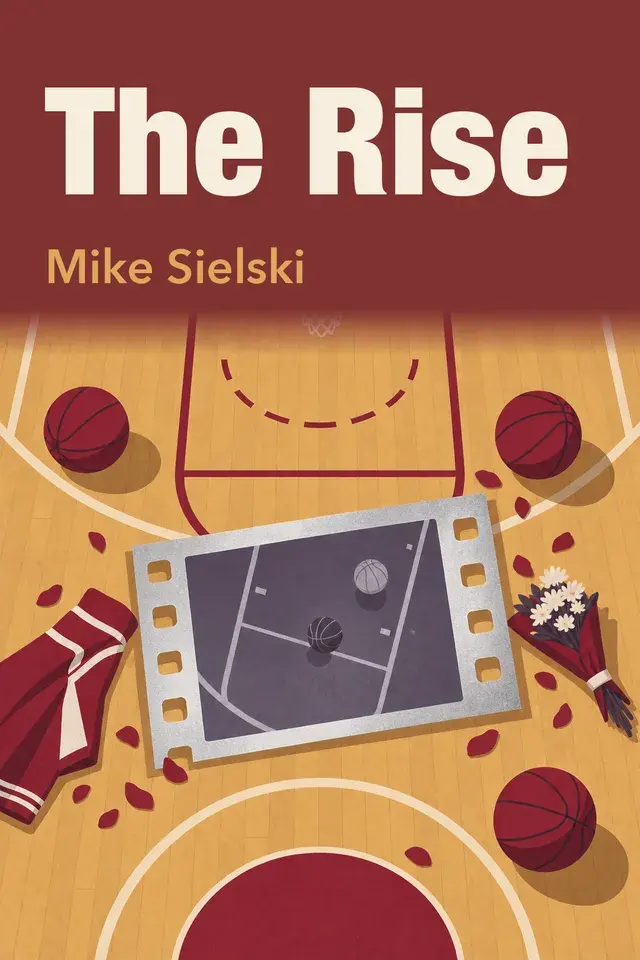
The Rise, by Mike Sielski.
The Rise begins with a fragment of a high school game, not a complete account of a career. That choice places Kobe Bryant’s story in the Philadelphia area, where people who watched him play could remember him as a freshman. The recording is a local point from which the author looks back. Its modest scale becomes part of its use: a famous life enters through a moment that a few people could identify from their own school years.
The author received the footage from Ben Relles, an Upper Dublin high-school classmate and friend, the day after Bryant died. Relles had preserved and digitized the recording. The game was between Lower Merion and Upper Dublin. Relles and the author were seniors; Bryant was a freshman playing his second game of high school.
The surviving short clip lasts thirty-six seconds. Bobby McIlvaine passes to Ari Greis, who drives past Bryant and scores a floater. The play is an ordinary defensive failure made memorable by who is in the frame and by the fact that the recording survived. Years later, Bryant watches it, laughs, and critiques his defense.
The short clip captures one mistake, not Bryant’s whole game. Bryant scored nineteen points in the game. A five-minute excerpt shows him driving and scoring, with the author describing him as commanding attention. That fuller glimpse makes the qualification concrete. The missed stop is real, but it is one small piece of a more varied performance.
Bryant’s amused response turns the old recording into a meeting with his younger self. The author reads the footage as a way to revisit the places, people, and experiences that shaped him. The scene offers a retrospective method for the book: a remembered detail can bring the past near, while the life that followed gives the detail new weight. The footage shows an early version of Bryant without making one possession explain everything he became.
The author places this local memory beside the scale of Bryant’s later career: five championships, fifteen All-Star appearances, 33,643 points, and a 2008 Most Valuable Player award. Those milestones show how far the story’s reach extended beyond one school gym. The footage keeps its beginning grounded in a Philadelphia-area community, while the career gives that beginning a much wider audience.
After Bryant, his daughter Gianna, and seven others died in a helicopter crash on January 26, 2020, the author recalls the news reaching into everyday life. At his son’s youth basketball game, a young opponent wore “KOBE” on his sleeve. That image joins the writer’s personal shock to a larger public attachment to Bryant. The account reports the crash but gives no explanation for its cause.
At Lower Merion, grief gathered at the school itself. Two days after the crash, candles, flowers, jerseys, sneakers, basketballs, and messages surrounded Kobe Bryant Gymnasium. Students stopped there, members of Lower Merion’s 2006 team left a photograph showing Bryant sitting with them, and people traveled to the school to feel close to him. The memorial made shared loss visible in a place already bound to Bryant’s youth.
The offerings grew until they blocked the school doors. Staff moved them to a nearby lawn so people could enter and leave safely. The detail places the work of maintaining the school inside the grief: its community had to care for the memorial while keeping daily access open.
Gregg Downer, Bryant’s high school coach, was initially unable to face the memorial and struggled to process the news. After two days, he returned to speak with players who had met Bryant. He urged them to manage their emotions, return to basketball, and appreciate their health and chance to play. His response links personal mourning to the responsibilities of a school community that continued around him.
The opening moves from one failed defensive possession to Bryant’s laughter, then to a community’s grief. That movement establishes the book’s locally grounded view of a life with much wider reach. Lower Merion’s memory gives the story a human scale; the small clip, and the people who gathered around it, cannot contain the breadth of Bryant’s life or career.
Chapter 2 of 13 · 7 min · Audio & textIn the app
Joe Bryant's Inherited Game
Joe Bryant’s childhood held both security and constraint. His father had come from Dooly County, Georgia, during the Great Migration, found steady industrial work in Philadelphia, and built a home for his family.
Chapter 3 of 13 · 6 min · Audio & textIn the app
Learning Basketball in Italy
At six, Kobe moved with his family to Italy. The move immersed him in another language and culture while changing the family’s daily rhythm.
Chapter 4 of 13 · 7 min · Audio & textIn the app
Lower Merion's Uneven Welcome
When Kobe returned from Italy, Lower Merion was a place with a powerful reputation and a more complicated reality. The Pennsylvania Railroad helped shape the Main Line as a wealthy retreat close to Philadelphia.
Chapter 5 of 13 · 7 min · Audio & textIn the app
Talent Meets Its First Limits
Kobe’s first high-school seasons unfolded while he and his sisters were still adjusting to American teenage culture after Italy. Family, friends, and student groups gave them places to belong.
Chapter 6 of 13 · 7 min · Audio & textIn the app
From Summer Prospect to Junior Leader
Summer 1994 was a development sequence, not a single discovery moment. Kobe filled it with leagues, camps, and AAU travel, gaining repetition against changing opponents.
Chapter 7 of 13 · 8 min · Audio & textIn the app
Myth, Memory, and the NBA Plan
In the closing minutes against Hazleton, Lower Merion was ahead by one and trying to run down the clock. The Aces spread out, but Tariq Wilson dropped the ball and it rolled out of bounds.
Chapter 8 of 13 · 5 min · Audio & textIn the app
Secrecy Under Team Pressure
By Kobe Bryant’s senior year, the question of college or the NBA had become more than a distant possibility. He was privately leaning toward the pros, but only a few trusted people heard him say so directly.
Chapter 9 of 13 · 7 min · Audio & textIn the app
When One Star Becomes the Team
When Lower Merion faced teams capable of matching its level, the question was no longer only how far Kobe Bryant could go. It was also whether the Aces could function as a team around him.
Chapter 10 of 13 · 7 min · Audio & textIn the app
The Cost of Carrying a Team
As Lower Merion moved toward the postseason, winning became both easier and more complicated. The Aces won their last 15 regular-season games, many by wide margins, and crowds and reporters increasingly treated Kobe Bryant’s presence as an event.
Chapter 11 of 13 · 7 min · Audio & textIn the app
Trust at the Championship Turn
The two games that completed Lower Merion’s run tested different parts of Kobe Bryant’s game. Against Chester, the problem was how to score when his legs and his shot had gone.
Chapter 12 of 13 · 10 min · Audio & textIn the app
Choosing the NBA on His Terms
Before the announcement, Kobe Bryant’s choice to enter the NBA without college moved from private intention to public question. At the McDonald’s All-American banquet, he said he could not wait to face the best players and believed he would be ready.
Chapter 13 of 13 · 6 min · Audio & textIn the app
Failure, Work, and Local Memory
Game Five against Utah ended the Lakers’ season and gave the public a simple image of Kobe Bryant’s rookie year. He missed a possible winning shot in regulation, then air-balled three more attempts in overtime.
Chapter 1 of 13 · 5 min · Audio & text: A Local Origin in the Footage
Wiseley supports reading and listening to summaries in the app.
Continue in Wiseley