What you'll learn
Key ideas from The Rise of Superman
These ideas compress the book's argument without treating the author's view as settled fact. Use them as an orientation before reading the full work or listening in Wiseley.
Clear goals, immediate feedback, and a fitting challenge support flow; focus, altered time, and fluid action describe parts of its experience.
Repeated cues can become chunks that help the brain predict events and support quick, coordinated action.
Flow’s intrinsic reward may connect present enjoyment with repeated, demanding practice without guaranteeing mastery.
Consequential risk can focus attention, but physical danger is neither required nor a reliable route to flow.
Struggle, release, flow, and recovery form a cycle, with preparation and rest supporting renewed effort.
Group flow emerges through interaction, when shared attention and action create a collective process beyond parallel individual focus.
Creative choices may help trigger flow, while flow may loosen inhibition and support novel connections.
Flow is morally neutral, and commercial or institutional pressure can turn its rewards into demands.
Inside The Rise of Superman
Read the first chapter in full here. The other 11 continue in the Wiseley app.
Chapter 1 of 12 · 8 min · Audio & text
Why Flow Became the Question
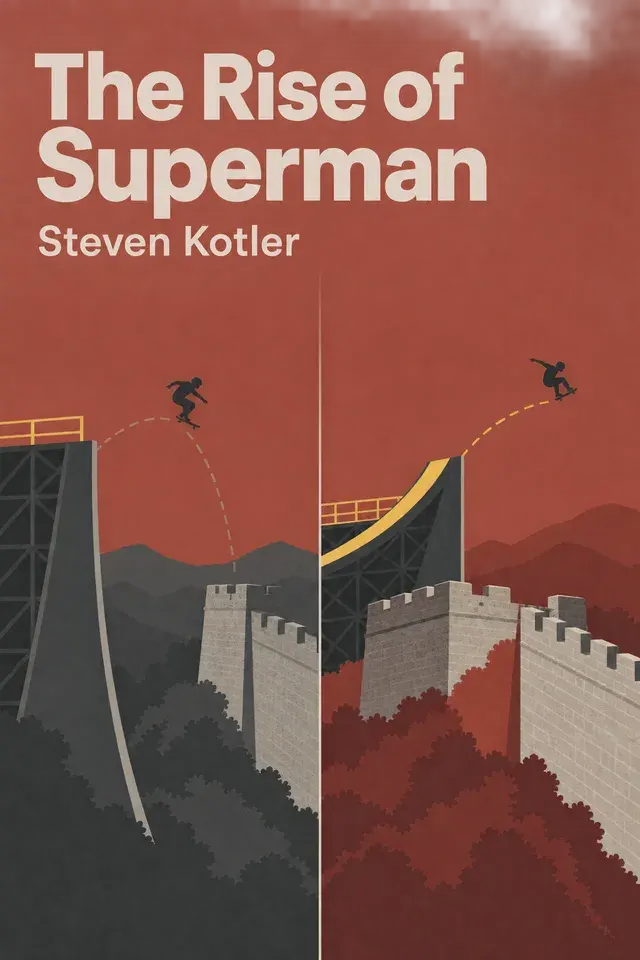
The Rise of Superman, by Steven Kotler.
Over a few decades, action-sport athletes began accomplishing feats that had once seemed beyond human ability. Tricks once treated as impossible became routine, and athletes kept extending what could be done on skis, boards, bikes, and in kayaks. Steven Kotler argues that this progress has been unusually fast. It is easy to miss because these sports can look like spectacle or daredevilry. But the feats raise a serious question: how do people learn to perform so effectively when the consequences of a mistake can be severe?
The question is not only about physical strength or courage. Kotler points to a combination of accumulated advances: earlier achievements, changing technology, and physical and mental training. Yet those factors do not fully answer how someone makes the right movement in a situation that allows almost no room for error. Nor do they tell us where human limits actually lie. The athletes’ performances make the gap between what seems possible and what someone can do newly visible.
Kotler distinguishes “ultimate human performance” from “optimal human performance.” Optimal performance means being at your best; ultimate performance means being at your best when any mistake could kill. The distinction makes the stakes central to the inquiry. Mark Foo’s death after a wipeout at Mavericks shows that those stakes are real. Foo was an experienced big-wave surfer. His death cannot be reduced to a harmless test of skill, and the account does not settle exactly what caused it. For Kotler, it makes the puzzle sharper: people continue to pursue performances in settings where expertise cannot remove the possibility of death.
Danny Way’s skateboard jump over the Great Wall gives that puzzle a concrete form. Way had helped popularize the MegaRamp, a huge structure with a long roll-in, a gap, and a steep quarterpipe. He saw the wall from a plane and decided he wanted to jump it. The construction gap turned out wider than expected, and the finished setup offered little margin for error. Way calculated that the quarterpipe would launch him high above the ramp’s deck. He was not repeating an ordinary contest trick in a familiar setting; he was attempting a first-of-its-kind jump over a major obstacle.
Before the successful jump, Way took a practice run from an unstable launch platform. A BMX rider had died after an earlier wall-jump attempt went wrong. Way’s own run failed. He had trained in thin desert air, but the humid Chinese air slowed him. He came up short, crashed, fractured his ankle, and tore his anterior cruciate ligament, or ACL. Workers then changed the ramp: they lengthened the roll-in and shortened the gap. The adjustment mattered; his return was not simply a repeat of the same attempt under identical conditions.
The following day, barely able to walk, Way climbed back to the platform and made the jump. Kotler presents this sequence as evidence of extraordinary performance, but its parts matter: preparation, a failed attempt, injury, a changed setup, and a return. The episode does not show that confidence or a special mental state makes such a feat safe. Instead, it leaves a more focused question. What lets an athlete coordinate trained movement under pressure, especially when the situation is new and the costs of error are so high?
Shane McConkey’s cliff jump offers a different kind of evidence. He intended to perform a double backflip, but that trick did not come together. Rather than force the original plan, he improvised a spread-eagle leap from the cliff. The moment, which impressed filmmaker Steve Winter, shows how an athlete’s response can change when the intended move fails. It is an example of creative adaptation, not a full explanation of how such decisions happen. Together, Way and McConkey make the central puzzle vivid: these performances demand not only practiced skill but effective action when events do not follow the plan.
Kotler’s answer is flow, a rare and radical state of consciousness in which, he argues, the impossible becomes possible. Way called his experience being “in the zone” and described a peaceful, narrowed focus when a difficult performance came together. For Kotler, this state explains how athletes can act effectively while pushing beyond their abilities, even though it does not establish exactly where human limits lie.
The search for such experiences has a longer history. In 1871, after falling on a mountain, geologist Albert Heim described altered perception: time seemed to slow, his vision widened, and he felt calm enough to think through what might happen next. Heim later surveyed other survivors of falls; 95 percent reported similar anomalous events. Kotler notes that many of Heim’s subjects had not been in actual jeopardy; they only thought they were in life-threatening situations. What caused these experiences remained a matter of long debate.
William James also compared accounts of unusual states, drawing on spiritual writing and his own experiments with drugs. He considered the psychological effects of such experiences real, while entertaining the possibility that ordinary waking awareness was not the only form of consciousness people could experience. These earlier inquiries connected danger and altered perception to broader questions about human capacity. They did not establish that risk itself unlocks exceptional ability, and Kotler does not need them to do so. Their importance here is that people had already begun asking how experience and performance might change under unusual conditions.
Later, Abraham Maslow studied high achievers and questioned whether motivation could be explained only as pursuing rewards or satisfying needs. He observed that focused activity could bring experiences resembling mystical states, including for people who were not religious. Maslow called these moments “peak experiences.” The term gave a secular name to intensely meaningful experiences without requiring a supernatural explanation.
Mihaly Csikszentmihalyi widened the inquiry. Rather than focus only on exceptional achievers, he asked people from varied backgrounds when they felt and performed at their best. He found similarities in how people described those moments, even when the activities differed, and adopted “flow” because interviewees used the word for fluid, seemingly effortless action. In Kotler’s account, this line of research connects peak experience to performance and gives the book its central term.
Action-sport feats show how rapidly performance has advanced, while Foo’s death and Way’s injury make clear that the danger is real. McConkey’s improvisation adds the challenge of responding when a plan fails. Kotler identifies flow as the real reason ultimate human performance has advanced nearly exponentially. The location of human limits, however, remains unresolved.
Chapter 2 of 12 · 7 min · Audio & textIn the app
The Shape of the Flow State
Flow is often called “the zone,” but that phrase can make it sound like one mysterious, uniform experience. A more useful account treats flow as a recurring pattern: attention gathers around an activity, unrelated concerns recede, and action feels unusually direct.
Chapter 3 of 12 · 7 min · Audio & textIn the app
A Brain Releasing Its Grip
Kotler’s account of flow turns on a paradox: a person may act with unusual clarity while some kinds of conscious control recede. Neuroscientist Arne Dietrich proposed that parts of the prefrontal cortex temporarily become less active during flow.
Chapter 4 of 12 · 7 min · Audio & textIn the app
Prediction, Chemistry, and Action
The brain does not wait passively for events to arrive. In Kotler’s account, it uses past experience and current sensory information to anticipate what may happen next.
Chapter 5 of 12 · 5 min · Audio & textIn the app
Practice Through Rewarding Challenge
A remarkable performance lasts only a moment. Mastery raises a longer question: what keeps someone returning to difficult work for years?
Chapter 6 of 12 · 6 min · Audio & textIn the app
Set the Stage for Flow
Flow can be encouraged by the conditions around us. Kotler describes three external triggers that draw attention into an activity: consequential risk, a rich environment, and deep embodiment.
Chapter 7 of 12 · 7 min · Audio & textIn the app
Shape the Challenge and Response
Kotler describes three internal triggers that can make flow more likely: a clear immediate goal, feedback that arrives quickly, and a challenge just beyond current ability. Together, they tie attention to the task at hand.
Chapter 8 of 12 · 6 min · Audio & textIn the app
How Communities Enter Flow
Flow is often described as one person’s absorption in a task. But people can also enter a shared state together.
Chapter 9 of 12 · 6 min · Audio & textIn the app
Creativity, Culture, and Risk
Creativity and flow may strengthen each other. In Kotler’s account, a creative choice can help bring on flow, while flow may make further invention easier.
Chapter 10 of 12 · 8 min · Audio & textIn the app
The Costs of Pursuing Flow
Flow can make difficult action feel absorbing and rewarding, so its appeal may reach beyond a single good experience. Kotler connects that appeal to autonomy, mastery, and purpose: people want to choose meaningful work, grow more capable, and feel that what they do matters.
Chapter 11 of 12 · 9 min · Audio & textIn the app
Imagine and Train New Limits
A record does more than mark a performance. It can change what the next person considers possible.
Chapter 12 of 12 · 5 min · Audio & textIn the app
From Performance to Abundance
The Red Bull Stratos jump gives Kotler a way to connect one person’s performance with problems beyond sport. The project sent Felix Baumgartner by balloon to about twenty-four miles, then into a free fall wearing a pressure suit.
Chapter 1 of 12 · 8 min · Audio & text: Why Flow Became the Question
Wiseley supports reading and listening to summaries in the app.
Continue in Wiseley