What you'll learn
Key ideas from The Revolutionary
These ideas compress the book's argument without treating the author's view as settled fact. Use them as an orientation before reading the full work or listening in Wiseley.
Adams’s influence came from helping turn political ideas into organized popular action, not from directing events alone.
Writs and revenue duties turned disputes over searches and taxation into claims about property, consent, and Parliament’s limits.
Dickinson’s newspaper essays circulated across the colonies; Adams linked Boston groups and sought intercolonial correspondence, later building on Dickinson’s arguments.
The Tea Act promised cheaper tea and relief for the East India Company, but accepting the duty meant recognizing Parliament’s authority to tax the colonies.
The Suffolk Resolves and Continental Association turned sympathy into coordinated political and economic action.
Samuel Adams’s move from unity to independence, and Congress’s divided vote, show that separation was not settled from the beginning.
Adams linked popular sovereignty with education and civic virtue, opposed powerful families and hereditary honors, and backed constitutional checks on majority passions.
Inside The Revolutionary
Read the first chapter in full here. The other 9 continue in the Wiseley app.
Chapter 1 of 10 · 6 min · Audio & text
The Hidden Hand of Revolution
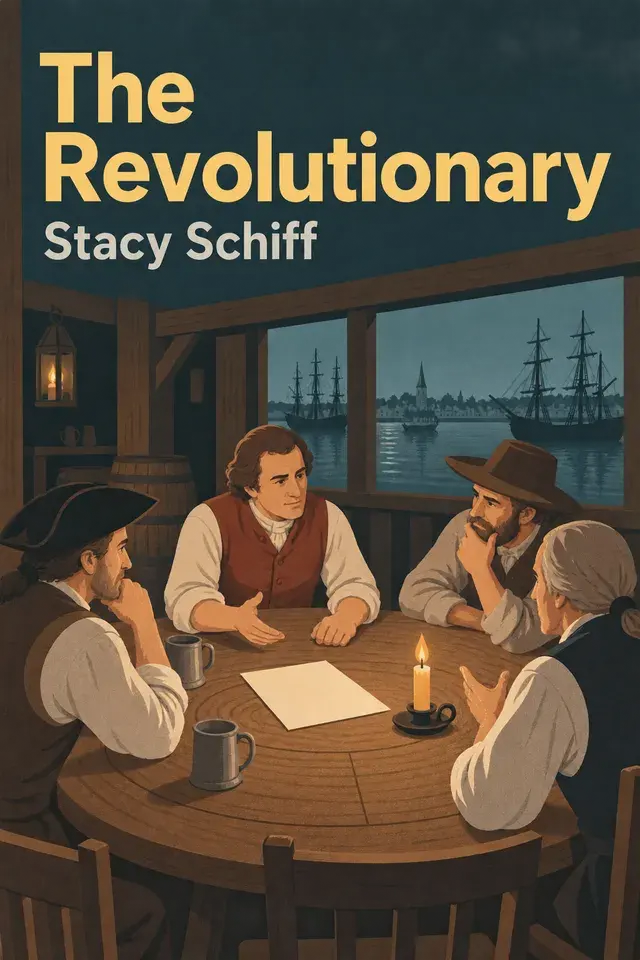
The Revolutionary, by Stacy Schiff.
Samuel Adams presents a problem of historical scale. He helped turn political arguments into popular action, yet the manner of his work makes it difficult to measure how much depended on him. Schiff describes an organizer who could draw ideas from public debate, give them moral force, and move people toward action. That influence was consequential without making him the sole author of the Revolution. The opening asks us to hold both parts together: Adams mattered, but his contribution cannot be reduced to a simple measure of personal control.
A conversation among Massachusetts farmers in a tavern in 1774 makes that problem concrete. They reason about what more taxes and affronts might mean for people like themselves. The question is not merely whether the authorities have acted unjustly; it is how exposed they may become if they wait. Their reasoning turns on sequence and risk. If further injuries are likely, resisting earlier may be safer than allowing power to gather and resisting later. They conclude that an earlier rebellion could be the less dangerous course. Schiff uses this exchange to show that resistance could grow through ordinary people considering consequences together. Its logic belongs to the farmers, even as it illustrates the kind of public reasoning Adams helped animate.
Here, Adams’s importance lies in connecting ideas to action, not in supplying every person with a finished view. He could collect arguments already circulating, frame them as a moral cause, and appeal to feeling as well as reason. This combination helps explain why influence is hard to locate in a single speech or order. Political work also consists of making a claim persuasive, giving it urgency, and helping people see a practical path from judgment to collective behavior. The farmers’ discussion makes the passage from judgment to action audible.
Schiff holds conviction and tactics together. Adams’s belief in liberty and self-government was sincere; at the same time, he worked through indirect, concealed, and sometimes extralegal means. Committees, crowds, aliases, and private meeting places let political work proceed without making his role fully visible. He did not always announce the destination at the outset. Adams’s grandson later put it this way: “Shallow men called this cunning, and wise men wisdom.” Either way, secrecy was part of his method, not evidence that his stated principles were merely a mask.
Secrecy also shaped what could later be known. Adams kept no copies of letters, destroyed correspondence, and concealed connections in order to protect associates. Only two notes between him and Paul Revere survive in Schiff’s example, despite their presumed frequent contact. Adams wrote no memoir and resisted gathering his political writings. The surviving record is therefore thin by choice in part, and it is also incomplete through loss and later handling. Historians must reconstruct his influence indirectly, often from fragments or from observers who opposed him. A missing document cannot prove a missing role, but it limits certainty about what he did and why.
Even during his lifetime, Adams’s influence could be recognized. Hutchinson described him as a leading source of colonial resistance, and Jefferson later praised him as among the earliest and most persistent revolutionaries. But recognition did not settle the account. Later portrayals have alternately vilified, sanitized, or ignored Adams; others have assigned him single-handed direction of major events. Both errors flatten the same problem: the evidence supports an influential organizer, but not an isolated mastermind whose will explains the movement. His role was substantial and shared.
Trumbull’s painting of the Declaration embodies this conflict over credit. Adams is difficult to find among the figures, and his position does not draw the eye. Whigs objected that the laurels of the Revolution had been transferred to others; Tories answered that the background suited Adams’s own preference. The arguments show how the same placement could be read as exclusion or self-effacement. Yet the painting cannot prove deliberate erasure. It is not an exact record of the event: it includes only forty-seven of the fifty-six signers, includes nonsigners, and does not accurately reproduce the room or Adams’s likeness. Its significance here is as a contested image, not a transparent measure of his part.
Schiff’s opening therefore treats the problem of credit as part of the history itself. If Adams is made incidental, the movement’s organizing work disappears; if he is made its hidden director in every instance, popular deliberation and the labor of others disappear. The tavern exchange and the painting point in opposite directions: one makes collective reasoning visible, while the other makes an influential participant hard to see. Together they set the book’s lens. Adams helped people turn political ideas into organized action, while secrecy and later memory make the extent of that contribution difficult to measure.
Chapter 2 of 10 · 13 min · Audio & textIn the app
A Bostonian's Political Education
Samuel Adams’s early years gave no clear sign of the public figure he would become. He received a demanding education at Boston Latin and Harvard, studying classical writers, mathematics, logic, Hebrew, astronomy, and Enlightenment thinkers such as Locke and Montesquieu.
Chapter 3 of 10 · 11 min · Audio & textIn the app
When Taxation Became a Rights Crisis
The Stamp Act crisis turned a complaint about taxes into a dispute about political authority. Could Parliament raise revenue from colonists who had no elected representatives there?
Chapter 4 of 10 · 8 min · Audio & textIn the app
Making a Coalition Across Colonies
The Townshend duties revived a question left open by the earlier repeal: could Parliament tax colonists who had no representatives there? The measures placed duties on imports and directed revenue toward colonial governors and justices.
Chapter 5 of 10 · 11 min · Audio & textIn the app
Print, Occupation, and Contested Violence
When British regiments arrived in Boston, resistance acquired a daily, physical object. Soldiers drilled in the streets, questioned and detained civilians, occupied public buildings, and disrupted trade.
Chapter 6 of 10 · 8 min · Audio & textIn the app
Keeping Resistance Alive in Quiet Times
Once the immediate crisis following the Massacre had subsided, Massachusetts seemed quieter. Hutchinson took the calm as evidence that the conflict was passing.
Chapter 7 of 10 · 8 min · Audio & textIn the app
Tea, Principle, and the Point of Rupture
The Tea Act joined an urgent business problem to a constitutional conflict. The East India Company had warehouses full of tea and faced collapse.
Chapter 8 of 10 · 10 min · Audio & textIn the app
Punishment Makes a Continental Cause
Britain’s answer to Boston’s resistance threatened to make the town an example to the other colonies. Samuel Adams argued that Boston was being punished without a hearing, as though the whole community could be starved for the acts of some of its people.
Chapter 9 of 10 · 8 min · Audio & textIn the app
From Lexington to Independence
By spring 1775, resistance had become more than protest and correspondence. It had also become a contest over who could learn what the other side planned, and how quickly local people could act.
Chapter 10 of 10 · 9 min · Audio & textIn the app
Wartime Duty and a Patriot's Limits
Independence brought no pause for Samuel Adams. In Congress in 1777, he carried a heavy committee workload, with duties touching commerce and military affairs and a place on the committee charged with founding an American navy.
Chapter 1 of 10 · 6 min · Audio & text: The Hidden Hand of Revolution
Wiseley supports reading and listening to summaries in the app.
Continue in WiseleyAbout Stacy Schiff

Stacy Schiff is an American biographer and essayist. “The Revolutionary” explores how Samuel Adams turned disputes over taxation, representation, and military power into collective resistance.
Explore more books by Stacy Schiff