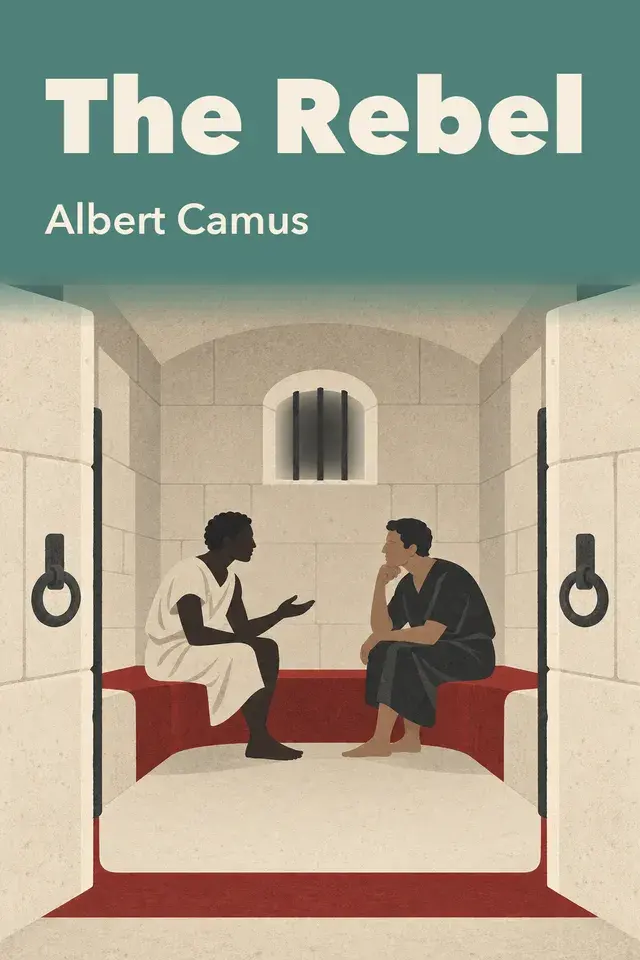
What you'll learn
Key ideas from The Rebel
These ideas compress the book's argument without treating the author's view as settled fact. Use them as an orientation before reading the full work or listening in Wiseley.
Rebellion’s refusal of humiliation also asserts a dignity that can extend beyond the rebel.
Rebellion rises from lived experience toward an idea; revolution starts with an idea and tries to bring historical life into conformity with it.
When unity becomes an absolute aim, freedom can be imposed as a collective duty and coercion can claim to serve liberation.
Marxism’s critique of myths and interests loses its evidential footing when a predicted endpoint is treated as guaranteed.
History is necessary experience, but shared human nature gives rebellion a limit from which historical power can be judged.
Art creates unity by reshaping reality while retaining the life, matter, and feeling from which it begins.
Shared dignity makes murder a contradiction in rebellion, so unavoidable violence must remain exceptional, limited, and personally answerable.
Rights, free expression, dialogue, and workplace unionism support gradual correction grounded in people’s lives.
Inside The Rebel
Read the first chapter in full here. The other 15 continue in the Wiseley app.
Chapter 1 of 16 · 5 min · Audio & text
The No That Says Yes
The Rebel, by Albert Camus.
The Rebel begins with a question made urgent by political violence: when murder is committed in the name of an idea, what makes it seem justified? Camus is not asking only about private guilt. He asks whether people can act in a violent world without claiming the right to kill, or to let others be killed. When crime borrows the language of philosophy, the killer can present himself as a judge and make the innocent answer for their innocence. Understanding this reasoning, rather than merely denouncing it, is the book’s starting task.
Herbert Read’s Foreword adds a brief political warning. He sees modern revolutions as liable to strengthen the central power they set out to replace. That warning makes it important to distinguish a refusal of oppression from the construction of a new government. Read presents this as his framing of Camus’s argument, not as a substitute for the inquiry that follows.
Camus first contrasts crimes of passion with crimes that claim to follow reason. The distinction is imperfect; premeditation is a practical way of sorting crimes, not a complete explanation of their motives. Heathcliff, in Camus’s example, would kill for Cathy. His imagined crime comes from overwhelming attachment, not a theory that declares murder reasonable or lawful. It remains an exceptional transgression. The danger Camus sees in ideological crime is different: once a person argues that murder is justified, the argument can multiply the crime and even claim authority to make it law.
The problem leads back to the absurd: the conflict between the human demand for meaning and a world that supplies no clear answer. Taken as a rule for conduct, this awareness can make every choice seem equivalent. If nothing has value, murder may seem no worse than care. Inaction offers no clean escape, since it may leave another person to be killed. With no standard beyond effectiveness, strength can become the measure, dividing people into masters and slaves. Murder then appears not merely possible, but privileged.
Yet this is not where Camus’s reasoning ends. The absurdist rejects suicide because it would end the very encounter with the world’s silence that gave the absurd its meaning. Life is therefore a condition the inquiry depends on. If the absurdist treats his own continued life as worth preserving, Camus asks why that value should belong only to him. Calculated murder cannot comfortably coexist with this reliance on life; the reasoning that seemed to permit murder begins to undermine its permission.
That contradiction does not turn the absurd into a finished moral code. To live and argue that nothing matters already involves choices and gives the argument some significance. Absurdist awareness can expose a condition and challenge easy answers, but it cannot, by itself, decide which actions are right. Camus treats it as a point of departure. Its impasse redirects the inquiry toward rebellion: the protest within the absurd that refuses an intolerable condition and demands an answer.
A rebel, in Camus’s opening account, says no without rejecting everything. The example is a slave who has long obeyed and finally refuses a degrading order. The refusal marks a boundary: the master’s authority has gone too far, and there is something the slave will no longer surrender. Before speaking, the slave may have endured injustice without naming a right. The refusal turns that experience into a judgment. It says, in effect, that this treatment is not acceptable and should not be imposed.
The no therefore contains a yes. The slave’s refusal does not defend only a passing preference; it reveals a part of the self the slave believes deserves respect. As the claim becomes clearer, rejecting one humiliating command can become a demand to be treated as an equal, rather than as property or an inferior. The value may be obscure at first, and the rebel may not yet have a complete account of it. But the refusal already moves from what has happened to what ought to be. It may become important enough to risk even life itself.
This is the test the opening sets for any later account of rebellion: identify what the refusal protects, then ask whether the value belongs only to the person asserting it. A demand for equal treatment points beyond the rebel, toward a dignity that others can also claim. Rebellion becomes intelligible not through its no alone, but through the yes that gives the refusal meaning. Camus’s historical survey is a working hypothesis, not an exhaustive explanation or the only possible reading of the past. Its purpose is to examine where rebellion’s claims lead, and whether their reasons can guide action without turning refusal into another license to rule.
Chapter 2 of 16 · 6 min · Audio & textIn the app
Ancient Measure and Cosmic Revolt
Camus takes the inquiry from a wrong imposed by one person on another to the conditions of existence itself. Metaphysical revolt asks whether a world containing suffering, evil, and death can be just.
Chapter 3 of 16 · 6 min · Audio & textIn the app
Sade's Prison of Freedom
Camus uses Sade to test what happens when a protest against injustice grants itself unlimited freedom. Sade’s long imprisonment helps explain the force of his anger, but Camus does not treat every speech by a fictional character as the author’s settled position.
Chapter 4 of 16 · 6 min · Audio & textIn the app
Romantic Defiance and Ivan's Test
Romantic revolt sharpens the question of evil by making defiance itself compelling. When goodness is identified with God, the rebel may treat opposition to God as a reason to choose evil.
Chapter 5 of 16 · 6 min · Audio & textIn the app
Nihilism Seeks an Affirmative
Stirner carries nihilistic revolt to its starkest image: humanity has been destroyed, and the singular individual sits alone as its king. The imagined ruler laughs over humanity’s tomb.
Chapter 6 of 16 · 6 min · Audio & textIn the app
Poetry Between Revolt and Conformity
Poetry lets Camus test rebellion in a form that moves quickly between thought and action. A poet may denounce an unjust world, then discover that the wish to destroy its limits also destroys the value the protest meant to defend.
Chapter 7 of 16 · 6 min · Audio & textIn the app
From Refusal to Revolution
Rebellion begins close to the ground. Someone refuses a wrong imposed on them, and in that refusal asserts a claim that can be shared.
Chapter 8 of 16 · 6 min · Audio & textIn the app
The People Become Sovereign
Camus begins with a conflict between grace and justice. Under divine-right monarchy, the king might protect people from aristocratic or bourgeois power, but that protection depended on his discretion.
Chapter 9 of 16 · 6 min · Audio & textIn the app
History's Master and Slave
Camus turns to Hegel to explain why historical struggle can seem to produce meaning, rather than merely destroy it. In this view, people are not finished beings who simply discover fixed truths.
Chapter 10 of 16 · 5 min · Audio & textIn the app
Terror Under Personal Limits
Camus shifts from arguments about history to the people who tried to make revolution by force. Their actions pose a practical question: can a cause retain limits when it claims to destroy every old rule?
Chapter 11 of 16 · 6 min · Audio & textIn the app
The State's Revolutionary Logic
Camus turns from the rebel’s responsibility for an act of violence to the institutions that can make violence a normal method of rule. He asks how revolutions that promise freedom repeatedly enlarge central power.
Chapter 12 of 16 · 7 min · Audio & textIn the app
Marxism's Promise on Trial
Marx begins from a material fact: people must produce what they need to live. For him, the way a society organizes production shapes its relationships, its conflicts, and the ideas people hold.
Chapter 13 of 16 · 7 min · Audio & textIn the app
Prophecy Becomes Political Rule
Camus does not dismiss Marxism’s original critical force. He credits it with rejecting myths and exposing the interests concealed beneath respectable explanations.
Chapter 14 of 16 · 5 min · Audio & textIn the app
Empire and the Historical Tribunal
Once history is treated as the final court of appeal, political rule acquires a tribunal without a stable law. The official claim is that present actions can be judged by their contribution to future liberation.
Chapter 15 of 16 · 6 min · Audio & textIn the app
Art Gives Rebellion Form
Camus turns to art as a positive answer to the failures of total negation. Artistic creation rejects what is missing from the world, yet depends on what the world gives.
Chapter 16 of 16 · 6 min · Audio & textIn the app
Measure, Violence, and Love
At the end of Camus’s argument, a political cause is judged by what it allows people to do to one another now. Rebellion begins by resisting humiliation, but it also discovers that the dignity at stake is shared.
Chapter 1 of 16 · 5 min · Audio & text: The No That Says Yes
Wiseley supports reading and listening to summaries in the app.
Continue in WiseleyAbout Albert Camus
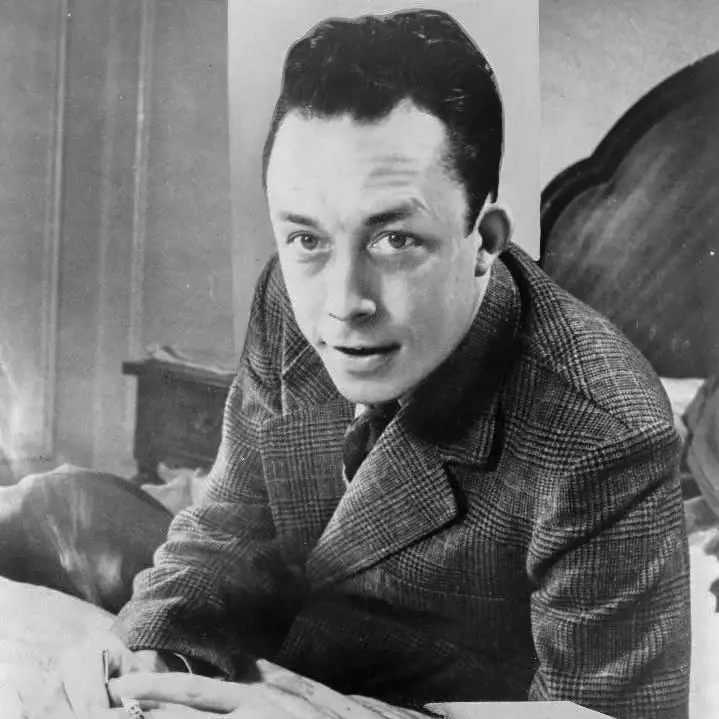
Albert Camus was a French philosopher and writer. “The Myth of Sisyphus” explores the tension between the human search for meaning and an indifferent world.
Explore more books by Albert Camus