What you'll learn
Key ideas from The Pursuit of Excellence
These ideas compress the book's argument without treating the author's view as settled fact. Use them as an orientation before reading the full work or listening in Wiseley.
Excellence measures movement toward personal potential, while success mainly measures position relative to other people.
An effective personal process is distinctive, repeatable, and revisable when evidence exposes a better way.
Disciplined repetition turns imperfect attempts and small progress into dependable quality, accumulated capability, and trust.
Small minimums, rituals, and redesigned environments reduce starting friction more reliably than symbolic dates or willpower alone.
Durable excellence draws energy from love of meaningful work, not willpower or external rewards alone.
Three-hundred-sixty-degree feedback broadens self-assessment into an accountable development process.
Confidence grows through preparation, execution, repeated exposure, and the memory of results.
Excellence remains a lifelong process because mastery depends on correction, humility, and beginner’s mind rather than arrival.
Inside The Pursuit of Excellence
Read the first chapter in full here. The other 9 continue in the Wiseley app.
Chapter 1 of 10 · 6 min · Audio & text
Define Excellence as Becoming
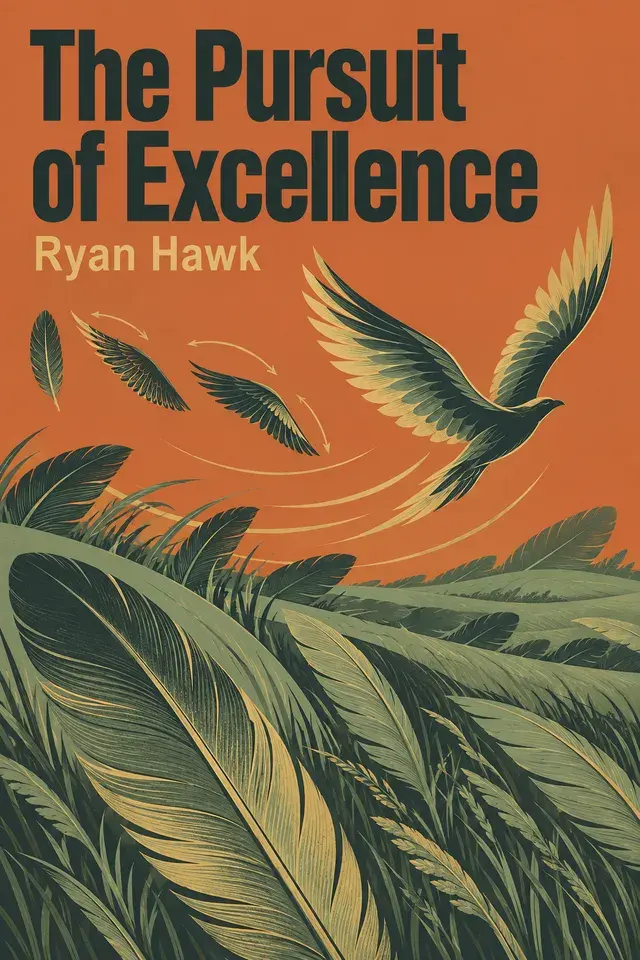
The Pursuit of Excellence, by Ryan Hawk.
Excellence begins with a different question from success. Success asks how our results compare with other people’s. Excellence asks whether today’s choices move us toward our own potential, and whether tomorrow’s self can be more thoughtful, intentional, and purposeful than today’s. The standard is not a permanent rank. It is the direction of becoming.
That distinction changes what we study. Hawk describes reverse-engineering excellence: observe people or organizations that sustain exceptional performance, break results into actions, behaviors, habits, rituals, and sequences, then ask which parts came from intention rather than luck. The Wright brothers’ study of birds illustrates the method. They examined wing angles, balance, air movement, and equilibrium to understand the mechanics behind flight. For Hawk, high performers can be approached in the same way. Their visible results are clues; the useful subject is the repeatable behavior underneath.
Study alone is not enough. The pursuit requires movement, action, effort, and exertion. Observations become useful when tested through questions, experiments, and choices about what to continue or stop. Small, smart decisions matter because consistency and time allow improvement to compound. That is why excellence is not a single breakthrough or a final win. One summit creates another, and the infinite-game frame keeps progress and endurance at the center.
Why keep going when ordinary success might be easier? Hawk answers with the idea that giving less than one’s best wastes a gift. This does not make struggle pleasant or guarantee a simple path. The book presents the harder path as more fulfilling because it meets inevitable problems directly. Competition becomes a test of personal endurance and improvement: are we better than our previous selves, asking better questions and making more purposeful choices? Excellence also links improvement with usefulness, service, gratitude, and the desire to honor the people who supported us.
Purpose follows the same developmental logic. The chapter rejects the assumption that purpose must arrive fully formed and separates purpose from immediate enjoyment. Hawk’s move into telephonic sales first felt humbling and disconnected from his childhood ambition. Meaning grew after he applied his competitive work ethic, improved his skill, helped customers, teammates, and his manager, and found autonomy, challenge, relationships, and useful results. His later podcast illustrates a skill-purpose loop: curiosity sharpened his questions and listening, stronger skill increased fulfillment, and better work opened new opportunities. Passion, in this account, can follow engaged mastery rather than precede it.
The chapter therefore questions advice to follow a predefined passion. It does not deny genuine interests. It argues that many people do not begin with a clear one, and that enjoyment is a poor test when work is difficult or unfair. Satisfying work is tied more clearly to qualities that can be developed—autonomy, mastery, relationships, relevance, and self-worth—than to matching an interest selected in advance. The text also cites research connecting purpose with lower stress-related indicators, better functioning despite pathology, and lower mortality risk. Those findings support the wider point that purpose reaches beyond immediate job satisfaction.
Growth mindset keeps this construction open. Dweck’s distinction contrasts a fixed mindset, which treats inherited traits as limits, with a growth mindset, which treats them as starting points for extensive development. The difference is not simply adopting an optimistic label. It is how a person responds to difficulty. A growth orientation allows unsolved problems, values effort and process, and treats mistakes as information about what still needs work. A fixed orientation protects the image of being smart; a growth orientation is willing to find a deficiency and overcome it. Ability, purpose, and identity therefore remain developable rather than fixed.
Together, reverse-engineering, purposeful work, and growth mindset define excellence as intentional, unfinished improvement. Exceptional performance becomes something to study, purpose something to build, and ability something to develop. The pursuit stays open because every result can reveal a better question, a better behavior, or a further edge of potential. Excellence is not arrival. It is continued becoming.
Chapter 2 of 10 · 7 min · Audio & textIn the app
Design a Process That Improves
Excellence becomes practical when it is designed into how a person sees, thinks, relates, and works. The aim is not to copy a champion's routine.
Chapter 3 of 10 · 7 min · Audio & textIn the app
Make Consistency Your Competitive Edge
Excellence is not proved by a single impressive result. It is built when attention returns to the work that can be done today.
Chapter 4 of 10 · 7 min · Audio & textIn the app
Use Resistance to Build Progress
Resistance is not only a crisis that arrives from outside. It can be the quiet belief that a present limit is permanent, the friction of beginning, the discomfort of practice, or the fantasy that a symbolic decision will change a life.
Chapter 5 of 10 · 6 min · Audio & textIn the app
Find Fuel for the Pursuit
Excellence lasts when a person has a reason to return after novelty fades, rewards fluctuate, and willpower weakens. Ryan Hawk locates that fuel in meaningful work: work that brings someone alive, uses their potential, and affects other people.
Chapter 6 of 10 · 8 min · Audio & textIn the app
Learn Faster Through Other People
Excellence is not a solo construction project. Other people supply missing information, challenge distorted self-assessments, and reveal possibilities solitary effort cannot see.
Chapter 7 of 10 · 7 min · Audio & textIn the app
Train Confidence to Act
Confidence, in the author's account, is not a personality gift reserved for naturally bold people. After more than four hundred interviews, he identifies it as a recurring quality among thoughtful leaders.
Chapter 8 of 10 · 7 min · Audio & textIn the app
Turn Preparation into Opportunity
Preparation earns its meaning when it can be used at the moment an opportunity appears. The author treats opportunity as brief and unpredictable, not as a reward that waits for someone who feels completely ready.
Chapter 9 of 10 · 7 min · Audio & textIn the app
Make Trust the Operating System
Excellence can begin as private competence, but it becomes durable influence only when people feel safe relying on it. This chapter treats relationships as an operating system, not a decorative advantage.
Chapter 10 of 10 · 7 min · Audio & textIn the app
Keep Mastering and Leave Tracks
Excellence has no arrival point. Hawk’s closing argument is that continued correction is the work itself.
Chapter 1 of 10 · 6 min · Audio & text: Define Excellence as Becoming
Wiseley supports reading and listening to summaries in the app.
Continue in WiseleyAbout Ryan Hawk

Ryan Hawk is the author of “The Pursuit of Excellence”. The book explores how a person can pursue excellence without treating success as a finish line.
Explore more books by Ryan Hawk