What you'll learn
Key ideas from The Purpose Myth
These ideas compress the book's argument without treating the author's view as settled fact. Use them as an orientation before reading the full work or listening in Wiseley.
The Purpose Myth expects one job to supply income, identity, meaningful contribution, and growth, though those needs may be met unevenly.
A personal why can connect a self-directed project to values and identity, giving creative work an internal source of motivation.
Repeated why questions can reveal an underlying cause that a description of the visible problem misses.
A focused How might we brief connects a specific human problem with an insight while leaving room for different solutions.
A solution must seek a clear change in what its audience thinks, feels, or does.
A minimum viable project keeps investment small while attracting and benefiting first paying customers; the wider Purpose Project need not earn income or be a product.
Useful KPIs measure attitudes, behaviors, or business results reliably and quantitatively against the project’s intended change.
Paid work can provide necessary income without defining identity or carrying every source of purpose; love and relationships matter in their own right.
Inside The Purpose Myth
Read the first chapter in full here. The other 9 continue in the Wiseley app.
Chapter 1 of 10 · 6 min · Audio & text
The Euro That Became a Project
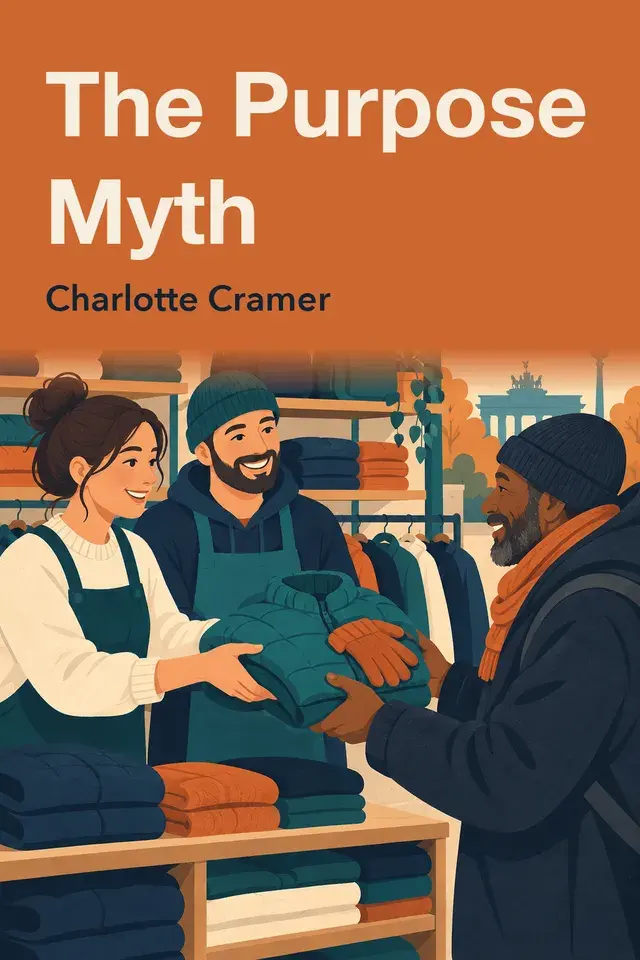
The Purpose Myth, by Charlotte Cramer.
In Berlin, Charlotte Cramer and her friend Scarlett Montanaro were asked by a man experiencing homelessness for a euro. They declined. Soon afterward, they spent seven euros on coffee. The contrast stayed with them: they thought of themselves as compassionate, yet had just refused a small request for help while spending more on themselves. Cramer confessed that she had never given money to someone on the street and asked Scarlett whether she ever gave when homeless people asked; their conversation then turned to why giving felt so difficult.
Their answer was uncertainty. They worried that cash might be spent on drugs or alcohol, and wondered whether people would give more readily if they knew exactly what their money provided. That was their hypothesis, not a settled explanation for why people hesitate to donate. Cramer says the question of whether money might be spent on the wrong things is complex.
In the weeks after Berlin, Cramer and Scarlett spoke with friends and people who had experienced homelessness. One man confirmed their worry by saying that people thought he might spend money on crack and cider. His remark cemented the idea and name CRACK + CIDER: a shop where customers could buy essential goods for people experiencing homelessness, which the founders would distribute. At first, their ambitions ran far ahead of a test: they imagined warehouses, a delivery fleet, jobs for people personally affected by homelessness, and a much wider range of goods and services. Those were plans they dreamed up, not things they had already built. The project then remained unrealized for about a year.
When Cramer and Scarlett met again about a year later, they agreed to try a smaller, manageable version, though they still made no plans. Later, at a party, a conversation about homelessness turned to posters warning that street donations might fund alcohol or drugs. Cramer recognized this as the same concern she and Scarlett had discussed in Berlin. She told the group she was already working with a friend to launch the shop. A shop owner there immediately offered them space, asking when they wanted to use it. Having someone else invest in the idea made it harder to leave as a possibility. The founders wanted to test whether the shop model could work without spending heavily. A single product for a single week seemed too limited to offer customers enough value, so, drawing on user research, they chose five essential options: an umbrella, a jacket, a backpack, a fleece, or a set of a hat, socks, and gloves.
They kept the first version practical by connecting to things that already existed. Shelters and soup kitchens could distribute the goods where supplies were short. Shopify templates provided the online shop, wholesalers supplied and delivered stock, and the founders made simple photos and materials themselves. The project became an online and pop-up shop rather than a new system for manufacturing products, running kitchens, or hiring a large staff. Cramer worked on it around freelance work, while the founders shared deadlines and daily tasks.
They also set a modest sales target, even though naming a goal meant risking a visible failure. Having spent 614 pounds, they aimed for 1,000 pounds in sales. On November fourth, 2015, more than 200 people came to the small shop and launch event. Within three weeks, hundreds of customers had bought more than 5,000 pounds of stock. By the sixth week, sales had reached 36,000 pounds, enough to provide items to guests at all thirteen partner shelters. The early results showed demand for the offer; they did not mean the project had solved homelessness.
The work also challenged how people encountered one another. People experiencing homelessness told the founders that being ignored or looked through could be especially painful. At talks, the founders gave attendees gloves to pass to someone on their way home, as a simple opening for contact. One friend later said she had given gloves to a man she saw every day, and only then realized she was seeing him as a person for the first time. She recognized that stereotypes and fears had shaped how she had treated him. The exchange could not fix the larger problem, but it made an ordinary interaction harder to overlook.
The name CRACK + CIDER was meant to provoke questions about the stereotypes attached to homelessness and addiction. The founders hoped that making those assumptions visible could help people examine how they formed and how they affected others. But the same provocation drew serious criticism. Before the launch, a caller told Cramer the project was wrong and should stop. At the event, he took the microphone and denounced the founders as poverty pimps. Other critics argued that the project repeated harmful stereotypes and profited from them.
The founders said they took no money from purchases, wanted to expose prejudice, and were open to learning. They even offered to let critics distribute the products. Those explanations did not settle the dispute. The criticism grew to include online threats and the posting of personal information about the founders. They considered quitting, but continued because useful items were reaching people as cold weather approached. The backlash showed that a good intention did not ensure that others would experience the project as helpful, or agree with its way of making a point.
Cramer also cautions anyone starting a project alongside paid work to check their employment contract and local law first. Some agreements may restrict outside work or claim rights to any intellectual property created while a person is employed, regardless of whether it was created during working hours or using company equipment. CRACK + CIDER began with one uncomfortable refusal and became a bounded effort to meet concrete needs. Its first results offered evidence that a small project could help, while its public response forced its creators to face the assumptions and risks built into their approach.
Chapter 2 of 10 · 8 min · Audio & textIn the app
Purpose Beyond the Paycheck
A job can provide income, but people often ask it to do much more. They may expect work to explain who they are, show what they value, let them contribute to something worthwhile, and keep them learning.
Chapter 3 of 10 · 7 min · Audio & textIn the app
Motivation That Builds Capacity
A self-directed project asks for effort without always providing the structure of a job. There may be no manager checking in, praise for each milestone, or penalty for stopping.
Chapter 4 of 10 · 10 min · Audio & textIn the app
Make Room to Begin
Wanting to do meaningful work does not add hours to a day, but it can change how existing time is used. Cramer questions the familiar equation of hours with progress: productivity varies, and time spent on an open task does not tell us what moved forward.
Chapter 5 of 10 · 8 min · Audio & textIn the app
Find the Problem Worth Solving
A project is more likely to help when it begins with a problem people actually experience, rather than an appealing solution its creator already has in mind. The author sets out four stages: identify and focus a problem, understand the people affected, write a focused brief, and then develop a solution.
Chapter 6 of 10 · 5 min · Audio & textIn the app
Turn Insight Into an Idea
Once a brief has defined the problem and the person it concerns, the work shifts to finding a response. This fourth stage begins by opening up possibilities, then narrows them to an idea that fits the problem.
Chapter 7 of 10 · 8 min · Audio & textIn the app
Make the Idea Testable
Once an idea has been chosen, it needs to become an offer people can understand and try. The aim is to make the project small enough to test, while preserving enough value to help its first users.
Chapter 8 of 10 · 9 min · Audio & textIn the app
Build a Workable Project
A concept becomes a project through work people can actually carry out. Once the project’s scope and measures are clear, the next step is to turn its plan into a sequence of actions.
Chapter 9 of 10 · 9 min · Audio & textIn the app
Bring the Project to People
Making something useful does not make it visible. The author says a project’s effort cannot affect people until they engage with it, and that engagement rarely happens by accident.
Chapter 10 of 10 · 8 min · Audio & textIn the app
Purpose as an Ongoing Practice
Once a project begins to work, purpose raises a second question: how can its contribution last and reach more people? Repeating a useful method can extend its impact without asking one founding team to do every task.
Chapter 1 of 10 · 6 min · Audio & text: The Euro That Became a Project
Wiseley supports reading and listening to summaries in the app.
Continue in Wiseley