What you'll learn
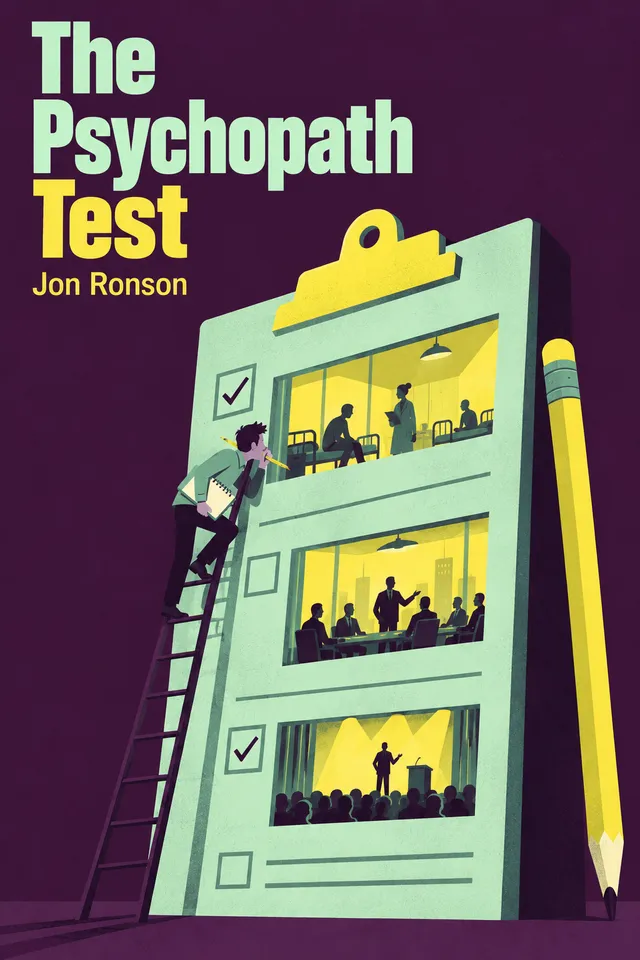
Key ideas from The Psychopath Test
These ideas compress the book's argument without treating the author's view as settled fact. Use them as an orientation before reading the full work or listening in Wiseley.
Tony’s testimony, hospital records, the assault described in his file, and Maden’s clinical opinion offer different kinds of evidence without resolving the diagnosis.
The checklist organizes observations into a score, but thresholds require judgment and do not establish a definitive boundary or future conduct.
Bob said prisoners welcomed researchers, while CEOs and politicians were harder to reach, limiting what prison research could show.
Traits, forecasts, and single-company examples cannot explain outcomes alone; incentives, assumptions, and consequences belong in the same account.
Media attention helps decide which unusual beliefs audiences recognize as madness, and Ronson sees journalists as part of that boundary.
A criminal profile can guide an investigation, but resemblance to an archetype does not establish identity.
A careful judgment names conduct and risk, considers history and change, and keeps accountability alongside a person’s ordinary qualities.
Inside The Psychopath Test
Read the first chapter in full here. The other 11 continue in the Wiseley app.
Chapter 1 of 12 · 8 min · Audio & text
The Puzzle That Started Everything
The Psychopath Test, by Jon Ronson.
At a Bloomsbury café, neurologist Deborah Talmi places an odd package in front of Jon Ronson. It was mailed from Gothenburg with an unsigned promise that the sender would explain more on returning. Inside is a costly, forty-two-page book, though text appears on only twenty-one pages. The cover shows M.C. Escher’s Drawing Hands, two hands drawing each other. The title is Being or Nothingness, and the author is named as Joe K. A page listing publication details has been removed. A warning sticker directs readers to a letter to Professor Douglas Hofstadter before reading further. The book also has cryptic verses, cut-out words, blank pages, and a hole through one page. These features are visible clues; what they mean is not yet clear.
Deborah learns that identical packages reached academics in several fields. The recipients begin discussing the book online, proposing a Christian allegory, a religious campaign, an expensive marketing effort, or an attempt to recruit selected scholars. Many assume that their own inclusion must be significant. Deborah offers a more self-referential possibility: perhaps the puzzle works by making recipients focus on why they were chosen, turning their attention back on themselves. She even notices that Levi Shand’s name can be rearranged as “Live Hands,” echoing the cover. It is an elegant connection, but a connection alone cannot establish the theory. Ronson agrees to investigate the book’s origin and purpose.
His curiosity is not detached from his own worries. Before Deborah’s invitation, he had called religious leader Dave McKay psychopathic while admitting he knew little about the subject. McKay threatened legal action, and Ronson panicked and apologized. Dave replied right away, thanking him and saying his respect for Ronson had risen. Ronson thought he had once again worried about nothing. When Ronson later visits Deborah’s workplace, he privately hopes she might offer him a brain scan because his anxiety has become severe. He does not reveal this motive. On the flight to Gothenburg, he also worries about lapses in his memory and fears a decline like his father’s. The book gives him an investigation to pursue while his personal questions remain just beneath the surface.
At a psychology department, James tells Ronson about research by Essi Viding. In a story James recounts, a man shown a frightened face cannot name the emotion, but says it is the expression people make just before he kills them. The unsettling anecdote leads Ronson to wonder about empathy and psychopathy, and whether low empathy might be found among powerful corporate or political figures. He has no evidence here that settles those wider questions. He considers pursuing them, then backs away, partly because his anxiety is already consuming him. The book’s puzzle and his interest in psychopathy begin as parallel inquiries, not as answers to one another.
In Gothenburg, Ronson traces a possible local lead to Petter Nordlund, whose name appears in a library archive as the book’s English translator. A company is also associated with him. Ronson knows that a translator may know little about a project’s authors, so the lead is suggestive rather than conclusive. Meanwhile, Deborah tells him about Shand, an Indiana University student who says he found eight copies beneath a railway bridge and took them to Hofstadter after seeing his name in the book’s letter. Shand also tells a story in which one French girl answers Hofstadter’s door and other girls are in the next room. The bridge echoes the book’s account of a manuscript left at an abandoned station, giving the tale a satisfying shape—and another reason to check it carefully.
Deborah doubts that Shand exists and suspects the story is a fabrication. Ronson contacts him by video and finds a real student. Shand says that he found the books and visited Hofstadter, though he allows the women may have been Belgian rather than French. This supports Shand’s existence and account of contact, but it does not independently verify every detail. In particular, the discovery beneath the bridge remains Shand’s report. Hofstadter later confirms that Shand delivered a few copies, while rejecting the harem story and saying much of Shand’s account was fabricated. The evidence is mixed: some parts of the story gain support, others are disputed.
Ronson’s conversation with Hofstadter complicates the idea that the mathematician and scholar might have designed the whole puzzle. Ronson finds him serious and focused on questions of consciousness and the soul. Hofstadter says he was an innocent recipient and that the anonymous author sent him many copies. He portrays the communications as obsessive and the project as the work of someone who believed they had found a key to the universe. That is Hofstadter’s explanation of the clues, not a complete account of the sender’s identity or motive. His interview gives Ronson a strong reason to reject parts of Shand’s sensational story, while leaving the book’s larger purpose uncertain.
Ronson eventually meets Petter and tells him that he thinks he wrote the book. Petter calls it an easy guess, then denies authorship. When Ronson asks why particular people received copies, Petter becomes animated, as if delighted by the question. Lily, Petter’s wife, quickly interrupts: how would Ronson know who got the book? Petter only translated it. Petter ends the visit by saying he has already said more than he should. A later email hints that one stage of the project may soon be over and others might continue it, but offers no concrete explanation. Petter’s words and reactions do not amount to a confession, and he does not explain the project. Still, Ronson says that, as he watched Petter at their meeting, it quickly became obvious to him that Petter was the culprit. Weeks later, he told Deborah he had solved the mystery, taking Hofstadter’s description of the author as a crackpot as his explanation. The motive remains unclear.
By this point, Ronson can separate what has support from what is inferred. The book and its unusual design are real; Shand is real, and Hofstadter confirms that Shand delivered some copies. The bridge story and much of Shand’s account are not independently established. Deborah’s theories connect details but remain theories. Ronson concludes Petter was the culprit and later tells Deborah he has solved the mystery, though Petter denies authorship; the motive and project’s purpose remain unclear. That conclusion is Ronson’s inference, not a confession. This is the chapter’s first lesson in investigation: clues invite interpretation, but a compelling pattern is not proof. The book has prompted questions about its origin and psychopathy; Ronson reaches a conclusion about the culprit, while his broader questions remain open.
Chapter 2 of 12 · 8 min · Audio & textIn the app
Tony and the Unsettled Diagnosis
Ronson wants to know whether a psychiatric diagnosis can be trusted when it carries serious consequences. Tony’s case gives him reasons to doubt the diagnosis, then reasons to take it seriously.
Chapter 3 of 12 · 8 min · Audio & textIn the app
An Experiment in Empathy
Ronson shifts from diagnosis to the question of treatment. At Oak Ridge, Elliott Barker tried to help people labeled criminal psychopaths develop empathy.
Chapter 4 of 12 · 6 min · Audio & textIn the app
How the Checklist Was Built
Hare’s path to a checklist began in prison, where he worked as a psychologist in the 1960s. He says repeated deception by inmates pushed him to look for signs of psychopathy behind an ordinary appearance.
Chapter 5 of 12 · 5 min · Audio & textIn the app
Psychopathy Beyond Prison
When Ronson asks how he can know whether Tony in Broadmoor is a psychopath, Bob reflects that he should not have done all his research in prisons; he should have spent time inside the Stock Exchange too. His suggestion leads to a broader claim: psychopathic people in corporate, political, and religious leadership can damage economies and societies.
Chapter 6 of 12 · 7 min · Audio & textIn the app
Charm, Performance, and Constant
Emmanuel “Toto” Constant made Ronson wonder how much a person’s manner can tell us about what he feels. Constant was easy to talk to, but the stories attached to him were grave.
Chapter 7 of 12 · 10 min · Audio & textIn the app
Corporate Rewards for Callousness
After considering how powerful people can use charm and confidence, Ronson turns to a different question: what happens when a company rewards decisive, unsentimental behavior? Sunbeam’s plant in Shubuta, Mississippi, makes the consequences visible.
Chapter 8 of 12 · 6 min · Audio & textIn the app
Making Madness into Entertainment
Ronson turns the scrutiny back on his own work as a journalist. He has pursued Dunlap’s unusual traits and hoped for a more pathological story.
Chapter 9 of 12 · 8 min · Audio & textIn the app
Conspiracy, Testimony, and the Madness Boundary
A survivor’s account can seem like direct evidence until listeners reject the event it describes. Jon Ronson follows Rachel North, who survived the July 7 bombing, as people in conspiracy communities reinterpret her account and, in some cases, deny that the attacks happened.
Chapter 10 of 12 · 7 min · Audio & textIn the app
When Profiles Become Proof
A criminal profile can help investigators decide what to look for. The danger begins when a plausible description becomes evidence that a particular person committed a crime.
Chapter 11 of 12 · 10 min · Audio & textIn the app
The Expanding DSM Checklist
The effort to make psychiatric diagnosis more consistent gained force after psychologist David Rosenhan tested how hospitals interpreted a symptom. He and seven people with no psychiatric histories entered hospitals using assumed names.
Chapter 12 of 12 · 7 min · Audio & textIn the app
A Person Is More Than a Score
Ronson’s return to Tony brings the argument to a concrete decision: how to acknowledge a terrible offense and still assess the person, history, and risk before you. Tony had spent years in Broadmoor’s Dangerous and Severe Personality Disorder unit and repeatedly sought a tribunal.
Chapter 1 of 12 · 8 min · Audio & text: The Puzzle That Started Everything
Wiseley supports reading and listening to summaries in the app.
Continue in Wiseley