What you'll learn
Key ideas from The Prodigal God
These ideas compress the book's argument without treating the author's view as settled fact. Use them as an orientation before reading the full work or listening in Wiseley.
The parable challenges insiders who treat respectability as proof of closeness to God and resent mercy for outsiders.
The father restores the younger son to the family before work or repayment can establish his place.
The sons represent two routes to self-salvation: autonomy through defiance and control through moral conformity.
Jesus is the true elder brother who seeks the lost and bears the cost of bringing them home.
Jesus bears humanity’s exile, and his resurrection anticipates embodied, communal life in a renewed creation.
Because God intends to renew embodied creation, grace bears fruit in care for vulnerable neighbors; service is evidence of salvation, not a way to earn it.
Christian growth depends on service, accountability, and shared insight within a believing community, even when churches have been unpleasant.
Inside The Prodigal God
Read the first chapter in full here. The other 8 continue in the Wiseley app.
Chapter 1 of 9 · 5 min · Audio & text
The Audience Behind the Parable
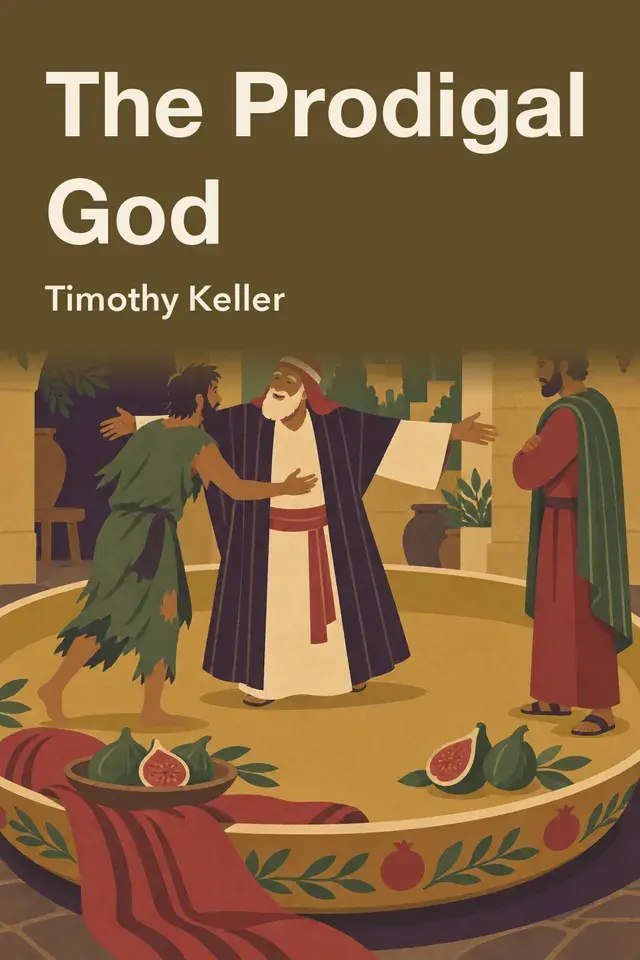
The Prodigal God, by Timothy Keller.
Luke 15 opens with two audiences, not a family scene. Tax collectors and sinners draw near to hear Jesus, while Pharisees and teachers of the law complain that he welcomes them and eats with them. The meal matters because welcome is public: Jesus receives people whom religious leaders regard as unsuitable company. Their complaint is the setting for the parable, not a stray detail after its meaning is already clear. Keller writes for people unfamiliar with Christianity and for insiders who think they know it; he expects the story to address both.
The familiar title, Parable of the Prodigal Son, can focus attention on the younger son alone. Keller prefers Two Lost Sons, keeping the respectable elder brother in the frame. He says Jesus tells the story primarily in response to the religious leaders’ complaint. The parable speaks to people who know they have gone wrong, but it is not merely reassurance that they can be welcomed. Read only that way, it becomes sentimental and lets its original hearers assume the story is about someone else. Keller argues that Jesus is addressing them directly.
The two audiences represent contrasting patterns. Tax collectors and sinners reject biblical morality and ceremonial purity; the religious leaders study Scripture, obey it, worship faithfully, and pray. Keller does not present these patterns as interchangeable. He places both within the parable’s question of who is lost and who is close to God. The story briefly signals two kinds of lostness, while leaving the sons’ full stories for what follows. Here the point is that neither visible irreligion nor respectable practice, by itself, establishes closeness to God.
Keller sees a similar contrast in modern society. Secular autonomy and suspicion of moral authority exist alongside religious movements defending traditional morality against relativism. It can be tempting to treat this as a choice between two sides and assume Jesus must belong to one of them. Keller refuses that division. In his reading, the parable especially exposes the spiritual danger of religious moralism, while challenging the assumption that either an irreligious or religious path can connect humanity to God. The respectable person who resents mercy for outsiders is not standing safely beyond the story’s reach.
The people Jesus welcomes sharpen that challenge. Keller points to New Testament examples of sexual, racial, and political outcasts connecting with Jesus while respectable religious figures do not. Jesus even says that tax collectors and prostitutes enter the kingdom before religious leaders. Keller carries this question into the present: if churches attract conservative moralists but repel the broken, marginal, licentious, and liberated, they may not be communicating Jesus’ message. The issue is not only who is welcomed in the parable, but also who objects to that welcome—and what a community’s response says about the message it teaches.
For Keller, this is more than a dispute about which group has better morals. Christianity is distinct from both conventional moral religion and secular autonomy. He describes early Christians as claiming that Jesus was the final temple, priest, and sacrifice. In Keller’s account, this makes Christianity categorically different from conventional religion: its center is Jesus, rather than a religious group’s moral standing. Romans called Christians atheists, a sign of how difficult their faith was to place within familiar religious categories. The parable does not ask readers simply to choose respectable religion over irreligion, or autonomy over moral authority. It directs attention to Jesus and to the welcome that provokes resistance.
So begin with the audience around Jesus. Who draws near, and who objects when he receives them? The parable offers a word to people conscious of their failures, but it also examines insiders who take respectability as proof of closeness to God. As the two sons’ stories unfold, both forms of lostness will come into view. Here, the opening challenge is to notice who resents mercy offered to outsiders.
Chapter 2 of 9 · 5 min · Audio & textIn the app
Two Sons, One Father’s Welcome
The younger son’s story begins with a demand that fractures his family. He asks for the share of the estate that would come to him, although his father is still alive.
Chapter 3 of 9 · 5 min · Audio & textIn the app
Sin Beneath Rulebreaking
The two sons show different ways of trying to build a life without trusting the father. Their outward choices look opposite: one rejects moral limits, while the other appears to honor them.
Chapter 4 of 9 · 5 min · Audio & textIn the app
The Respectable Shape of Lostness
The elder brother’s lostness shows itself in what his goodness produces. He may meet his responsibilities and keep a strong moral record, yet experience obedience as joyless drudgery.
Chapter 5 of 9 · 5 min · Audio & textIn the app
The Brother Who Pays the Cost
The father moves toward both sons, taking the initiative in reconciliation. That brief reminder sets the starting point: neither son can earn his way back into the father’s love.
Chapter 6 of 9 · 6 min · Audio & textIn the app
Longing for a True Home
The younger son’s return can be read as more than one person’s reconciliation. Keller places the parable within the Bible’s wider story of exile and homecoming, so that it speaks about humanity’s longing to belong and the hope of a restored world.
Chapter 7 of 9 · 5 min · Audio & textIn the app
A Foretaste Made Tangible
Salvation begins with something more solid than a feeling. Christ’s saving work reconciles people to God and secures a real verdict of pardon.
Chapter 8 of 9 · 7 min · Audio & textIn the app
Grace Practiced in Community
The gospel is not only the message by which a person first comes to faith. Keller calls it the A-to-Z of Christian life: believers keep returning to Christ’s grace because conversion does not end the heart’s need for it.
Chapter 9 of 9 · 3 min · Audio & textIn the app
The Feast That Points Beyond
At the close, Keller turns to Babette’s Feast, an artistic image that gathers the book’s contrast between sensual self-indulgence and austere moralism. The two paths differ, but neither satisfies the heart’s longing.
Chapter 1 of 9 · 5 min · Audio & text: The Audience Behind the Parable
Wiseley supports reading and listening to summaries in the app.
Continue in WiseleyAbout Timothy Keller

Timothy Keller was an American pastor, theologian, and founder of Redeemer Presbyterian Church in New York City. “The Prodigal God” explores the parable of the two sons as exposing both rebellion and respectable self-righteousness.
Explore more books by Timothy Keller