What you'll learn
Key ideas from The Prince and the Pauper
These ideas compress the book's argument without treating the author's view as settled fact. Use them as an orientation before reading the full work or listening in Wiseley.
Edward’s celebrated birth and Tom’s unwanted one assign radically different value before either child has acted.
Clothing, ceremony, and coaching make Tom’s borrowed identity publicly workable while silencing his account of who he is.
Hendon protects Edward while believing his royal identity is delusion; care does not depend on agreement about who the boy is.
Edward’s royal identity offers little protection when others recast him as a mad son, a comic king, a vagrant, or a thief.
A valuation above thirteenpence ha’penny could make the pig theft a capital offense.
Prisoners’ suffering gives Edward a personal reason to promise mercy and change to cruel laws.
Tom’s growing ease with ceremony and servants turns royal privilege into a source of pleasure and vanity.
Edward’s mercy remains limited by testimony, law, and timing; remembering suffering guides his rule but cannot undo every injustice.
Inside The Prince and the Pauper
Read the first chapter in full here. The other 8 continue in the Wiseley app.
Chapter 1 of 9 · 5 min · Audio & text
Two Births, One Exchange
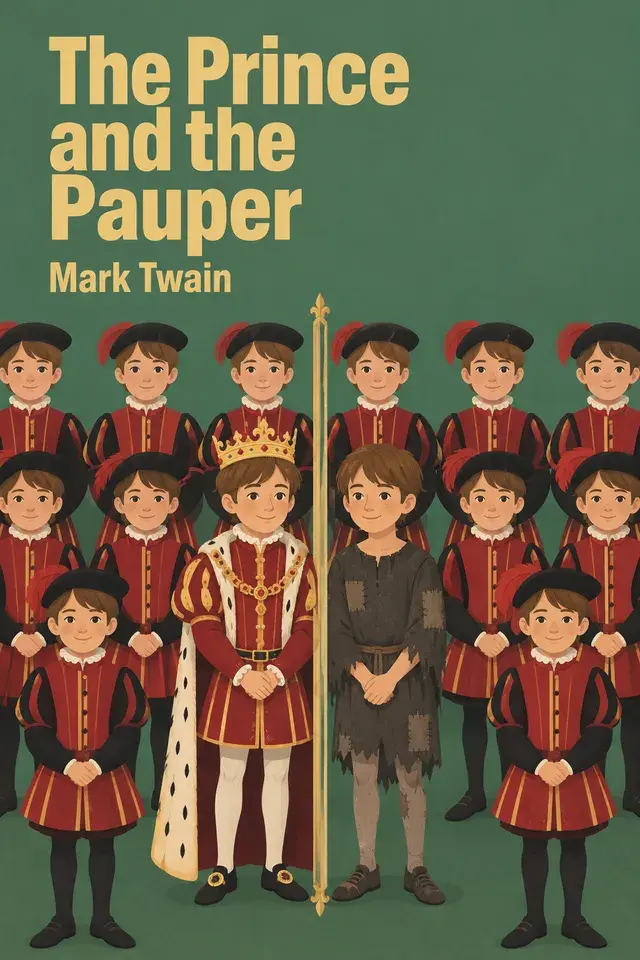
The Prince and the Pauper, by Mark Twain.
Before the boys exchange clothes, the preface asks what kind of story we are hearing. The narrator says the tale has passed from father to son for more than three centuries, yet admits he cannot say whether it is history, legend, or tradition. He offers only that its events could have happened. That uncertainty lets the story explore rank and identity without claiming to be a certain historical record.
Edward Tudor and Tom Canty are born on the same day, but their arrivals are treated as opposites. Edward is wanted by a wealthy royal family and by England. His birth brings days of public celebration, with banners, pageants, bonfires, feasting, and dancing. Tom is unwanted by his poor family; his birth draws no such welcome. Before either child has done anything, the world has assigned one immense value and the other almost none.
Tom grows up in Offal Court, a crowded, dirty district near London Bridge. His family shares one cramped room, sleeping on straw and blankets. His father and grandmother drink, fight, and beat him; his mother and twin sisters are poor but kind. Tom and his sisters are made to beg, while the adults fail to make them thieves. The house gives them shelter, but little safety or comfort. Around them, hunger, drunkenness, brawling, and injury are ordinary parts of life.
The story calls Tom’s life pleasant enough only in a limited, ironic sense. He knows that he is beaten and hungry, but assumes this is normal because other boys around him are no better off. His neighborhood also has games, companionship, and moments of ease. Those pleasures are real, but they do not cancel his exposure to violence, the need to beg, or the degrading conditions in which he lives. His apparent contentment comes partly from having no standard by which to judge how much he lacks.
One exception to that narrow world is Father Andrew, a dispossessed priest who teaches Tom to read and gives him some Latin. He also tells stories of giants, fairies, castles, kings, and princes. Tom’s reading and imagination carry him into a life of splendor: in his dreams he can become a pampered prince, far from hunger and beatings. The refuge has a cost. When he wakes, his dirt and rags seem even harder to bear, because he has imagined how different life could be.
Tom’s princely fantasies also shape how he acts among other children. His speech and manners begin to resemble the royal figures he has read about. The children mock him when he admits that he wants to see a real prince, but his performance eventually earns their admiration. They play at court, taking the parts of guards, lords, ladies, and officials, with Tom as their prince. The game gives him a place of importance that his family does not give him, and lets him rehearse a world he cannot enter. It offers belonging and imaginative escape, while sharpening his desire to see the real thing.
That desire leads Tom to Westminster and the palace. A soldier rudely pushes him away from the gate. Edward sees this and defends Tom as one of his subjects, then orders the gates opened. Inside, Edward welcomes him and asks about his family. Tom describes beatings, and Edward is shocked enough to imagine punishing Tom’s grandmother. Tom corrects him that she is of low degree and that the Tower is for the great alone. Edward concedes that he had not thought of that. Even his first idea of justice is shaped by the social rules that protect his own world.
Their conversation exposes other differences that are hard for Edward to see. He assumes Tom’s sisters have servants and more than one set of clothes. Tom explains that they do not, and Edward promises to provide what he thinks is missing. His offer is kind, but it treats poverty as a simple lack that a royal command can fix. For Tom, the absence of clothing and comfort is part of daily life. Their exchange makes clear that each boy has been taught to see the other’s circumstances through the limits of his own.
The boys then speak of what each would like to wear. Edward says he would trade his kingdom for the chance to put on Tom’s clothes, go barefoot, and play in the mud without being rebuked. Tom says he would like, just once, to wear Edward’s splendid garments. Edward agrees, and they change clothes, expecting a brief happiness before anyone comes to disturb them. Only afterward do they stand before a great mirror. They stare at each other and their reflections in astonishment: their hair, eyes, voices, manners, forms, stature, and faces seem the same. Edward says that even naked, no one could tell them apart. Their bodies offer little to distinguish a prince from a pauper, while their clothes make their opposite stations visible.
Chapter 2 of 9 · 10 min · Audio & textIn the app
The Court Learns Tom
With Edward gone from the prince’s cabinet, Tom first delights in the fine clothes and the image they give him. He tries the prince’s bearing before a mirror and handles the sword and dagger.
Chapter 3 of 9 · 10 min · Audio & textIn the app
Crowds, Crowns, and Loyalty
At Guildhall, kingship becomes a public spectacle. Tom travels through a city bright with lamps and crowded with people cheering from the riverbanks.
Chapter 4 of 9 · 8 min · Audio & textIn the app
Mercy Tests the Evidence
Tom’s first judicial decisions place him before people the court has already condemned. One man is accused of poisoning a sick person.
Chapter 5 of 9 · 12 min · Audio & textIn the app
A King Without Recognition
Edward’s separation from Hendon leaves him vulnerable to a boy who claims Hendon has been hurt. Edward follows him into the woods, where the promised friend is nowhere to be found.
Chapter 6 of 9 · 7 min · Audio & textIn the app
When Law Mistakes the King
When the law encounters Edward here, it treats him as an ordinary boy accused of theft. A woman identifies him as the thief, and no one contradicts her.
Chapter 7 of 9 · 10 min · Audio & textIn the app
Home, Prison, and Earned Honor
Miles Hendon rides toward Hendon Hall imagining the homecoming he has long hoped for. The village and buildings are familiar, and he expects his father, brother, and Edith to recognize him.
Chapter 8 of 9 · 6 min · Audio & textIn the app
The Seductions of Kingship
Tom’s first alarm at palace life has given way to ease. The routines that once marked him as an outsider now feel like privileges.
Chapter 9 of 9 · 8 min · Audio & textIn the app
Proof, Restoration, and Mercy
At Westminster Abbey, the coronation seems ready to turn Tom Canty’s borrowed identity into public fact. He is robed, acclaimed, and kneeling as the crown is about to be placed on his head.
Chapter 1 of 9 · 5 min · Audio & text: Two Births, One Exchange
Wiseley supports reading and listening to summaries in the app.
Continue in WiseleyWhat The Prince and the Pauper is about
Mark Twain’s novel follows Edward and Tom, boys of nearly identical appearance but radically different rank, after they exchange clothes. Through their parallel ordeals, it asks how recognition, law, and social standing shape identity and justice, and whether suffering can make political power more humane. The story offers a way to examine how credibility and punishment shift with status.
About Mark Twain
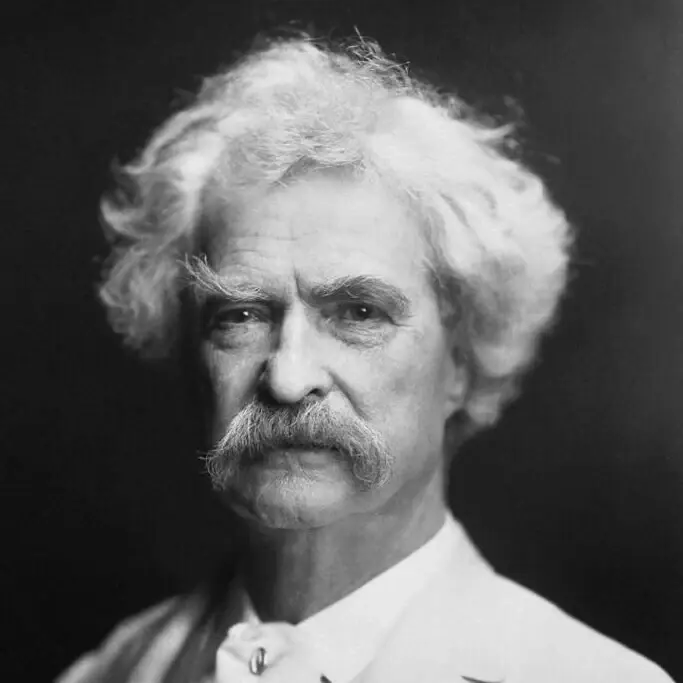
Mark Twain was an American author and humorist. “The Prince and the Pauper” explores how recognition, law, and social standing shape identity and justice when two look-alike boys of different rank trade places.
Explore more books by Mark Twain