What you'll learn
Key ideas from The Prepared Leader
These ideas compress the book's argument without treating the author's view as settled fact. Use them as an orientation before reading the full work or listening in Wiseley.
Readiness spans warning, preparation, containment, recovery, and learning, even when the exact crisis cannot be predicted.
Sense-making and perspective-taking help leaders interpret warnings by combining signals, diverse sources, and stakeholder views.
A deliberate decision process defines the problem and outcomes, limits alternatives, evaluates them, and then selects a course of action.
Crisis teams need complementary expertise, shared goals, clear roles, and mutual accountability to turn knowledge into coordinated action.
Cross-border response depends on diverse expertise, reliable information flows, local autonomy, and alignment across organizational boundaries.
AI can help forecast risks, while ethical judgment, alignment, and inclusive access remain essential to its use.
Crisis experience becomes preparedness when reflection changes routines, systems, and culture.
Inside The Prepared Leader
Read the first chapter in full here. The other 6 continue in the Wiseley app.
Chapter 1 of 7 · 8 min · Audio & text
Readiness Across the Crisis Cycle
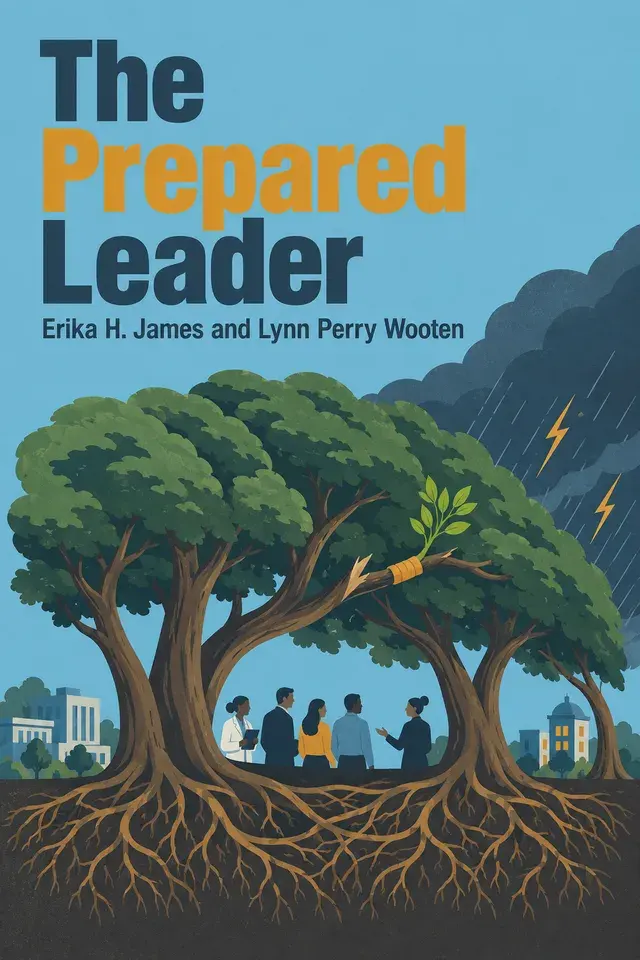
The Prepared Leader, by Erika H. James and Lynn Perry Wooten.
Crises often look sudden once they break into view, but some have been taking shape for a long time. They differ from routine problems because they are unusual, disrupt expected conditions, and can exceed the resources or capabilities used in ordinary work. A technology failure can smolder; so can a culture or procedure that permits malpractice, fraud, discrimination, or harassment. A natural disaster or act of violence may be far harder to foresee. And crises do not wait neatly for one another: another may begin while an organization is still dealing with the first. James and Wooten treat recurrence as a fact of organizational life. The task is not to know exactly what will happen, but to build the capacity to respond when ordinary assumptions no longer hold.
The pandemic made the gap between warning and readiness visible. Before COVID-19, scientists had warned of future outbreaks. During the SARS outbreak, public-health measures such as quarantines, masks, temperature checks, virtual schoolrooms, and stockpiling were used. Ebola later spread across six West African countries. In 2015, Bill Gates also warned that another pandemic would come and urged governments to strengthen preventive measures. These signals could not say exactly where or when an outbreak would begin, or how extensive its effects would be. They did show that a pandemic was a class of risk worth preparing for. The authors cite estimates of pandemic losses, but caution that its total costs cannot yet be fully known. Some estimates are incomplete, and possible longer-term health and psychological effects remain uncertain.
Even when alarms are loud, attention often fades. The authors describe a cycle: a crisis creates urgency and a burst of response, then distance from danger restores ordinary priorities. Funding, surveillance, and response mechanisms lose support; when a related crisis returns, leaders face it with less capacity and renewed alarm. By 2017, international support for the World Bank’s pandemic financing facility had effectively collapsed: only two donors remained active. This does not mean every crisis could have been prevented. It shows why warning alone is not readiness: capacity must persist after an immediate threat recedes.
Human judgment can contribute to this cycle. People do not usually plan day to day for anomalous events, and mental shortcuts that help with ordinary routines can distort crisis assessment. An outbreak far away can seem irrelevant; the present can outweigh a future risk; an early interpretation can stick after evidence changes. People may imagine rapid growth as gradual, or hold onto a plan because they have already invested in it. The authors describe these patterns as probability neglect, hyperbolic discounting, anchoring, exponential-growth bias, and the sunk-cost fallacy. Their point is not that people cannot think clearly. It is that attention can be pulled toward what feels close and familiar. Deliberate scanning, along with planned checks of assumptions and new information, can interrupt these habits. Such checks improve the chance of noticing change; they do not reveal the exact form of a future crisis.
That distinction underlies the book’s proposal to make Prepared Leadership a fourth bottom line alongside people, planet, and profit. The authors argue that preparedness supports an organization’s ability to meet those responsibilities and remain viable when a crisis arrives. Prepared Leadership is the continuing capacity to notice signals, prepare leaders and systems, act during disruption, recover, and incorporate lessons. It is not simply expecting the worst. The authors describe readiness as open and learning-oriented: leaders remain receptive to new experience, willing to learn and take risks, and confident that people and organizations can emerge stronger. That stance offers a reason to prepare without pretending to control every outcome.
The authors’ own university leadership experience during the pandemic gave this model immediate context. In 2020, both entered prominent university leadership positions. COVID-19 then required them to gather information quickly, understand institutional needs and vulnerabilities, make difficult decisions, secure resources, and build consensus while physically isolated. Their experience brought the model’s central tension into focus: leaders must address urgent needs while maintaining their institutions’ strengths and capacity for the future.
The authors organize this work into five connected phases. The first is warning and signal detection: scan beyond daily demands and interpret early cues while there is still time to respond. The second is preparation and prevention: act on what has been noticed, preventing a crisis where possible or helping people brace for its impact when prevention is not possible. The third is damage containment, which limits harm and keeps a localized crisis from spreading. The fourth is recovery, an effort to restore capacity, assess what has been lost, and set goals for the period ahead. The fifth is learning and reflection: examine underlying causes and change procedures or systems so that experience informs the next round of preparation. The phases describe work across a crisis cycle, not a forecast of one specific event. Some crises, including natural disasters and violence, are harder to foresee, and preparation cannot eliminate all uncertainty.
Adam Silver’s response as commissioner of the National Basketball Association illustrates how several phases can connect. On March 11, 2020, as the World Health Organization declared COVID-19 a pandemic, Silver suspended the league’s season despite expected revenue losses. He sought advice from health and scientific experts, put public health first, and built support within the league. The NBA later used a bubble to resume play. Players in the bubble played 172 games. The account says the bubble cost $190 million, helped recoup $1.5 billion in otherwise lost revenue, and had no infections among players or staff during its existence. The authors describe the response as becoming a contingency protocol. Viewed through the five phases, the initial pause acted on emerging evidence, the bubble prepared for a return while containing exposure, and the protocol carried learning forward.
Nextdoor shows that the cycle also applies to crises rooted in organizational practices. After reports that users were racially profiling African American and Latino neighbors, a small, diverse task force analyzed data. The company trained its operations team, revised and communicated its guidelines, and redesigned the app. The account reports a 75 percent reduction in profiling within months. The sequence connects recognition of harm with organizational repair and changes to how the platform operated.
Prepared Leadership, then, is sustained work across warning, preparation, containment, recovery, and learning. Leaders cannot name the next crisis with certainty, but they can keep attention and response capacity from fading as soon as the alarm passes.
Chapter 2 of 7 · 7 min · Audio & textIn the app
The Nine Skills in Motion
Prepared leaders need a repertoire of skills, not one fixed response. The authors identify nine capabilities: sense-making, perspective-taking, influence, organizational agility, creativity, effective communication, risk-taking, resilience-building, and individual and systemic learning.
Chapter 3 of 7 · 6 min · Audio & textIn the app
Judgment Under Pressure
Crisis decisions are unusually hard because they arrive with little time, high stakes, unfamiliar conditions, and consequences that may unfold both soon and later. Under pressure, leaders can settle quickly on one interpretation and treat it as the whole problem.
Chapter 4 of 7 · 8 min · Audio & textIn the app
Trust and Team Adaptation
A crisis asks more of a team than any one person can know or do. The people best placed to understand the problem may be far from the executive suite, lower in the hierarchy, or outside the organization.
Chapter 5 of 7 · 7 min · Audio & textIn the app
Lead Across Borders and Stakeholders
A global crisis rarely stays confined to one event, market, or country. In 2020, the pandemic coincided with social justice protests, political division, poverty and inequality, and intensifying climate risks.
Chapter 6 of 7 · 6 min · Audio & textIn the app
Technology Extends Leadership
Technology can extend crisis leadership’s reach and speed. It lets people share information, coordinate across distance, and bring expertise into a problem quickly.
Chapter 7 of 7 · 7 min · Audio & textIn the app
Turn Experience Into Preparedness
A crisis does not teach an organization simply because it has happened. Prepared Leadership depends on examining what happened and changing how people decide, communicate, and act.
Chapter 1 of 7 · 8 min · Audio & text: Readiness Across the Crisis Cycle
Wiseley supports reading and listening to summaries in the app.
Continue in Wiseley