
What you'll learn
Key ideas from The Power of Unwavering Focus
These ideas compress the book's argument without treating the author's view as settled fact. Use them as an orientation before reading the full work or listening in Wiseley.
Purpose sets priorities, and priorities determine where attention and energy go, so circumstance and habit need not decide a life’s direction.
Repeated attention directs energy into a mental area, strengthening its pattern and influencing which emotions and circumstances become easier to revisit.
Observation preserves consciousness of an experience without requiring absorption, leaving open the choice to enter or withdraw.
Recurring daily activities become concentration practice when they receive undivided attention and deliberate transitions.
Completion gives the subconscious evidence that an endeavor can be carried through to its natural end.
Technology becomes a focus aid or a distraction trainer according to whether purpose, limits, and content selection govern awareness.
The present is where action occurs, while past and future are useful when awareness visits them deliberately for learning, planning, or assessment.
Inside The Power of Unwavering Focus
Read the first chapter in full here. The other 9 continue in the Wiseley app.
Chapter 1 of 10 · 7 min · Audio & text
Choose What Deserves Your Life
The Power of Unwavering Focus, by Dandapani.
How should a person decide what deserves a life? Dandapani begins with a distinction. A focused life means giving undivided attention to whatever one is doing. A purpose-focused life adds intentional selection: purpose defines priorities, and priorities decide which people, activities, and inputs receive attention. The central question is whether circumstance and habit will make those decisions, or whether a chosen purpose will. The author says choice remains possible even under severe constraint. A mother described in the book, despite widowhood and poverty, made her children laugh each morning. Her story supports his claim that environment need not have the final say.
The reason focus needs training becomes clearer in the book’s simplified map of the mind. Dandapani sketches a three-story building. The conscious mind is the sensory, instinctive ground floor, tied to perception, basic drives, movement, and impulsive thought. The subconscious is the middle floor, associated with reason and logic, stored experiences, impressions, habits, and involuntary physical processes. The superconscious is the top floor, described in his Hindu spiritual vocabulary as the soul’s all-knowing intelligence and source of creativity, intuition, and profound spiritual experience. He presents this as a simple framework, not a complete account. Its immediate lesson is that the ordinary mind cannot automatically tell what is beneficial. The French-fries and smoking examples show how untrained preferences can work against well-being. Training means taking in information, processing it, and forming clear conclusions rather than letting mental clutter produce confusion.
This leads to the book’s sequence: understand and focus the mind, discover purpose, define priorities, and focus on those priorities. Dandapani rejects the objection that purpose must always come first. He argues that purpose is discovered through mental understanding, mastery, focus, and self-reflection. He also rejects chasing a feeling directly. The recommended route is a purpose-shaped lifestyle whose overall by-product is happiness, even though necessary activities remain unpleasant. Full attention makes meaningful engagements richer by allowing a person to be present for them. Focus is therefore a means by which chosen priorities become a way of living.
For that means to last, a person must make the case for it personally. Dandapani says a wish to live with focus often appears during pain and fades when pain subsides. Durable change requires buy-in: definite desire, belief that the goal can be attained, and patience with a process that may take years. He calls this inextinguishable desire, a force that can withstand critics, obstacles, and setbacks.
His own story illustrates intensity without pretending perfection. At twenty-one, he told his guru that his purpose was Self-Realization and that he would give his life for it. After repeated tests, he entered a Hindu monastery three years later and gave up his former way of life. Yet he also reports breaking down, crying, failing, and questioning himself. Doubt did not mean the purpose had disappeared. Desire is not magic or the only condition for achievement; focus is one necessary trait among several, joined to belief and steadfast patience.
“Making the case” also applies when persuading others. After a 2017 conversation in Seoul, Dandapani realized that teaching requires connecting an idea to the listener’s circumstances. An environmental argument may not move a single mother working two jobs until its relevance to her responsibilities is clear. He saw that he had taught focus without always explaining why it mattered. Commands do not create the needed buy-in by themselves. The same reasoning applies inwardly: without personal conviction, sincere intentions lose force when ordinary pressures return.
After decades of pursuing a purpose-focused life, Dandapani gives three broad reasons to choose it: an overall happy life, the ability to manifest goals, and death. Focus supports the first because presence lets a person experience important engagements more fully. It supports goals because attention directs effort and energy toward selected aims. The author treats focus as one trait needed to turn vision into reality, while cautioning that desire and focus do not guarantee results or provide shortcuts. The point is not continuous enjoyment, but an overall life organized around purpose and priorities.
Death is the strongest reason because it awaits everyone, although the author does not claim certainty about what follows. Religious and philosophical accounts differ, and no one knows the afterlife for sure. What matters here is the difference between knowing that people die and realizing that one’s own life is finite. Dandapani says his guru’s death changed his perspective permanently. By contrast, Julie’s grief after her father’s death shows that deep pain does not automatically produce a lasting change in how someone lives. Realization is measured by subsequent behavior.
He prefers “life is finite” to “life is short.” Life may be long, but its ending is definite and unpredictable. People often act as if they and their loved ones will always be available, allowing urgent demands to displace family. In his workshop exercise, participants imagine only three hours remain and consistently choose loved ones over shopping, an unwanted call, a latte, or the workshop. As imagined time shrinks, priorities become sharper. Mortality, realized rather than merely acknowledged, concentrates attention on what cannot be postponed.
That reflection leads to Dandapani’s personal standard. An amazing life is not a performance for praise or protection from criticism. It is a judgment about the life one has lived. Even while believing in reincarnation, he treats this particular life as a singular opportunity to live as himself. Having a life is reason enough to take charge of it. Purpose identifies what matters, priorities give it order, and focus determines what receives limited attention and energy. The aim is to live so one’s final reflection can be that the life was amazing.
Chapter 2 of 10 · 4 min · Audio & textIn the app
Practice the Path, One Step
The author’s practical point is that an intention becomes a capability through practice. Focus is not gained by finishing a book, collecting techniques, or finding a shortcut.
Chapter 3 of 10 · 5 min · Audio & textIn the app
Awareness Is Not the Mind
The chapter begins by treating the mind as humanity’s most powerful tool, yet one that people are rarely taught to understand. It is always present, and it can produce remarkable creations or serious harm when left ungoverned.
Chapter 4 of 10 · 6 min · Audio & textIn the app
Where Attention Sends Energy
With the book’s distinction between awareness and mind in place, this chapter follows the energy that moves when awareness changes location. Its governing law is “where awareness goes, energy flows.”
Chapter 5 of 10 · 6 min · Audio & textIn the app
Recover the Power to Choose
If awareness can be moved by whatever surrounds it, the practical question is whether it can notice that movement and choose again. Dandapani turns his distinction between awareness and the mind into a felt exercise.
Chapter 6 of 10 · 6 min · Audio & textIn the app
Make Concentration a Daily Practice
Earlier, the book described awareness as something that can be directed. Here, Dandapani turns that idea into a daily system.
Chapter 7 of 10 · 4 min · Audio & textIn the app
Build Willpower Through Completion
Concentration needs a partner: willpower. Dandapani defines it as channeling energy toward one point for a chosen period.
Chapter 8 of 10 · 6 min · Audio & textIn the app
Program the Mind for Focus
Focus is programmed long before a person sits down to practice it. It is shaped by repeated choices: what receives awareness, what interrupts it, and what the environment rewards.
Chapter 9 of 10 · 6 min · Audio & textIn the app
Stay Present Under Mental Pressure
After distinguishing awareness from the mind, the book applies the same training to time, worry, fear, anxiety, stress, and reaction. Presence is not physical proximity.
Chapter 10 of 10 · 6 min · Audio & textIn the app
Extend Focus Into Work and Community
Focus matters most, the author argues, when it moves into performance. He begins with sport.
Chapter 1 of 10 · 7 min · Audio & text: Choose What Deserves Your Life
Wiseley supports reading and listening to summaries in the app.
Continue in WiseleyWhat The Power of Unwavering Focus is about
The Power of Unwavering Focus presents focus as a trainable way to direct awareness, energy, and action. It asks how a person can choose meaningful priorities, resist distraction, and remain present. The summary traces the book’s spiritual model of the mind into practical routines for concentration, willpower, relationships, and work.
About Dandapani
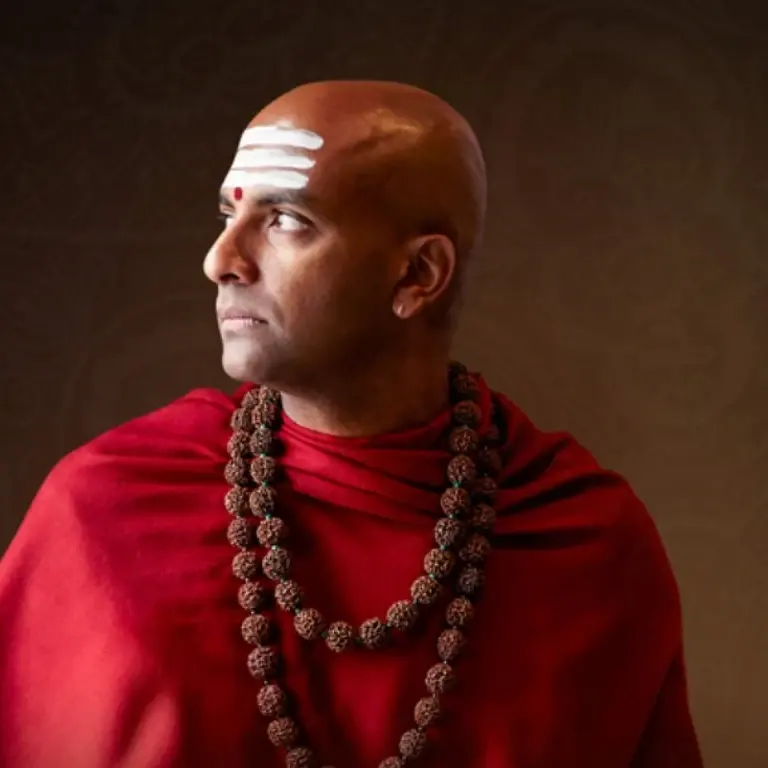
Dandapani is a Hindu priest, speaker, and former monk. “The Power of Unwavering Focus” explores focus as a trainable way to direct awareness, energy, and action.
Explore more books by Dandapani