What you'll learn
Key ideas from The Power of the Downstate
These ideas compress the book's argument without treating the author's view as settled fact. Use them as an orientation before reading the full work or listening in Wiseley.
Human capacity grows through repeating Upstate effort and Downstate replenishment, not through permanent activation or fixed equilibrium.
Circadian signals from light organize hormonal, metabolic, cognitive, and restorative timing across the body.
Sleep is an active Downstate in which ordered stages restore energy, regulate emotion, consolidate memory, and maintain the brain.
Exercise becomes restorative through a cycle of REV activation, compensation, and supercompensation shaped by dose and recovery.
Loneliness, gender norms, caregiving, income, race, work, and autonomy shape access to restorative conditions.
Motivation, gradual habit layering, and flexible action-item selection make adherence more workable than an immediate total overhaul.
Thriving cannot rest on personal discipline alone; autonomy, safety, and psychological support must also be built into institutions.
Inside The Power of the Downstate
Read the first chapter in full here. The other 6 continue in the Wiseley app.
Chapter 1 of 7 · 6 min · Audio & text
The Rhythm of Recovery
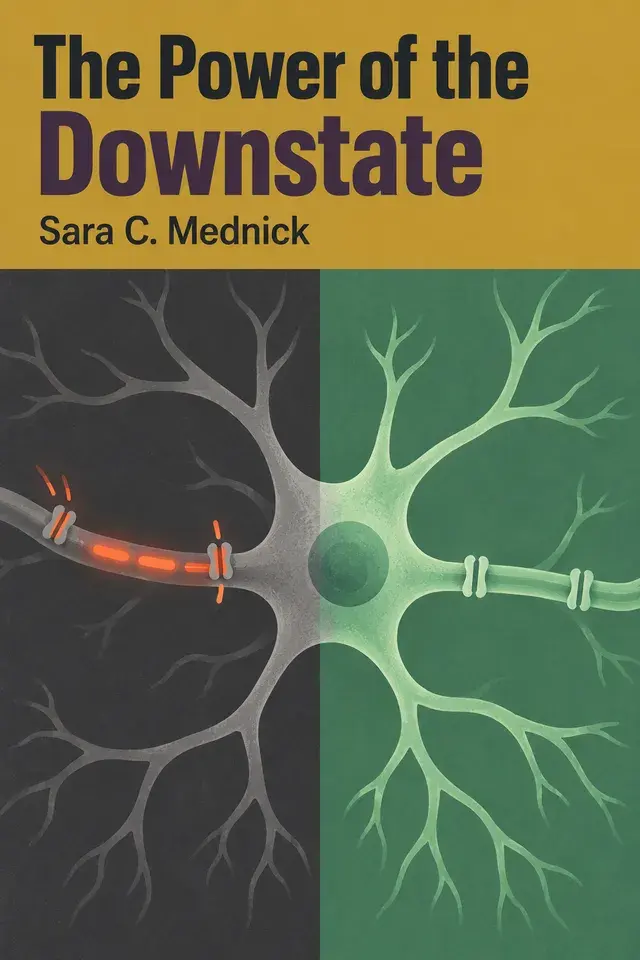
The Power of the Downstate, by Sara C. Mednick.
Human capacity grows through a rhythm, not by holding every system at one fixed level. We enter Upstates to gather information, focus attention, meet challenges, and spend energy. We need Downstates to replenish what action uses. When that cycle is completed, recovery can leave us with more capacity for the next demand. This is the book’s central model: progress comes from alternating effort and restoration.
Mednick introduces Downstate as her own umbrella term for the times, places, and activities through which body and mind restore themselves. It includes restorative states during sleep, but it is broader than sleep. The term also covers waking processes that calm the system, repair depletion, process emotion, integrate experience, and prepare a person for future action. Its opposite, Upstate, names activation: the mobilization of attention, energy, and physiological resources. Neither state is sufficient by itself. A functioning life depends on their relationship.
The logic begins at the cellular level. Neurons communicate by firing, and repeated firing helps organize thought, feeling, and action. Yet each firing is followed by a refractory period, when the neuron restores the conditions needed to respond again. Mednick generalizes this pattern to organs, muscles, and the whole person: biological systems are resource-limited, so activation without replenishment eventually weakens performance. Downstate is therefore not empty time. It is the interval in which depleted resources are restored and experience can become usable capacity.
This is also why the author distinguishes recovery from static homeostasis. Homeostasis accurately describes the body’s need to keep life-critical variables, such as temperature, glucose, oxygen, and pH, within narrow ranges. But a fixed set-point cannot explain why training, learning, or emotional regulation aim to change what a person can do. The growth-oriented pattern is an upward zigzag: an Upstate creates demand, Downstate repairs what was spent, and RecoveryPlus adds enough surplus to raise the next set-point. The aim is not to return unchanged to baseline, but to become better prepared for a comparable challenge.
Mednick gives the autonomic branches names that make this cycle easier to see. REV is the sympathetic, energetic side. It reacts to novelty, gathers information, directs attention, mobilizes the body for action, and prepares defensive responses when something seems threatening. RESTORE is the parasympathetic, reflective side. It inhibits prolonged stress activation, replenishes resources, supports healing, and helps the mind process memories, emotions, and ideas. REV and RESTORE are partners, not rivals. The author cautions that neither constant activation nor excessive calm is sufficient for optimal functioning.
The distinction also clarifies the difference between adaptive stress and chronic imbalance. A manageable challenge can be eustress: it raises energy, sharpens attention, motivates effort, and may expand confidence when recovery follows. Distress becomes damaging when demands continue without sufficient restoration. Then REV is activated repeatedly, while sleep, exercise, and other recovery opportunities are pushed aside. The issue is not whether stress exists, but whether the organism has time and resources to complete the cycle.
The author argues that modern life often interrupts that completion. Screens and notifications extend attention into every setting; work is glorified as constant busyness; convenience foods and self-medication offer short-term coping; and financial, family, health, and social pressures keep people alert. These forces can produce a chronic Upstate in which exhaustion becomes part of daily life. The result is autonomic imbalance: an overused stress system and a Downstate too depleted to restore it.
The consequences reach beyond mood or productivity. The book connects persistent autonomic imbalance with impaired memory and cognition, disrupted metabolism, cardiovascular strain, inflammation, and higher risk across chronic diseases. It presents these findings as associations and as a common pathway, not as proof that one mechanism explains every illness. It also rejects the idea that recovery is purely a matter of personal discipline. Poverty, discrimination, unsafe conditions, and time scarcity can increase physiological stress while removing the safety, time, and resources that recovery requires.
The alternative is not permanent calm or withdrawal from demanding life. It is a repeating partnership: REV spends capacity on what matters, and RESTORE replenishes, integrates, and expands that capacity. Once recovery is understood as an active phase of growth, breaks are no longer the opposite of achievement. They are part of how achievement, resilience, health, and human potential become sustainable.
Chapter 2 of 7 · 6 min · Audio & textIn the app
Living by Biological Time
Recovery, in Mednick’s account, depends on when the body is asked to activate or restore. Circadian rhythm is the approximately daily system coordinating the sleep-wake cycle and many biological processes.
Chapter 3 of 7 · 7 min · Audio & textIn the app
Sleep as Active Repair
Sleep can look like a blank interval between productive days. The author presents it as the most powerful Downstate: an active period when body and brain restore what waking has spent.
Chapter 4 of 7 · 9 min · Audio & textIn the app
Training the Recovery System
Recovery is not a passive state that appears only when demands stop. It is a capacity the body can practice: recognizing safety, adjusting arousal, and returning from effort without losing flexibility.
Chapter 5 of 7 · 7 min · Audio & textIn the app
Recovery Across the Lifespan
Aging, in this chapter, is not simply the number of birthdays completed. It is the cumulative result of how often life pushes the body into REV and how consistently RESTORE is allowed to rebuild it.
Chapter 6 of 7 · 5 min · Audio & textIn the app
Making Recovery Habitual
The Downstate RecoveryPlus Plan is the book’s bridge from explanation to daily life. It translates earlier science into a tailored routine across four domains: autonomic regulation, sleep, exercise, and nutrition.
Chapter 7 of 7 · 4 min · Audio & textIn the app
From Survival to Thriving
At the book’s edge, enhancement is a question of fit, not a race toward superhuman performance. Mednick’s answer to whether people can become smarter, stronger, or faster is “sometimes.”
Chapter 1 of 7 · 6 min · Audio & text: The Rhythm of Recovery
Wiseley supports reading and listening to summaries in the app.
Continue in WiseleyAbout Sara C. Mednick
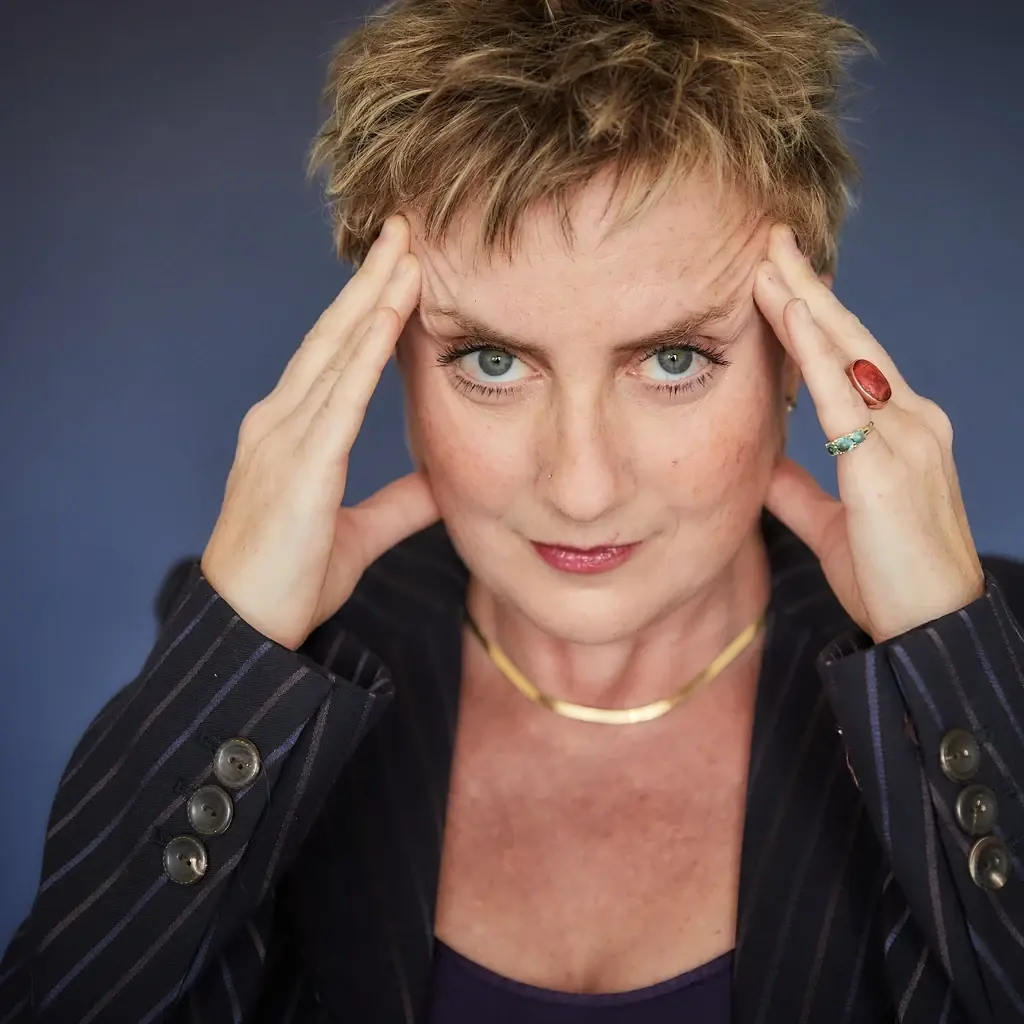
Sara C. Mednick is a cognitive neuroscientist and professor at the University of California, Irvine. “The Power of the Downstate” explores how people can recover in a culture that keeps them activated.
Explore more books by Sara C. Mednick