What you'll learn
Key ideas from The Porn Trap
These ideas compress the book's argument without treating the author's view as settled fact. Use them as an orientation before reading the full work or listening in Wiseley.
Porn can offer immediate reward, while a growing role may compete with honesty and intimacy; use does not imply universal harm.
Porn involvement can deepen or fade as access, needs, relationships, and competing sources of satisfaction change.
Ambivalence can persist after a sincere decision, so motivation needs continued attention.
The six recovery actions reinforce one another through honesty, treatment, access boundaries, support, self-care, and healthier sexual learning.
A quickly addressed slip differs from sustained use, and a setback does not erase prior recovery progress.
Trust grows through credible, consistent actions over time; promises or stopping porn alone do not restore a partner’s confidence.
Freedom in recovery is the growing ability to choose actions aligned with personal values, honesty, health, and meaningful relationships.
Inside The Porn Trap
Read the first chapter in full here. The other 11 continue in the Wiseley app.
Chapter 1 of 12 · 8 min · Audio & text
When an Outlet Becomes a Trap
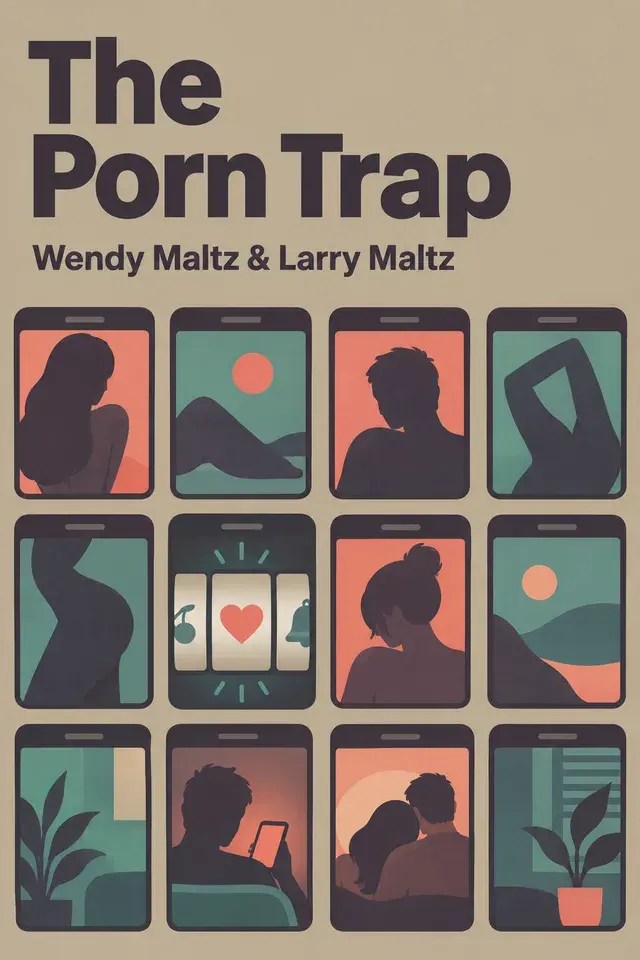
The Porn Trap, by Wendy Maltz & Larry Maltz.
The authors begin with a question about what pornography is. People disagree about the label because their judgments can reflect personal, cultural, emotional, and moral views. Rather than define it by a fixed level of explicitness, they use a practical definition: sexually explicit material intended to be, or actually used as, a sexual outlet. This shifts attention from the material alone to the role it plays for the person using it. In their distinction, sex education aims to provide information, and erotic art or literature celebrates the body and sexuality; pornography seeks arousal and can draw the consumer into a sexual relationship with the material. The working definition gives readers a way to consider use without first settling every cultural argument about the word.
That relationship with material has become easier to enter as access has changed. The authors trace a shift from printed material and films toward computers and connected devices that offer abundant content privately and on demand. They also describe incidental encounters through links, pop ups, or unsolicited messages. Access does not determine what anyone will do, but it can make sexual material available with little effort and allow browsing to continue from one image or interaction to the next.
Tony’s story illustrates how quickly an outlet can change its place in a relationship. During a rough patch, while his girlfriend was away, he began with free online previews. Over one weekend, his activity progressed to sexual chats and a swinger site. He then lied about what he had been doing. A month later, his girlfriend left him. His account is one person’s experience, not a forecast for everyone who views porn. It does show how an apparently limited visit can become a sequence of increasingly involved activities, and how concealment can enter that sequence.
The immediate appeal is part of the authors’ concern. Porn can offer sexual stimulation and gratification quickly, without setting a mood, communicating with another person, or attending to a partner’s needs. Images and sound can focus attention on sexual bodies and acts, while ordinary interruptions and relational demands fall away. Some people describe the experience as exciting, convenient, or a way to escape. In the moment, an outlet that asks little of the user may feel simpler than partnered intimacy, which involves another person’s feelings, responses, and needs.
The authors’ concern is not that every use replaces a relationship. It is that porn can become a competitor for sexual attention and time, especially when its role grows while honesty and emotional presence diminish. The shift may be gradual: an occasional diversion can become a more regular way of seeking pleasure or escape before the person recognizes how important it has become. This makes the short term reward and the longer relationship question different parts of the same issue. The immediate experience may satisfy, while repeated reliance could pull attention away from the closeness the user values.
The authors also describe a reward in the act of searching. Online browsing can mean moving through many images in hope of finding a preferred look or fantasy. The next click might be more appealing, but there is no fixed point at which it will appear. They compare this uncertain pattern to a slot machine: an unpredictable reward can keep someone trying again. The anticipation before a click or download may add to the excitement, so the search itself can become part of the experience. With on demand access, this cycle can repeat quickly, and time may pass unnoticed.
Repeated use may also connect familiar cues with expected pleasure. A device, a private moment, opening a site, or beginning to browse can come to signal the possibility of sexual reward. In the authors’ account, these learned associations may encourage someone to return, even before the material appears. This offers one explanation for why continued browsing can feel compelling for some users. It does not mean that everyone who encounters the cues will keep using porn or develop a serious problem.
The authors describe these responses in causal terms, while qualifying particular parts of the account. They say porn stimulates the brain’s pleasure centers and causes dopamine production to spike; they describe the resulting increase as producing a drug-like high, which some researchers consider most similar to the high caused by crack cocaine. They also say sexual images and sounds most likely change hormone levels, including testosterone, drawing in part on research about male monkeys watching copulation. In their account, oxytocin and vasopressin released with orgasm contribute to lasting emotional attachment to whoever or whatever is in a person’s thoughts, and more orgasms with porn increase sexual and emotional attachment to it. These are the authors’ causal explanations, supported by cited research and analogies; they do not mean that every user experiences the same changes or develops a problem. The authors acknowledge that long term research is limited, particularly research on porn use in natural settings and its relationship to intimacy. That limitation matters when weighing broad conclusions about what happens in every user’s brain or body.
Readers can apply the working definition by asking what the material is meant to do and how they actually use it. Does it serve as information or art, or does the person turn to it as a sexual outlet? What role does it have in the person’s life, and what effects does that role seem to have? These questions place the focus on intended use and experience rather than on a universal list of images that must count as porn. They also leave room for people to answer differently.
The authors describe a range of experiences: not every user develops a problem, and involvement can change with personal circumstances. Tony’s progression illustrates one risk, not a universal path. The opening concern is narrower and more useful than assuming that arousal itself proves harm. Porn can provide immediate reward, while anticipation and familiar cues may reinforce further use for some people. The question is when this outlet begins to take a growing place at the expense of integrity and intimacy, a tension the rest of the book examines.
Chapter 2 of 12 · 7 min · Audio & textIn the app
Early Exposure, Lasting Meanings
A first encounter with pornography may happen before a child understands what they are seeing. In the accounts the authors collected, children found magazines at home or elsewhere, saw material with friends, or were shown it by an older relative.
Chapter 3 of 12 · 8 min · Audio & textIn the app
Forces That Shape Involvement
The authors describe porn use as a relationship that can grow stronger or fade. Some people they interviewed felt hooked from their first exposure, but most moved in and out of use as their needs and circumstances changed.
Chapter 4 of 12 · 8 min · Audio & textIn the app
Costs to the User
The authors ask readers to consider what porn use may be costing a person in everyday life. Serious harm, they argue, does not depend on someone accepting the label addiction.
Chapter 5 of 12 · 10 min · Audio & textIn the app
When Partners Discover the Secret
Porn use can be a private habit to the person viewing it, but secrecy can make it a relationship experience for someone else. A partner may notice distance or rejection without knowing why.
Chapter 6 of 12 · 9 min · Audio & textIn the app
Crises, Ambivalence, and Motivation
Recognizing a problem and deciding to leave it behind are different tasks. Porn may still offer pleasure, excitement, or relief even while someone sees the harm it brings.
Chapter 7 of 12 · 11 min · Audio & textIn the app
Six Actions for Recovery
The authors turn the decision to quit into six actions that can support one another: tell a trustworthy person, continue suitable treatment, make the environment porn-free, build a reachable support team, care for physical and emotional health, and develop healthier sexual attitudes and behavior. They call these steps basic because they regard them as important to lasting change, not because they are easy.
Chapter 8 of 12 · 8 min · Audio & textIn the app
Interrupting a Relapse in Progress
Relapse can feel like one sudden break in recovery, but the authors describe it as a process that can unfold in stages. Seeing those stages matters because a person may be able to turn back before renewed use becomes prolonged.
Chapter 9 of 12 · 7 min · Audio & textIn the app
Planning Around Vulnerability
When a person has some distance from a vulnerable moment, prevention can start by studying where risk might arise. Chapter 8 focuses on responding after a relapse process has begun; here the attention shifts earlier, toward routines and limits that can be shaped in advance.
Chapter 10 of 12 · 9 min · Audio & textIn the app
Repairing Trust Together
Once the immediate discovery is past, quitting porn may stop one source of harm, but it does not by itself repair a relationship. The authors describe four connected kinds of work: restoring trust, understanding each partner’s experience, moving from anger toward forgiveness, and communicating more openly.
Chapter 11 of 12 · 9 min · Audio & textIn the app
Practicing Intimacy Beyond Porn
Recovery can involve more than stopping a behavior. The authors offer practices for learning a way of relating sexually that includes attention, communication, touch, and care.
Chapter 12 of 12 · 6 min · Audio & textIn the app
Freedom as an Ongoing Choice
The authors close by defining recovery in terms of freedom: the ability to choose a life that supports health and happiness, to live honestly according to one’s values, and to build meaningful relationships with dignity. Freedom, in this account, is more than the absence of temptation.
Chapter 1 of 12 · 8 min · Audio & text: When an Outlet Becomes a Trap
Wiseley supports reading and listening to summaries in the app.
Continue in WiseleyAbout Wendy Maltz & Larry Maltz

Wendy Maltz
Wendy Maltz is an American sex therapist, psychotherapist, and author. “The Porn Trap” explores how to tell when pornography has become a harmful pattern and what recovery can require.
Explore more books by Wendy Maltz