What you'll learn
Key ideas from The Performance Paradox
These ideas compress the book's argument without treating the author's view as settled fact. Use them as an orientation before reading the full work or listening in Wiseley.
The Performance and Learning Zones describe complementary states of attention: delivering with current skills and developing skills for future work.
Deliberate practice develops a defined subskill through manageable challenge, concentration, repetition, feedback, and adjustment.
Rough prototypes invite feedback, and test results can guide iteration or a return to research.
Trust and shared purpose let teams use members’ knowledge and raise concerns that would otherwise stay hidden.
Leadership development begins with examining one’s own behavior, seeking feedback, and changing what colleagues experience.
Brief check-ins reconnect execution to larger aims and identify the next useful lesson, while keeping experimentation bounded by the stakes.
Learning is linked with agency, well-being, persistence, wonder, and empathy, while performance carries work into the world and can inform further learning.
Inside The Performance Paradox
Read the first chapter in full here. The other 10 continue in the Wiseley app.
Chapter 1 of 11 · 6 min · Audio & text
Why Performance Can Stall
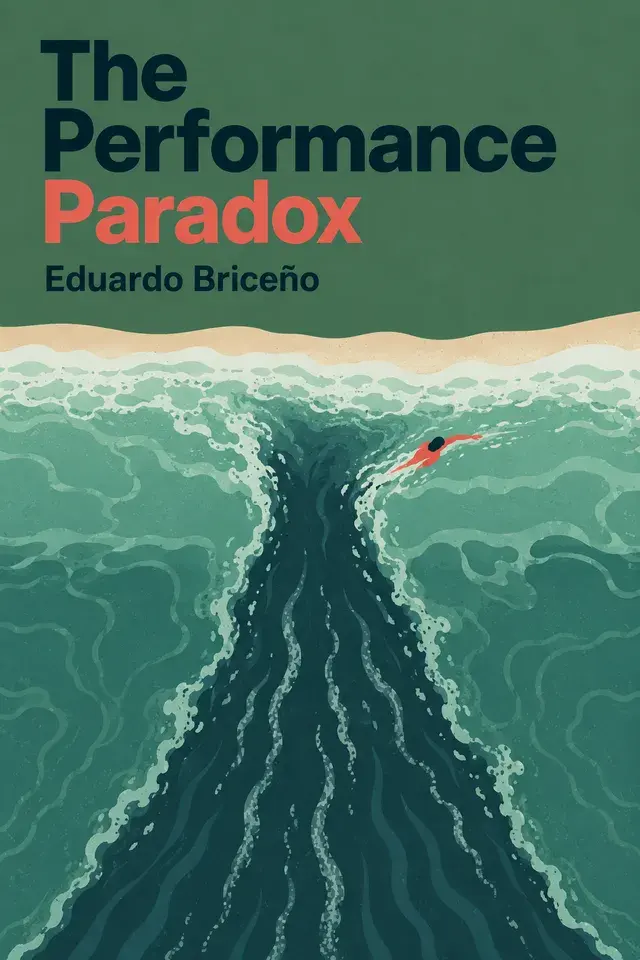
The Performance Paradox, by Eduardo Briceño.
Gino cared about doing his restaurant work well, so he took on many responsibilities himself and avoided training others. When business declined, he responded by working more hours. But after years of long workweeks, he had little time or energy left to rethink how the restaurant was run. His effort was considerable; it did not automatically give him a better way forward.
Briceño describes this pattern as chronic performance: continually trying to complete every task flawlessly, avoid mistakes, and keep work moving. It can look responsible, especially when the list is long and people depend on you. Yet doing more of a familiar task mostly draws on the skills you already have. It may keep things going without improving how effectively you work. People can also become reluctant to ask questions, admit uncertainty, or seek feedback because those actions seem to threaten the appearance of competence.
The author’s story about being caught in a rip current gives this problem a physical form. He swam directly toward shore, but the current kept carrying him away. More force in the same direction did not bring him closer. He had to notice what the water was doing and change his course before he could make progress. Briceño uses the experience as a reminder that effort alone cannot solve every problem: sometimes a person needs to learn a different way forward.
He calls the two orientations the Performance Zone and the Learning Zone. They are states of mind, not places, job titles, or fixed blocks of time. In the Performance Zone, attention goes to doing a task as well as current abilities allow, completing it, and minimizing errors. In the Learning Zone, attention goes to developing skills and knowledge. That may mean asking questions, seeking feedback, trying an unfamiliar approach, or noticing what remains unclear.
These zones serve different purposes. Performance gets necessary work done; learning develops the capacity to do future work better. A person can shift attention between them, even within the same role. The aim is not to treat execution as a mistake or to spend every moment experimenting. Work still needs to be delivered. But when all attention stays on flawless execution, development can be squeezed out.
Repetition can help when someone is new to a task. A beginning presenter, for example, may improve across early talks by noticing audience reactions and colleague feedback. Once the task feels familiar, however, repeating it at one’s current best may stop producing growth. The person may maintain a level of performance without strengthening the underlying skill. Doing something often and learning to do it better are related, but they are not the same.
Briceño uses Serena and Venus Williams to make that distinction. Their father, Richard Williams, emphasized school and tennis practice rather than years spent in junior tournaments. The account says the sisters later became the best in the world. The point is not that competition has no value; competition calls on abilities a player already has. Practice gives attention to developing those abilities, so performance alone cannot carry improvement.
Lizzie Dipp Metzger’s story offers another example. She entered insurance sales during a difficult family and financial transition, without a strong interest in insurance or an existing identity as a salesperson. Instead of simply maximizing the number of calls she made for immediate income, she learned about personal finance, the products she sold, and the approaches of experienced agents. She pursued courses, sought mentors and coaches, and joined a study group. Briceño reports that after seven years she became New York Life’s top-performing agent. He attributes her progress to believing she could improve and to her learning habits, rather than to a natural salesperson identity.
Immediate rewards help explain why people and organizations can remain focused on performance. Present bias is the tendency to value what happens now more than future gains. A sales representative close to quota at quarter’s end may reasonably prioritize closing sales over testing a new approach. The problem comes when every week feels like a make-or-break deadline, leaving no time to build skills for later. Near-term targets and visible results are easier to recognize and reward than future capabilities.
The same pressure can shape workplaces. When goals measure only output, and people believe they are rewarded for appearing flawless, questions and experiments can feel risky. Briceño also notes that investors and executives often face pressure to emphasize near-term earnings, even though those results may say little about long-term prospects. He acknowledges that the future is difficult to predict. His concern is that constant short-term pressure can make learning seem dispensable, even when new skills will be needed.
Performance remains essential: without it, work does not get done. But performance without learning can leave people repeating what they already know, while learning without performance leaves useful work unfinished. Reliable growth depends on pairing competent execution with deliberate development, so today’s results do not become the limit of what can be done next.
Chapter 2 of 11 · 6 min · Audio & textIn the app
Learning While Doing
The earlier distinction between learning and performing becomes practical when work is already underway. A busy shift, a customer call, or a deadline may leave little room to step away and practice.
Chapter 3 of 11 · 10 min · Audio & textIn the app
Practice That Builds Capacity
Improvement does not come from adding effort indiscriminately. It comes from choosing a useful challenge, learning from relevant feedback, and adjusting how you work.
Chapter 4 of 11 · 9 min · Audio & textIn the app
Turning Mistakes Into Learning
A mistake does not teach by itself. It becomes useful when someone notices what happened, considers what could change, and decides whether anything needs to be repaired.
Chapter 5 of 11 · 8 min · Audio & textIn the app
The Growth Propeller
Growth mindset is often reduced to positive thinking, perseverance, or the idea that hard work guarantees success. Briceño argues for a more demanding definition: abilities can develop, but belief alone does not build them.
Chapter 6 of 11 · 12 min · Audio & textIn the app
Designing Learning Organizations
An organization can hire people who want to grow and still make learning difficult. Its everyday norms, incentives, and systems may reward quick answers, protect familiar routines, and leave little time to develop.
Chapter 7 of 11 · 8 min · Audio & textIn the app
Teams Learn Through Design
Design thinking gives a team a way to learn while solving a human problem. Instead of deciding at the outset who has the right answer, people explore what users need, choose a promising direction, and make something users can respond to.
Chapter 8 of 11 · 10 min · Audio & textIn the app
Trust Makes Collaboration Work
A learning team works on relationships as well as tasks. Members need skills for the work, but they also need trust, shared goals, and room to contribute.
Chapter 9 of 11 · 12 min · Audio & textIn the app
Leading for Everyday Growth
A learning culture becomes believable when a leader’s daily conduct matches the message. Care and trust matter, but people also need guidance about when to rely on established methods, when to test a new one, and what will happen after either choice.
Chapter 10 of 11 · 8 min · Audio & textIn the app
The Competence Flywheel
Strong performance does not require choosing between delivering and learning forever. The Performance Zone is where the work has to get done; preparation and practice help make reliable execution possible.
Chapter 11 of 11 · 8 min · Audio & textIn the app
Learning Beyond the Workplace
Learning’s reach extends beyond personal careers and organizations. When a problem affects many people, familiar policies and assumptions can keep being repeated without showing whether they work.
Chapter 1 of 11 · 6 min · Audio & text: Why Performance Can Stall
Wiseley supports reading and listening to summaries in the app.
Continue in WiseleyAbout Eduardo Briceño

Eduardo Briceño is the author of “The Performance Paradox”. The book explores why repeated effort can keep people busy without helping them improve.
Explore more books by Eduardo Briceño