What you'll learn
Key ideas from The Next Generation of Women Leaders
These ideas compress the book's argument without treating the author's view as settled fact. Use them as an orientation before reading the full work or listening in Wiseley.
Syllabus ratings and hiring judgments show how the same syllabus or assertive behavior can be interpreted differently when associated with women.
Career direction develops as values, interests, strengths, preferred environments, and desired impact are examined together.
Evidence records, balanced feedback, and stated career aims turn reflection into practical development conversations.
Women-only groups can offer belonging and role models, while mentors advise and sponsors advocate for advancement.
Research, contribution evidence, leverage, rehearsal, and clear limits support a considered request.
Respectful dissent is most useful when grounded in facts, timed with care, and redirected toward shared organizational interests.
Work and life fit through changing priorities and personal definitions of success, rather than equal attention to every domain.
Authentic leadership and helping others develop connect career achievement with meaning beyond individual advancement.
Inside The Next Generation of Women Leaders
Read the first chapter in full here. The other 9 continue in the Wiseley app.
Chapter 1 of 10 · 8 min · Audio & text
Why Leadership Still Needs Women
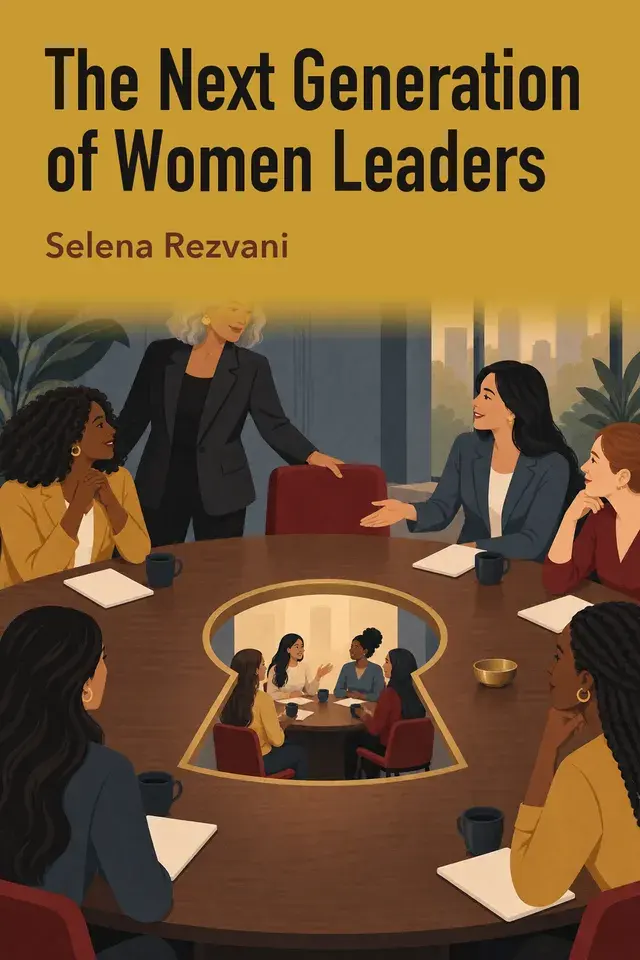
The Next Generation of Women Leaders, by Selena Rezvani.
The book begins with a gap between women’s presence in the workforce and their representation at the top. In the late-two-thousands figures Rezvani cites, women made up 46.5 percent of the U.S. workforce but only 15.7 percent of Fortune 500 corporate officers. Women held 3 percent of those companies’ chief executive roles in 2009. These are historical snapshots, not timeless measurements, but they establish the problem the book sets out to address.
The gap is striking beside women’s educational achievements. In data from 2007, women earned more than half of bachelor’s and master’s degrees and nearly half of doctorates. In law, they made up 46.7 percent of students, 34.4 percent of lawyers, and 18.7 percent of partners. Rezvani argues that when fewer women reach senior posts, younger women also have fewer visible examples and fewer chances to learn from women leaders. The issue is therefore not only access to individual jobs, but also whether leadership feels like a realistic future.
Rezvani points to social expectations as one reason women’s abilities can be discounted. In a state university study she cites, 141 students reviewed syllabi for several courses, including Sociology of Gender. The researchers compared ratings of the same Sociology of Gender syllabus under a female instructor’s name and a male professor’s name. Students were more likely to say the syllabus made the course appear overly political and biased, with subjective exams and papers, when it named a woman. With a male professor’s name, students gave more favorable ratings for reasonable workload, instructor credibility and availability, and lower bias. The syllabus did not change; the judgment did. The example suggests that assumptions about who is presenting an idea can affect how it is received.
A related double bind appears when women behave assertively. In a cited job-interview study, ambitious women were judged competent but lacking in social skills, which lowered their chances of being hired. Confident men, by comparison, were seen as both competent and likable. Women may also be criticized for seeming too feminine or too masculine. Rezvani uses these findings to show how narrow expectations can make the same quality—confidence—read as an asset in one person and a social flaw in another.
Economic inequality adds another barrier. The book cites figures showing that women’s median full-time weekly earnings in 2008 were 79.9 percent of men’s, after reaching 81 percent in 2005. Rezvani treats unequal pay as an injustice in itself. She adds that if a woman thinks she will not be paid fairly for equal work, she may be discouraged from becoming an executive or dismiss it as a worthwhile career path. If a woman expects less reward for comparable effort, the imbalance can shape not only her paycheck but also whether advancement appears to offer a fair return.
There are also psychological barriers. Rezvani describes women turning down assignments or promotions because they believe they lack enough experience, authority, financial skill, or confidence. Jeanine Becker, a senior counsel at Motorola, says women may feel they need a certain level of prior training and experience that men do not necessarily demand before stepping into a new role. This hesitation can be especially strong early in a career, when confidence and experience are still developing. The book’s point is not that every woman faces the same doubts, or that every concern is baseless. It is that fear of making an irreversible mistake can rule out opportunities before a person has tested what support would make success possible. Rezvani emphasizes that young careers can adapt, so a difficult choice need not define an entire working life.
Rezvani connects this argument to her own change in behavior. She interviewed 30 senior women from varied fields, asking what younger women should understand about advancement and influence. Applying what she heard, she asked for a substantial raise, became keenly aware of unnecessary apologies and phrases that diminished the strength of her ideas, and brought evidence of her accomplishments to a performance review. Her experience shows what acting on advice can look like; it does not suggest that individual assertiveness removes unequal systems.
Awareness of barriers can help a person respond more deliberately. When work or ideas are discounted, recognizing a familiar stereotype can keep that reaction from becoming proof of personal inadequacy. At the same time, self-doubt and structural obstacles are different kinds of barriers. Questioning an unsupported belief may create room to act, while unequal pay or biased evaluation also calls for changes in how organizations judge and reward people. For Rezvani, seeing the barriers clearly is a reason to navigate them, not a reason to withdraw.
The case for women’s leadership rests on fairness and organizational value. Rezvani argues that organizations benefit when leadership reflects the people who work there, and that inclusive cultures give employees more room to use their abilities and take productive risks. She links effective diversity management with retaining employees and customers. She also cites a DiversityInc study reporting that, over a ten-year period, publicly traded companies in its Top 50 Companies for Diversity Index yielded as much as 23.5 percent higher returns than the Standard & Poor’s 500, with dividends reinvested. The figure is one piece of the book’s business case, alongside its argument that inclusion is the fair thing to pursue.
Rezvani adds that women’s influence over consumer purchases can make women leaders a source of insight about customers. These arguments do not require assuming that all women lead alike or possess identical strengths. They support a broader point: organizations lose perspective and talent when they overlook capable people, and representation matters both to those seeking opportunity and to the institutions making decisions. The chapters that follow turn from this case for change to the practices women can use to shape their careers.
Chapter 2 of 10 · 8 min · Audio & textIn the app
Turn Self Knowledge Into Direction
A career direction need not arrive as a single revelation. It can take shape as you learn what matters to you, notice which work uses your strengths, and test ideas against experience.
Chapter 3 of 10 · 9 min · Audio & textIn the app
Build Credibility and Leadership Presence
Credibility starts with the work already entrusted to you. A role has its visible duties, along with expectations that take time to understand.
Chapter 4 of 10 · 10 min · Audio & textIn the app
Make Contribution and Ambition Visible
Doing good work matters, but people need to understand what you contributed and where you hope to go before they can connect you with opportunities. Rezvani’s advice is to make that evidence visible while continuing to deliver, learn, and build the skills leadership requires.
Chapter 5 of 10 · 9 min · Audio & textIn the app
Build Networks That Create Opportunity
Networking can sound like collecting names or working a room. Rezvani gives it a more lasting purpose: creating relationships through which people learn, support one another, and connect each other with opportunities.
Chapter 6 of 10 · 8 min · Audio & textIn the app
Develop Leadership Beyond Your Role
Building relationships can reveal new possibilities. Concrete learning and responsibility beyond a job description can add the skills and evidence to pursue them.
Chapter 7 of 10 · 9 min · Audio & textIn the app
Negotiate With Preparation and Confidence
Negotiation is a learnable skill for shaping decisions, not a rare event reserved for salary offers or major deals. It can help with pay, assignments, promotions, workload, training, and disagreements, as well as everyday choices.
Chapter 8 of 10 · 8 min · Audio & textIn the app
Read and Shape Workplace Politics
A proposal can be sound and still stall if it ignores how decisions actually happen. Office politics names the often-unspoken rules and relationships that shape who has influence, what information moves, and how work gets done.
Chapter 9 of 10 · 9 min · Audio & textIn the app
Design Work Around a Whole Life
Many leadership roles reward long hours and constant availability, while a full life includes responsibilities beyond work. The expectation that an executive must always be ready can make caregiving and personal health seem like private obstacles.
Chapter 10 of 10 · 7 min · Audio & textIn the app
Shape a Career With Lasting Meaning
Career myopia sets in when every decision is judged only by what it does for the job in front of you. Rezvani asks readers to look across a longer span and consider the work, experiences, and positions they hope to reach.
Chapter 1 of 10 · 8 min · Audio & text: Why Leadership Still Needs Women
Wiseley supports reading and listening to summaries in the app.
Continue in WiseleyAbout Selena Rezvani

Selena Rezvani is the author of “The Next Generation of Women Leaders”. The book explores why capable women still encounter barriers to leadership and how they can build careers with greater agency.
Explore more books by Selena Rezvani