What you'll learn
Key ideas from The Nazi Conspiracy
These ideas compress the book's argument without treating the author's view as settled fact. Use them as an orientation before reading the full work or listening in Wiseley.
Nazi racial ideology turned occupation into deliberate warfare against civilians, with Leningrad showing how starvation could serve a policy of population elimination.
The second-front dispute combined real Soviet battlefield sacrifice with British fears that an early cross-Channel landing would become a catastrophic defeat.
Cicero’s documents and the reported Persian-rug clue show intelligence access, but capability and interest still fall short of an authorized assassination plan.
Relocation accepted Soviet protection and its political complications because avoiding repeated travel mattered even without proof of a complete assassination plot.
The agreement joined a May invasion with southern support, Soviet offensives in the east, and deliberate deception.
The authors find a real danger plausible, while leaving the operation’s full scope, leadership, and dramatic details unproved.
Roosevelt's fourth term, Yalta's partial agreements, and his death before victory reveal that defeating Germany did not settle peace or accountability.
Inside The Nazi Conspiracy
Read the first chapter in full here. The other 9 continue in the Wiseley app.
Chapter 1 of 10 · 11 min · Audio & text
How Enemies Became Necessary Allies
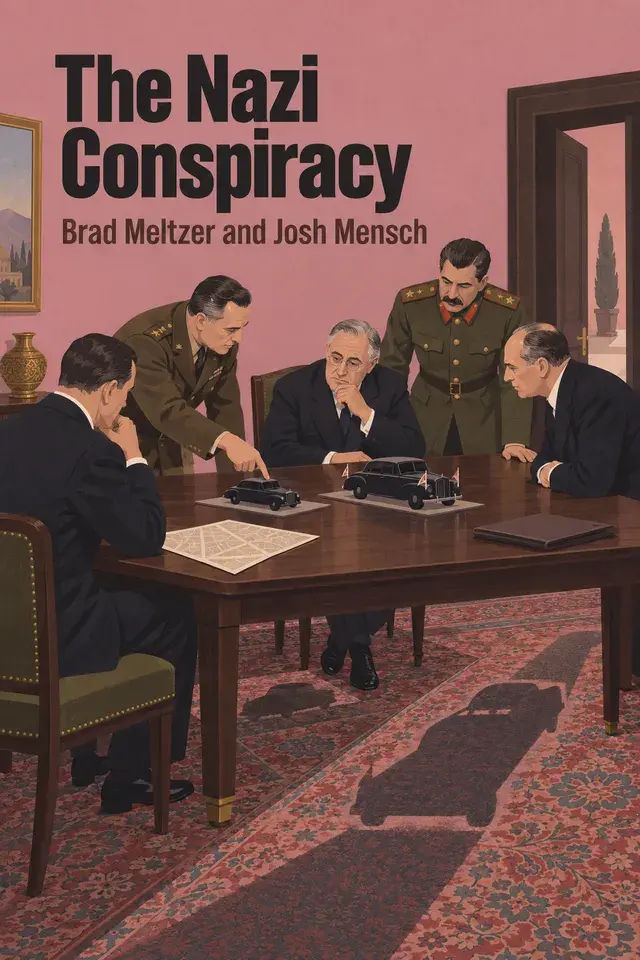
The Nazi Conspiracy, by Brad Meltzer and Josh Mensch.
The Allied coalition did not begin as a community of shared political values. It formed because separate threats converged, while leaders repeatedly misjudged what their actions would produce. American isolationism, Japanese expansion, Pearl Harbor, Hitler’s declaration of war, and Germany’s failure to defeat the Soviet Union gradually created a partnership among governments that otherwise had little in common.
American isolationism grew from the human cost of the First World War, disillusionment with overseas commitments, and the economic devastation of the Depression. Many Americans wanted recovery at home, not another foreign war. Military power remained a low priority; in 1939, the American Army ranked nineteenth in the world. Roosevelt recognized Nazism as a grave danger, but Congress and public opinion limited what he could do before circumstances changed.
Public opinion was not completely uniform. Some German American groups adapted Nazi rhetoric to American patriotism, racism, and anti-Semitism. The German American Bund even staged a large rally at Madison Square Garden. Henry Ford circulated anti-Semitic material, and Charles Lindbergh used the America First movement to promote white supremacy and nonintervention. At the same time, Jewish Americans pressed for stronger opposition, and popular culture expressed an increasingly open resistance to Hitler. These contrasts mattered because Roosevelt had to act within a divided country, not an eager one.
Lend-Lease showed how far action could move ahead of formal intervention. In March 1941, Roosevelt authorized military supplies for Britain without sending American troops. The policy supported a country fighting for survival while remaining short of a declaration of war. It also exposed the limits of presidential freedom: in April, eighty-one percent of Americans still opposed entering the conflict. Lend-Lease was therefore both a strategic commitment and a domestic compromise. It helped Britain endure, but it did not erase the public’s resistance to direct involvement.
The danger confronting Britain came from a regime whose nationalism was explicitly racial. Hitler promised to restore German strength by blaming defeat and hardship on immigrants, minorities, Jews, intellectuals, urban elites, and progressive ideas. Nazi leaders turned those accusations into a conspiracy story about Jews and global forces supposedly controlling Germany’s fate. The regime codified racial supremacy, attacked political enemies, rearmed in violation of the postwar settlement, and expanded through threats and annexations. Institutional genocide belongs to the later story, but the political logic was already visible: racial ideology joined domestic repression to aggressive foreign policy.
Japan’s expansion followed a different historical path, though it also became an imperial and racial project. Japanese leaders argued that Western powers had colonized and exploited Asia, and that Japan had to become strong enough to resist them. That criticism had some basis, but Japan used the language of liberation while controlling Korea, creating Manchukuo after invading Manchuria, and attacking China. Its belief in Japanese superiority helped justify atrocities in occupied territories. Roosevelt opposed colonial conquest in Europe and Asia, supported China, and relied on the American Pacific Fleet as a deterrent.
Japan’s alliance with Germany and Italy was meant to discourage American interference. Instead, it helped produce alarm, sanctions, and an oil embargo. Japanese militarists concluded that conflict with the United States might be unavoidable and that a sudden attack was preferable before American naval strength grew further. They believed one overwhelming blow could disable the fleet and persuade the United States to stop policing the Pacific. That assumption turned a tactical calculation into a strategic gamble.
The gamble began with remarkable operational success. Japanese carriers traveled roughly three thousand five hundred miles under strict secrecy and approached Hawaii in battle formation. The attack on Pearl Harbor caught the base unprepared, destroyed or damaged ships and aircraft, and caused severe loss of life. It was also part of a wider offensive against American and British positions across the Pacific. Yet its strategic consequence was almost the opposite of Japan’s intention. Instead of frightening the United States away, the attack unified American opinion behind war.
Roosevelt responded with a short, direct speech that described the attack as deliberate and requested a declaration of war. Congress acted rapidly, declaring war on Japan. The distinction is important: Pearl Harbor did not itself produce an immediate American declaration of war against Germany. The United States had entered the Pacific conflict, while the European decision remained unresolved until Hitler made it for him.
Churchill understood why that distinction mattered. After France fell, Britain was the principal European power still fighting Germany. German bombing threatened British cities, while the English Channel, the Royal Navy, and the Royal Air Force stood between Britain and catastrophe. Churchill had long regarded American involvement as Britain’s great hope. When Roosevelt confirmed the Pearl Harbor attack and said that the two countries were now in the same boat, Churchill felt relief because the United States had finally entered the war against Japan. But he was still waiting for the larger alignment in Europe.
Churchill’s cooperation with Stalin was even more morally uneasy. After Germany attacked the Soviet Union, Britain supported Stalin because the Soviet Army was fighting the same enemy. Yet Stalin led a communist and authoritarian regime associated with murder, mass violence, and atrocities. The Soviet Union had also collaborated with Hitler in conquering Poland before the German invasion. Churchill therefore had to treat an oppressive former partner of Germany as a necessary ally. The coalition was built on urgent necessity, not trust.
Meanwhile, Hitler was facing the first serious military setback of the war. He had invaded the Soviet Union seeking territory, resources, anti-communist victory, and the persecution of Jewish populations. German forces advanced rapidly at first, but the campaign stretched supply lines across enormous distances. Hitler expected victory before winter and failed to provide adequate cold-weather equipment. Soviet resistance strengthened, and on December fifth, Soviet forces launched a counterattack against German forces advancing toward Moscow. Germany pulled back into defensive positions. It still held much western Soviet territory, but the retreat damaged Hitler’s image of invulnerability and gave Stalin time to prepare.
Pearl Harbor gave Hitler a way to hide that setback behind a new public narrative. Some German officials feared that American entry would add another powerful enemy while Germany was already fighting Britain and the Soviet Union. Hitler reacted differently. He saw the Japanese attack as renewed momentum and as a diversion from the Eastern Front. Several ministers urged caution, but Hitler believed a great power had to remain the aggressor, project strength, and dictate events. He also underestimated the United States through racist assumptions. Without consulting his military leaders, he ordered a formal declaration of war.
On December eleventh, Hitler addressed a Reichstag whose opponents had been removed and whose proceedings were carefully controlled. He presented German victories, used inaccurate casualty figures, and omitted the Soviet counteroffensive, the failure to capture Moscow, and the suffering of German troops. He attacked Roosevelt personally, then shifted into anti-Semitic conspiracy rhetoric, portraying Roosevelt and Churchill as instruments of an invented Jewish and globalist threat. The speech made propaganda serve strategy: it concealed weakness, personalized the enemy, and presented escalation as strength. Germany was now directly at war with the United States, alongside Japan and Italy, against Britain, the Soviet Union, and the United States.
By the end of this sequence, the coalition existed in military fact but not in political harmony. The United States had moved from nonintervention to war through a mixture of pressure, aid, and attack. Britain welcomed American power because survival required it. Stalin cooperated because Germany threatened the Soviet Union, despite the regime’s authoritarianism and earlier dealings with Hitler. Japan’s tactical victory had produced the opposite strategic result, and Hitler’s propaganda triumph had helped widen Germany’s war. The Allied partnership was therefore born from converging threats and strategic miscalculations. Its members did not share a political vision; they shared enemies, dangers, and the need to keep one another in the fight.
Chapter 2 of 10 · 10 min · Audio & textIn the app
The Regime Behind the Threat
The Nazi threat becomes intelligible only when its intelligence work is placed inside the regime’s racial war. Germany’s invasion of the Soviet Union sought strategic conquest, but it was also an ideological campaign against Slavs, communists, and Jews.
Chapter 3 of 10 · 6 min · Audio & textIn the app
What Killing a Leader Changes
Killing a prominent enemy figure is never only a question of whether the weapon reaches its target. The strike may remove a commander, lift allied morale, expose an intelligence source, or trigger punishment against people who had no role in the attack.
Chapter 4 of 10 · 9 min · Audio & textIn the app
Iran's Underground and Its Undoing
Iran joined Germany's interest in oil and geography to the Allied war effort. After Germany attacked the Soviet Union, Britain and the Soviet Union occupied Iran, and American and British supplies moved north on the Trans-Iranian Railway.
Chapter 5 of 10 · 10 min · Audio & textIn the app
Bargaining for a Second Front
At Casablanca, the Allies displayed a united front, but the strategic weakness was clear: Stalin was absent. Roosevelt regarded that absence as the conference’s central failure because Soviet forces were carrying the main ground fight against Germany.
Chapter 6 of 10 · 8 min · Audio & textIn the app
Capability, Intelligence, and an Alleged Opportunity
By late 1943, Nazi leaders had a reason to believe a small team could do what an army could not. Otto Skorzeny was a wounded Waffen-SS officer experienced in engineering, explosives, flight, weapons, and battlefield leadership.
Chapter 7 of 10 · 8 min · Audio & textIn the app
Protecting Roosevelt Under Uncertain Intelligence
Once Tehran became fixed, Reilly’s protective problem began long before the leaders met. Roosevelt had to cross the Atlantic, pass through Allied bases, fly onward, and then move through Tehran.
Chapter 8 of 10 · 8 min · Audio & textIn the app
Turning a Meeting Into Commitments
Tehran’s lasting achievement was not a ceremony or a single promise. It was the conversion of three competing strategies into coordinated military commitments.
Chapter 9 of 10 · 10 min · Audio & textIn the app
What the Evidence Can Establish
The central question now is not whether Tehran was dangerous, but what the surviving evidence can establish about the alleged plan to kill the three Allied leaders. The authors take a middle position: a genuine German threat is plausible, perhaps in limited form, but the record does not securely reconstruct the operation later stories describe.
Chapter 10 of 10 · 8 min · Audio & textIn the app
Victory's Costs and an Unfinished Peace
The Tehran conference mattered most in what it set in motion. The Three Powers declaration paired a promise of peace with a commitment to destroy German forces and intensify the attack.
Chapter 1 of 10 · 11 min · Audio & text: How Enemies Became Necessary Allies
Wiseley supports reading and listening to summaries in the app.
Continue in WiseleyAbout Brad Meltzer & Josh Mensch

Brad Meltzer
Brad Meltzer is an American writer. “The Nazi Conspiracy” explores a reported Nazi plot to assassinate Roosevelt, Churchill, and Stalin and what the conflicting evidence can establish.
Explore more books by Brad Meltzer
Josh Mensch
Josh Mensch is a coauthor of “The Nazi Conspiracy”. The book explores a reported Nazi plot to assassinate Roosevelt, Churchill, and Stalin and what the conflicting evidence can establish.
Explore more books by Josh Mensch