What you'll learn
Key ideas from The More of Less
These ideas compress the book's argument without treating the author's view as settled fact. Use them as an orientation before reading the full work or listening in Wiseley.
Minimalism is defined as removing distractions so possessions support a personally meaningful life.
Accumulation grows when marketing turns ordinary products into promises of security, acceptance, pleasure, or contentment.
Handling every item and sorting it into keep, relocate, or remove turns vague intention into a concrete decision process.
Temporary separation turns uncertain needs into evidence about actual use, missed items, and practical consequences.
The lasting shift is from owning less to wanting less, supported by repeated routines and practiced appreciation.
Family minimalism depends on consent, calm discussion, and agreements about shared areas; secretly discarding another person’s belongings damages the practice.
Freed money, time, and skills can support chosen causes, volunteering, and everyday help without requiring one person to solve every need.
Recovered freedom needs a chosen destination, whether service, family, health, creative work, rest, or another purpose, as illustrated by the pearl and The Hope Effect.
Inside The More of Less
Read the first chapter in full here. The other 8 continue in the Wiseley app.
Chapter 1 of 9 · 8 min · Audio & text
Make Possessions Serve Your Purpose
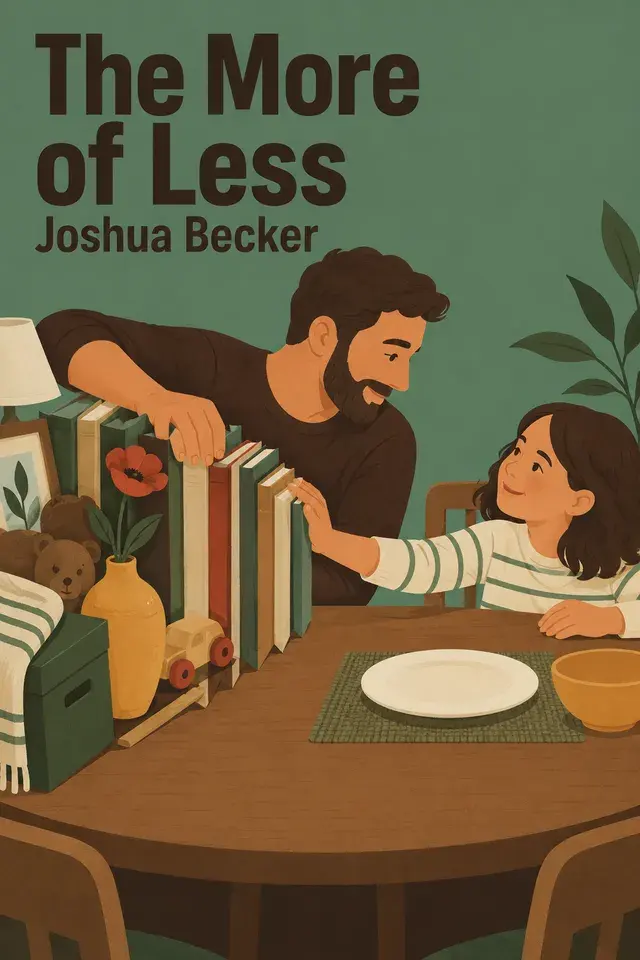
The More of Less, by Joshua Becker.
When possessions fill a room, the key question is not whether the room can be made tidier. It is whether those possessions are serving the life you value, or consuming the time, money, attention, and energy that life requires. Joshua Becker’s central argument is that minimalism is intentional promotion: keep and use what supports what matters most, and remove what distracts from it. The point is not an empty home. It is a home whose contents are helping rather than competing with your purposes.
That distinction separates minimizing from organizing. Organizing rearranges possessions, buys containers, or finds more storage. It may calm a room, but the excess remains and must be managed again. Minimizing removes what is unnecessary. It changes the buying pattern and the costs of storing, cleaning, repairing, replacing, and disposing of things. Organization has a place, but it cannot answer whether an item deserves the resources required to own it.
Less does not mean none. A minimalist household may still contain seating, clothing, books, toys, craft supplies, and a television. There is no universal item count, required home size, or single model for everyone, nor is frugality the whole goal. Fewer excess possessions can make room for quality where quality matters. The standard is functional and personal: does this possession help someone live the life they are trying to live? That answer can change with work, family, health, hospitality, or responsibility.
Becker learned this standard in a garage, not in a definition. On the Saturday of Memorial Day weekend, he spent much of the day cleaning and managing belongings while his son wanted him to play. The work looked responsible, but its opportunity cost was visible: he was giving a day of relationship to objects. A neighbor’s comment helped him see that the pile itself, not merely the disorder, was part of his discontent. He and Kim began selling, giving away, and discarding things. Within six months, they had removed about half of what they owned. The important change was not a perfect garage. It was the recognition that ownership had become a claim on family time.
Ownership has a long tail. It asks people to earn money for purchases, research, shop, maintain, organize, repair, replace, and sell. Each task may seem small, but together they consume attention that could go to relationships, creative work, rest, faith, health, or service. Becker does not say every possession creates equal burden or every reader gets the same benefit. His point is that excess has an opportunity cost, even when its price and clutter are easy to ignore.
The Balthrops show what happens when possessions no longer match stated priorities. Dave and Sheryl had financial resources, yet their home-centered lifestyle did not fit their priorities of family, faith, health, savings, and retirement. They sold or gave away much of their property and moved to a smaller home. Becker presents the result as less distraction and more room for family, faith, and peace of mind. Dave discovered writing, and Sheryl redirected her legal practice toward mediation and families in need. Their story does not mean everyone should move or share those priorities. It shows how removing excess can create margin, then reveal neglected roles and work.
This is why Becker treats minimalism as a process of discovery, not merely a philosophy to understand before acting. Some people know exactly what they want their possessions to support. Others begin with a vague sense that their current arrangements are taking too much. In either case, action can supply information. When an item leaves, you may notice more time, less maintenance, or a neglected desire. Those observations sharpen your purpose, and a clearer purpose improves the next decision. The relationship runs both ways: purpose guides reduction, while reduction clarifies purpose.
Becker writes from a Christian perspective, and his faith shapes the way he interprets simplicity, responsibility, and service. That perspective is part of his story, not a test readers must pass. He also presents the underlying lesson as broadly human: possessions should fit a person’s calling rather than dictate it. In his discussion of biblical examples, he resists turning one person’s renunciation into a rule for everyone. Different roles can require different resources, while excess can still obstruct the work those resources are meant to support.
Before sorting anything, identify the life possessions are supposed to serve. Think about the roles you inhabit or want to inhabit: parent, partner, friend, professional, caregiver, neighbor, learner, artist, volunteer, or person of faith. Consider formative experiences, energizing work, valued achievements, unrealized dreams, admired qualities, and the legacy you hope to leave. You do not need a complete life plan. Choose the few priorities that deserve more of your limited resources.
Write a provisional statement beginning, “Owning less should make it possible for me to...” Complete it with a concrete direction, such as being present with family, making room for meaningful work, protecting health, practicing faith, welcoming people, or contributing to a cause. It is not a slogan or a promise that decluttering will solve everything. It is a decision standard. Let actual choices revise it. If a possession supports the statement, its place may be justified. If it repeatedly consumes resources needed for the statement, its claim deserves examination.
That question can govern every later decision: buying, keeping, giving, and replacing. It keeps minimalism from becoming a contest. The aim is not to own the fewest things, imitate Becker’s household, or turn deprivation into virtue. It is to remove distractions until possessions serve a meaningful life. The garage revealed the cost of missing that standard; the Balthrops showed how acting on it can uncover obscured purposes. Your purpose may become clearer through this continuing exchange between what you value and what you choose to carry.
Chapter 2 of 9 · 9 min · Audio & textIn the app
Understand What Makes You Buy
Once we ask what possessions are meant to serve, a harder question follows: why do unwanted ones keep arriving? Becker’s answer joins an external force with an internal one.
Chapter 3 of 9 · 7 min · Audio & textIn the app
Build Momentum Through Small Removals
Once you have written down why you want to simplify, the next step is not to invent a perfect storage system. It is to remove something.
Chapter 4 of 9 · 8 min · Audio & textIn the app
Release Objects Without Erasing Meaning
Once the obvious excess has been removed, decluttering changes character. The hard questions are no longer simply whether an object is useful.
Chapter 5 of 9 · 8 min · Audio & textIn the app
Discover Enough Through Real Experiments
When the right amount of something is unclear, Becker recommends replacing speculation with a controlled trial. The question is not whether a minimalist rule declares one number correct, but whether fewer possessions help this particular life.
Chapter 6 of 9 · 8 min · Audio & textIn the app
Keep Clutter From Returning
A clearout can create a dramatic before-and-after, but empty space is not self-protecting. If old habits remain, possessions return through shopping, gifts, postponed decisions, and ordinary items left where they were used.
Chapter 7 of 9 · 9 min · Audio & textIn the app
Simplify Together Without Forcing Agreement
Minimalism changes character when it enters a family. Alone, you decide what to own and what to remove.
Chapter 8 of 9 · 9 min · Audio & textIn the app
Turn Surplus Into Deliberate Generosity
Owning less creates a question beyond what to remove: what should happen to the money, time, and objects no longer tied up in accumulation? Becker presents generosity as the outward turn of minimalism.
Chapter 9 of 9 · 9 min · Audio & textIn the app
Spend Your Freedom on What Matters
The practical work of owning less reaches its real test after the objects are gone: what will the recovered time, attention, money, and energy serve? Becker extends intentionality into the rest of life.
Chapter 1 of 9 · 8 min · Audio & text: Make Possessions Serve Your Purpose
Wiseley supports reading and listening to summaries in the app.
Continue in WiseleyWhat The More of Less is about
What could owning less make room for? Joshua Becker explores how possessions compete with relationships, purpose, and generosity. This summary explains the motives behind accumulation and practical ways to declutter, test what is enough, navigate family differences, and use recovered time and money more intentionally.
About Joshua Becker

Joshua Becker is an American writer. “The More of Less” explores what owning less can make room for and how possessions compete with relationships, purpose, and generosity.
Explore more books by Joshua Becker