What you'll learn
Key ideas from The Metaverse Handbook
These ideas compress the book's argument without treating the author's view as settled fact. Use them as an orientation before reading the full work or listening in Wiseley.
The Metaverse is an unfinished continuum of increasingly digital work, identity, relationships, recreation, and attention.
Corporate announcements can draw attention, but failed predictions make sustained builders and working communities important evidence.
Sandbox worlds let users create within shared rules, while community activity and useful experiences give people reasons to return.
Adoption may grow gradually through familiar interests and friend networks, with each person choosing an activity and interface that fit.
Digital assets can express identity, community membership, and status, with personal meaning extending beyond resale price.
Portability claims are clearest when they specify what moves, what changes, who controls the connection, and which costs and risks remain.
Inside The Metaverse Handbook
Read the first chapter in full here. The other 8 continue in the Wiseley app.
Chapter 1 of 9 · 8 min · Audio & text
Forecasts for a Future Internet
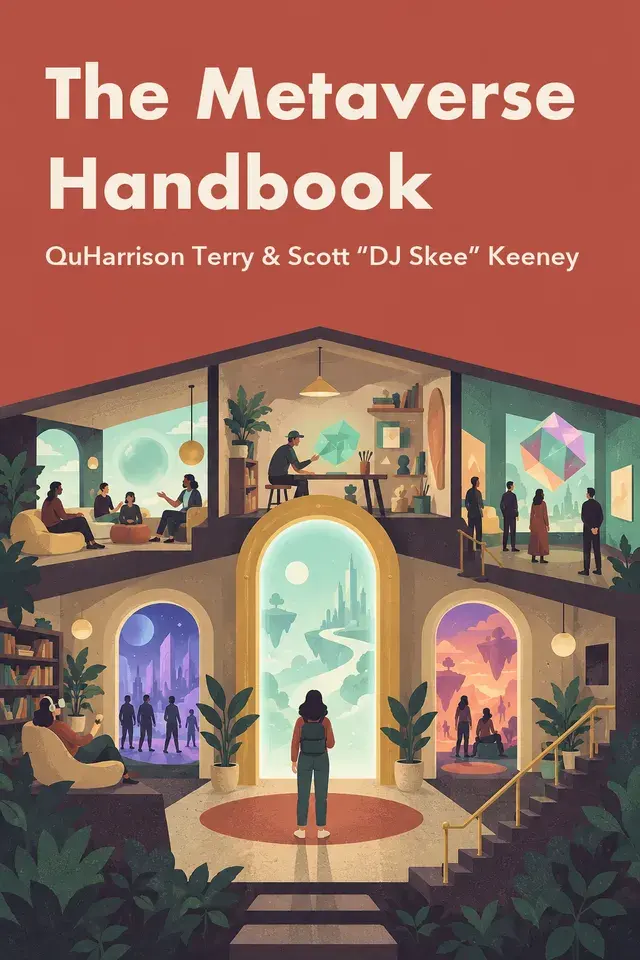
The Metaverse Handbook, by QuHarrison Terry & Scott “DJ Skee” Keeney.
The authors invite readers to imagine digital life in 2032: more immersive, more personal, and more assisted by software. This is a future scenario, not a report that a finished Metaverse has arrived. The question is how familiar activities might change as virtual environments, useful services, and social experiences come together.
Extended reality, or XR, sits at the center of that question because the authors see it as a new way to communicate. Games, entertainment, and commerce might persuade people to try immersive devices, while meeting and interacting with others could give them a reason to return. John Riccitiello predicts that virtual and augmented reality headsets could be as common as gaming consoles by 2030. He does not predict that they will be as widespread as smartphones. The authors use that distinction to frame a possibility, not a guaranteed adoption date, and ask which applications could become part of everyday life by 2032.
Coca-Cola’s CC Metro offers an early example of what a social branded space can contain. The authors describe it as an island created in 2007, where avatars could shop, dance, watch films, ride hoverboards, play, and meet other people. Coca-Cola also integrated its MyCokeRewards program. The setting offered entertainment and social activity alongside a connection to the brand; it was more than a virtual billboard.
But CC Metro’s existence does not prove that later virtual worlds will win a large audience. Earlier worlds lost ground to two-dimensional social networks, which were easier to join and offered immediate gratification. The authors take this history as a reason to ask what would make new environments useful and appealing. A branded place might attract attention, but repeat participation would depend on what people could do there and with whom.
One possibility is that each person has a curated digital home: a personal base for organizing applications, games, work tools, meetings, events, and communities. The shared environment would then be made up of many smaller spaces shaped around individual interests and needs. The authors point to RTFKT’s Spacepods as an early move toward three-dimensional galleries and possible social centers. They also acknowledge that the project’s ultimate direction was undisclosed and doubt that its near-term form would go much beyond a gallery. These examples suggest a direction, not a settled model for how people will use personal spaces.
In this scenario, familiar services could be redesigned around the space rather than simply copied from a phone or computer screen. The authors imagine a newspaper appearing at the doorstep of a virtual home, a visit to a friend’s space as a way to reach Instagram, or Salesforce becoming an assistant in a virtual office. These are speculative examples. Existing touch-screen applications and controller-based games may not translate well to headsets, so the interfaces and experiences would need to be rethought. The broader change would be in how people encounter digital conveniences and services, not just in adding another standalone platform.
Bots could help make those spaces practical by taking on routine tasks. The authors point to existing workplace and community bots that schedule meetings, track progress, process reimbursements, moderate groups, translate, and suggest content. They imagine such helpers carrying out actions on a person’s behalf in immersive environments. In the authors’ forecast, interacting with bots and digital humans will become a primary means of social interaction in the Metaverse. This does not mean people stop engaging with one another: these digital helpers will carry out tasks, provide services, and curate experiences with other people. The authors reject a bleak future in which people are pushed aside by their automated helpers.
The authors also imagine some of these services taking visible form as digital humans. If speaking becomes a common way to use immersive environments, a user might ask an embodied assistant for help instead of working through menus. Companies such as UneeQ, Synthesia, and Soul Machines are cited as developing digital humans for uses like financial updates, weather forecasts, and beauty consultations. Looking ahead, the authors picture an invited assistant waiting until needed, then helping organize schedules, find events or communities, or manage work. These are examples of the role digital humans might play, rather than evidence that personal assistants already work this way.
Existing bots also show how automation can affect communication more directly. Boy Bye Bot was a project created by Hassan S. Ali in 2017; women could give its number to men who persistently asked for theirs, and the bot would turn them away. The authors also describe Replika, a chatbot platform that grew from a bot Eugenia Kuyda made using messages from a friend who had died. The chatbot learned his texting quirks and nuances, and the platform took an interest in what users were doing and feeling. The authors say hundreds of thousands of people treated this digital companion as a close friend. These examples span delegated communication and companionship, showing how automated interaction had already reached beyond workplace efficiency.
Paris Hilton’s experience, described in the foreword, offers a creator-led example of people experimenting with these formats. After an early encounter with Ethereum, she bought cryptocurrency, became an avatar through a three-dimensional scan, and built a virtual reality world where she could socialize and perform for friends and fans. Learning about NFTs led her to make a charity NFT based on a drawing of her cat, Kitty. Later, she DJed at a Decentraland festival and built Paris World in Roblox as a virtual place for fans. Taken together, these steps trace a path through crypto, avatars, virtual reality, NFTs, and virtual performance. They show how one creator moved between technologies and forms of participation; they do not establish that every creator, or audience, will follow the same route.
The authors’ forecast keeps physical life in view. They expect digital activity to matter more to social life, brands, and creators, but they do not claim that the physical world will disappear. Nor do they present the 2030–2032 vision as inevitable: household use of XR, personal digital homes, and routine assistance from bots remain projections. Their central idea is that adoption could grow through layers of useful and social experiences. Immersive communication could give people a reason to gather, personal spaces could organize services around them, and bots could reduce everyday friction. Together, these possibilities frame the book’s question about how digital life might change while people continue living in the physical world.
Chapter 2 of 9 · 14 min · Audio & textIn the app
Defining the Digital Continuum
People use the word “Metaverse” for different things: a virtual reality product, a social world, a new Internet, or a collection of blockchain projects. The authors treat that disagreement as a sign that the idea is still taking shape.
Chapter 3 of 9 · 11 min · Audio & textIn the app
Parallel Histories, Persistent Builders
The history of the Metaverse begins with a puzzle of attention. People often wait for a famous leader or a large company to validate an emerging field.
Chapter 4 of 9 · 7 min · Audio & textIn the app
Tools for Making Virtual Worlds
Making a virtual world is a layered craft. A creator may shape an object in one application, bring it into a real-time engine, then rely on formats and standards to make the result usable across devices.
Chapter 5 of 9 · 10 min · Audio & textIn the app
Sandbox Worlds as Experiments
A sandbox world gives people room to create without assigning everyone one fixed goal. Users can build, express themselves through avatars, and make experiences within the platform’s shared structure.
Chapter 6 of 9 · 8 min · Audio & textIn the app
Many Doors into Digital Life
There is more than one way to enter the Metaverse. A person might start with a game, a social gathering, a digital version of a familiar place, or a shop that connects virtual browsing with physical goods.
Chapter 7 of 9 · 10 min · Audio & textIn the app
Ownership, Identity, and Assets
A digital possession can help someone present themselves, signal affiliation, enter an activity, or shape a place. It may also have a price.
Chapter 8 of 9 · 12 min · Audio & textIn the app
Portability, Fragmentation, and Trust
The Metaverse’s promise depends on more than putting many digital places on one map. It depends on continuity: a person’s money, chosen objects, and participation should retain meaning when that person moves between worlds.
Chapter 9 of 9 · 7 min · Audio & textIn the app
Plans for Lasting Participation
The authors’ “million virtual miles” idea asks participants to think about whether their plans can endure. They borrow the image of Volvo owners keeping cars on the road for a million miles, then apply that patience to a very different kind of thing: software.
Chapter 1 of 9 · 8 min · Audio & text: Forecasts for a Future Internet
Wiseley supports reading and listening to summaries in the app.
Continue in WiseleyAbout QuHarrison Terry & Scott “DJ Skee” Keeney

QuHarrison Terry
QuHarrison Terry is a coauthor of “The Metaverse Handbook”. The book explores what an immersive, user-owned internet could become and how people might participate in it.
Explore more books by QuHarrison Terry