What you'll learn
Key ideas from The Memory Palace
These ideas compress the book's argument without treating the author's view as settled fact. Use them as an orientation before reading the full work or listening in Wiseley.
A familiar route supplies a stable sequence, and its fixed locations give each item a place.
A distinctive image links an abstract title to concrete visual or sensory details at a specific stop.
Numbers, sounds, names, characters, and exaggerated actions turn Shakespeare’s titles into varied retrieval images.
Learning the route’s movement before encoding lets attention focus on the title images at each stop.
Questions about sequence, position, neighbors, distance, and image identity test different relationships among list items.
Answer checks reveal gaps in recall and help identify which part of the route needs another review.
Inside The Memory Palace
Read the first chapter in full here. The other 3 continue in the Wiseley app.
Chapter 1 of 4 · 4 min · Audio & text
Build the Palace in Place
The Memory Palace, by Lewis Smile.
A list of titles can be hard to hold when each item is only a few words on a page. Lewis Smile’s Memory Palace method gives those words an ordered setting: a familiar route, with a distinct image attached to each place. The route supplies the sequence; the image gives each title something concrete to bring to mind. Together, they offer more cues than a bare list.
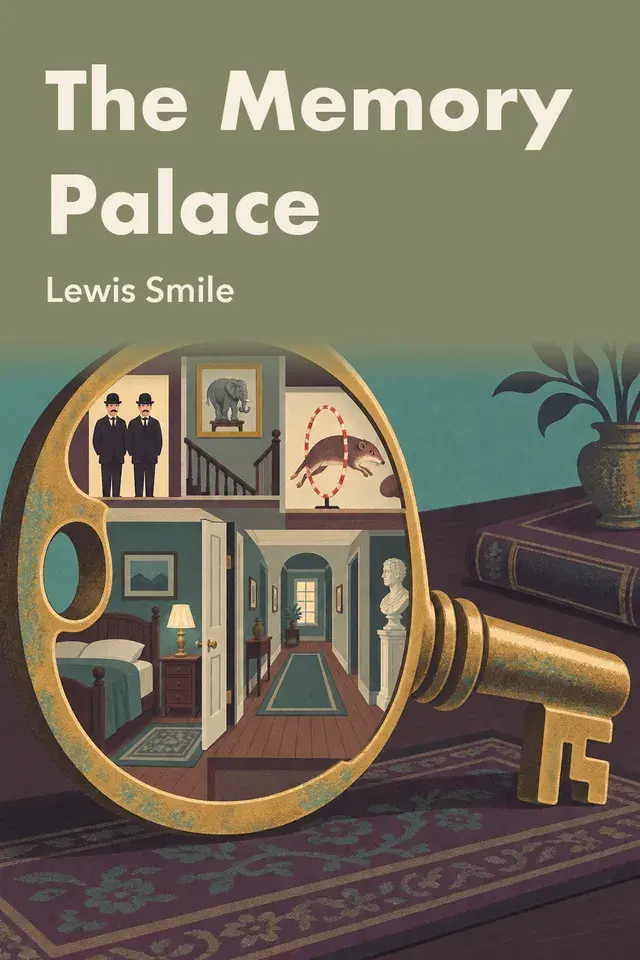
Begin with a route you already know well enough to picture in order. It might pass through rooms at home or follow another familiar journey. What matters is that the places feel settled in your mind, so you can mentally move from one to the next without having to invent the route as you go. The book’s opening examples begin with an ordinary bedroom and hallway, showing that a palace need not be grand or unfamiliar.
Choose fixed stopping places along that route. A room, doorway, or turn can serve as a location, provided each stop is easy to distinguish and stays in the same position in the journey. Give each item its own place, then keep moving in the route’s natural order. The sequence of places becomes a simple framework for the sequence of titles: arriving at one stop brings one image to mind, and the next stop cues the next item.
At each stop, turn the title into something you can picture. A name may suggest an object, a sound, or a character; a word may become an action. The image should be specific enough to distinguish that title from its neighbors. The author favors scenes that are vivid, exaggerated, or strange, with details that hold attention. Movement, color, noise, or an unexpected scale can make an image more noticeable, though no single detail is required.
The picture is deliberately fantastical rather than realistic. Its job is to make a memorable link between the title and its location, not to recreate the play or claim that its events happened. When a title is abstract, wordplay or an invented scene can give it a visual form. The route then adds another cue: the learner can recall not only an image, but where it appeared and what stop followed it.
For The Two Gentlemen of Verona, imagine two men in bowler hats, each marked with a V. The pair points to “two gentlemen,” while the V points to Verona. Rather than leaving the title as a verbal label, the image combines its parts in a single scene. Place that scene at one fixed stop. When the route brings that location back to mind, its two figures and their V marks can prompt the title.
For The Taming of the Shrew, picture a shrew jumping through hoops. The animal gives “shrew” a concrete form, and the trained action makes “taming” visible. Again, the point is not realism. It is an unusual action that binds parts of the title together and stands out at its location. If the journey moves from the first stop to the next, the images also preserve the titles’ order.
These examples show the two parts working together. A location on its own helps organize information but does not explain which title belongs there. An image on its own may be vivid but can be difficult to place in an ordered list. Linking one distinctive scene to one stable stop gives the title both an association and a position. The image supplies details to notice; the route supplies a path through them.
The method starts with a modest link: know the route, hold its stopping places steady, and attach a concrete, unusual scene to each item in order. The two Shakespeare titles demonstrate how a few words can become characters and actions. A familiar journey organizes those images, while their distinctiveness gives abstract titles more ways to come back to mind.
Chapter 2 of 4 · 8 min · Audio & textIn the app
Walk Shakespeare in Sequence
A memory palace turns an ordered list into a journey. A familiar route supplies a series of stops; at each one, a vivid image stands for an item.
Chapter 3 of 4 · 5 min · Audio & textIn the app
Design a Dickens Route
The earlier demonstration supplied a journey. This exercise asks you to make one of your own, using the twenty Dickens novels in the supplied order.
Chapter 4 of 4 · 5 min · Audio & textIn the app
Test, Retrieve, Transfer
Once images have been placed along a route, the next task is to find out what you can retrieve and how well the items remain connected. The Memory Palace can be treated as an organized internal library.
Chapter 1 of 4 · 4 min · Audio & text: Build the Palace in Place
Wiseley supports reading and listening to summaries in the app.
Continue in Wiseley