What you'll learn
Key ideas from The Love Prescription
These ideas compress the book's argument without treating the author's view as settled fact. Use them as an orientation before reading the full work or listening in Wiseley.
Repeated positive responses to everyday bids build connection and friendship.
Love maps are living knowledge of a partner’s changing inner world, not a record completed once.
Specific observation and appreciation can make invisible labor visible and reopen fondness beneath resentment.
A softened start-up links personal feeling and concrete circumstance with a specific positive action, without labeling the partner’s character.
Clear agreements about welcome, unwelcome, timing, and erotic meaning protect freedom while making small touch rituals possible.
Protected dates restore shared discovery through conversation, play, learning, adventure, sensuality, and welcome affection alongside sex.
A seven-day sequence becomes a living routine through observation, adaptation, and consistency.
Inside The Love Prescription
Read the first chapter in full here. The other 6 continue in the Wiseley app.
Chapter 1 of 7 · 9 min · Audio & text
Connection Begins With Small Responses
The Love Prescription, by John Gottman & Julie Schwartz Gottman.
Love can feel mysterious, but The Love Prescription begins with a practical claim: love is something people do in small doses, repeatedly. Relationships are shaped less by one dramatic gesture than by ordinary moments—a glance, a thank-you, a pause, or an answer when a partner reaches out. These actions can build the friendship that makes hard conversations more workable. Love remains difficult to define and highly individual, yet its sustaining practices can still be described. The book’s seven-day sequence therefore offers a beginning, not a promise of complete repair in one week.
The authors frame this claim within a research program that observed conversation, body language, conflict, personal histories, heart rate, stress hormones, and detailed video coding across varied couples. In one central study, 130 newlywed couples were observed in a comfortable apartment without instructions. Their ordinary behavior was recorded and coded, then compared with later happiness, unhappiness, and divorce through major life transitions. Couples who later divorced turned toward bids 33 percent of the time. Couples who stayed together turned toward them 86 percent of the time.
That finding is important, but it has limits. The study was an observational comparison, so it identifies a strong pattern without proving that one response alone caused a later outcome. The percentages are not a forecast for any individual couple. The authors’ broader predictive claims are probabilistic rather than literal foresight, and changed behavior can alter the future. No couple turns toward a partner every time; the amount of responsiveness matters more than perfection.
A bid is an invitation to connect. It can be obvious or subtle, verbal or physical, and it may arrive as a remark, question, sigh, greeting, request, or invitation. A partner might say, ‘This article is interesting,’ ask whether you have seen something, sigh deeply, call from another room, or signal a wish for help. When the other person looks up and asks about the article, that is turning toward. Continuing to type without acknowledging it is turning away. Snapping, ‘Be quiet,’ is turning against. If the bid is a sigh, asking whether the partner is tired turns toward; saying nothing turns away; responding irritably turns against.
Turning toward does not require unlimited time or a perfect answer. It might be a returned smile, a name, a brief pause, or a sentence showing that the partner was heard. A difficult-to-read bid may not look positive, and a missed bid is not automatically a failure. But when missed bids become a pattern, it helps to ask without accusation what stress, busyness, or overwhelm may be getting in the way.
Repeated responses to bids create what the authors call an emotional bank account. Each attentive response is a small deposit. The deposits do not erase disagreements, but they remain available when tension rises. A partner who remembers recent care, laughter, interest, or practical help may find more room for empathy, humor, a peace offering, and repair. Very small acts—a kiss in passing, a few minutes over coffee, or brief attention to a minor story—can therefore become substantial relationship investments over time.
This is why the authors place friendship before concentrated conflict work. In their workshop comparison, one group received training in friendship and intimacy, another received conflict training, and a third received both. After one year, the combined group retained the most lasting change. The friendship-only group was also doing well, while the conflict-only group fared worst. The conclusion is about sequence and leverage, not avoidance. Conflict is part of close relationships. A stronger base of connection can make it easier to manage conflict, recover after a rough exchange, and attempt repair.
Alison and Jeremy show what this looks like under pressure. During the pandemic, remote work, childcare, remote schooling, and repeated disagreements left them with almost no conversation that was not logistical or problem-solving. They did not need to discover a free afternoon. They began with a short morning check-in and paid closer attention to bids during the day. They asked what was on each person’s mind, what they anticipated, and what caused anxiety. The questions revealed schedules and inner life, and sometimes produced laughter. If Alison leaned over to murmur an observation while Jeremy was in the middle of an email, his assignment was to pause, take his hands off the keyboard, and give her his attention. The email would still be there in two minutes, but Alison would notice the difference. Their work and parenting pressures continued, but Alison described feeling that they were on the same team against the chaos.
The first usable practice is a ten-minute check-in. At any workable time, when both partners can listen without rushing away, one can ask, ‘Is There Anything You Need from Me Today?’ The question invites a partner to name a need, communicates willingness to be present, and creates an opportunity for a reasonable effort to help. The request might be a break from childcare or lunch together. This brief check-in keeps the connection open; it is not a replacement for a longer conversation when a serious issue needs attention.
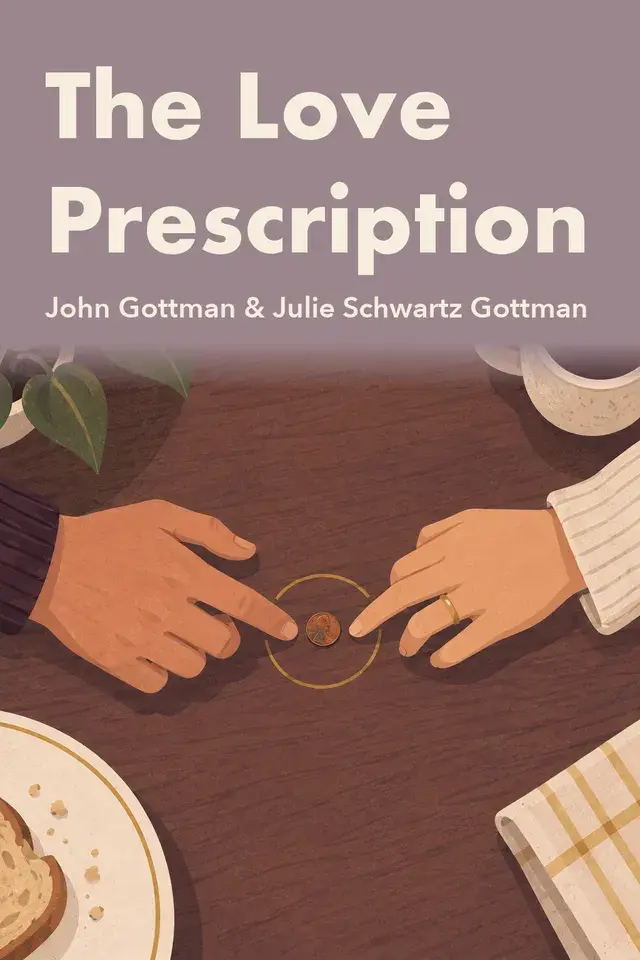
The authors also describe this as picking up pennies. Throughout the day, notice the small chances to connect: eye contact, a smile, a greeting, a request, a favor, something pointed out, a call from another room, sadness, frustration, or a sign that something is heavy. Respond when possible. If immediate attention is impossible, acknowledgment is still possible: ‘I want to hear this, but I need to finish this email. Can we talk at ten-thirty?’ That response names interest, explains the constraint, and gives the bid a concrete return time instead of leaving it unanswered. If nonresponse keeps happening, the pattern itself deserves a calm, noncritical conversation.
Shared participation is ideal, but one partner can begin by learning the idea and trying the practices. That may influence the relationship’s pattern, but it cannot guarantee that the other partner will respond or change. New habits take effort, and improvement may lag behind the first attempts. The seven-day sequence is therefore a starting point for repeated attention, not a promise that a week will settle every difficulty.
The central lesson is modest but consequential: connection is built in ordinary seconds. Repeatedly noticing a bid, answering it, or returning to it at a promised time strengthens the friendship and trust that help couples face difficult conversations. It does not make serious conflict disappear. It gives partners more shared goodwill, empathy, and repair to draw on when that conflict must be addressed.
Chapter 2 of 7 · 9 min · Audio & textIn the app
Stay Curious About a Changing Partner
Living with someone can create a convincing illusion that you know them completely. You know who buys groceries, who handles the bills, what needs repairing, and how the evening usually unfolds.
Chapter 3 of 7 · 14 min · Audio & textIn the app
Notice Goodness and Express Respect
Love can remain present while attention stops registering it. The authors distinguish two ways of seeing a partner.
Chapter 4 of 7 · 10 min · Audio & textIn the app
Make Needs Clear and Hearable
Needs that stay unspoken do not disappear. A person may want time together, help with housework, support for a career decision, rest, or affection, yet offer only a hint.
Chapter 5 of 7 · 9 min · Audio & textIn the app
Build Affection Through Consensual Touch
A couple can love one another, cooperate efficiently, and still lose the feeling of being physically connected. Grace and Andrew had a busy, loving household, but family logistics had turned them into excellent teammates.
Chapter 6 of 7 · 10 min · Audio & textIn the app
Protect Time for Shared Discovery
Couples do not have to stop loving one another to begin living parallel lives. They can share a home, children, work, bills, and routines while meaningful physical, emotional, and intellectual contact shrinks.
Chapter 7 of 7 · 7 min · Audio & textIn the app
Turn a Week Into Continuing Practice
A seven-day plan matters because it can interrupt old patterns, but the authors do not present the week as a graduation. The practices are meant to become part of a couple’s changing routine: observed, adjusted, and repeated as life changes.
Chapter 1 of 7 · 9 min · Audio & text: Connection Begins With Small Responses
Wiseley supports reading and listening to summaries in the app.
Continue in WiseleyWhat The Love Prescription is about
How can couples stay connected when daily demands crowd out their relationship? John and Julie Gottman describe how small, repeated acts of attention, curiosity, appreciation, clear asking, and affectionate touch build closeness. Their practical exercises help partners understand each other, communicate needs, and protect time together.
About John M. Gottman & Julie Schwartz Gottman

John M. Gottman
John M. Gottman is an American psychologist. “The Seven Principles for Making Marriage Work” explores patterns of interaction and practical approaches intended to strengthen marriages.
Explore more books by John M. Gottman
Julie Schwartz Gottman
Julie Schwartz Gottman is an American clinical psychologist and cofounder of the Gottman Institute. “Eight Dates” explores how couples can stay close through guided conversations about trust, conflict, sex, money, family, and dreams.
Explore more books by Julie Schwartz Gottman