What you'll learn
Key ideas from The Kite Runner
These ideas compress the book's argument without treating the author's view as settled fact. Use them as an orientation before reading the full work or listening in Wiseley.
Amir and Hassan share an intimate childhood, but Pashtun privilege and Hazara servitude organize their lives differently.
Amir turns the tournament into a test of Baba’s approval; after he wins, Hassan retrieves the blue kite Amir hopes to present as proof of worth.
Hassan refuses to surrender the blue kite, but Amir flees when Hassan faces assault, choosing the hoped-for reward over reciprocal courage.
Baba’s concealed paternity and Amir’s silence echo a family pattern of betrayal, making Sohrab an opportunity to act.
Farid’s challenge reveals how Amir’s privileged childhood and long absence leave him distant from Afghanistan’s wartime reality.
Amir experiences pain as relief from guilt, yet suffering cannot undo betrayal or earn Sohrab’s trust.
Amir’s orphanage proposal breaks the assurance Sohrab relied on, and the sour-apples story cannot contain his fear.
Shared kite flying brings a fleeting smile, a possible opening rather than evidence of healing or restored family life.
Inside The Kite Runner
Read the first chapter in full here. The other 7 continue in the Wiseley app.
Chapter 1 of 8 · 10 min · Audio & text
The Inheritance of a Divided Home
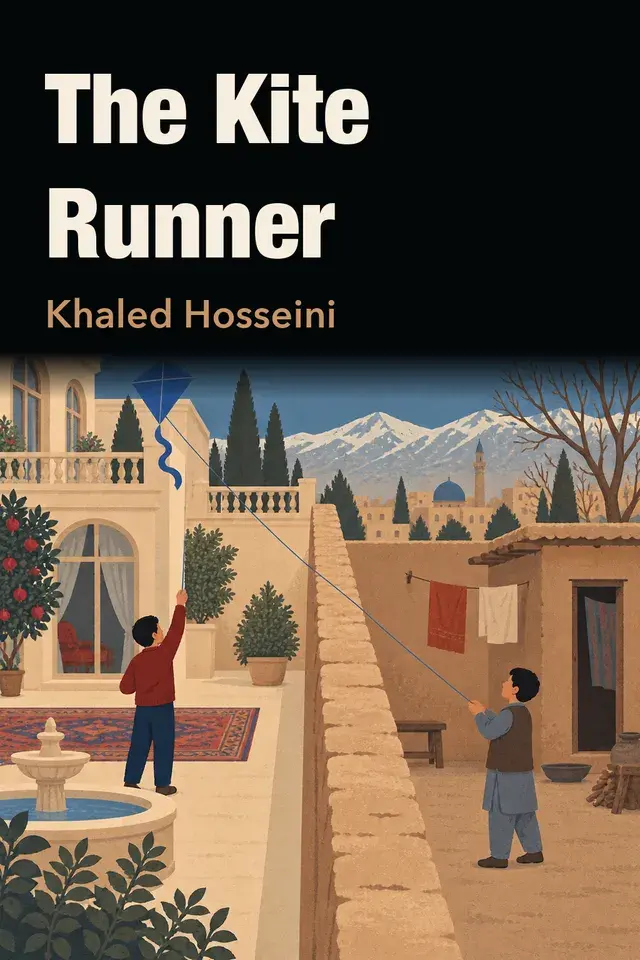
The Kite Runner, by Khaled Hosseini.
Looking back, Amir places a life-changing event on a winter day in 1975, when he was twelve. The story first returns to the childhood that made his later guilt possible. Amir and Hassan share games, stories, and a familiar yard, but their closeness grows inside a home divided by wealth, ethnicity, and service.
They share a nursing woman, take their first steps in the same yard, and speak their first words under the same roof. Hassan’s first word is Amir. They climb trees and play together, and Amir recalls Hassan as his constant companion. Yet Amir is the son of a wealthy Pashtun household, while Hassan is a Hazara and the son of its servant, Ali. Amir lives in the mansion; Hassan and Ali occupy a modest hut on the estate. Amir goes to school with Baba. Hassan prepares Amir’s breakfast and belongings, then joins Ali in household work. Their play does not erase that division. Amir even reflects that he does not call Hassan a friend in the usual sense.
Amir’s memories combine what he witnessed with what others told him. At a military barracks, he sees a soldier single Hassan out for being Hazara and sexually humiliate him with an insult about his mother, Sanaubar. The soldier also boasts that he assaulted her; Amir can report the boast, but it is not independent proof of what happened. Amir tells Hassan to keep walking. Later, he tries to comfort him at the cinema, then claims the soldier mistook Hassan for someone else. His kindness and his evasion sit side by side: he recognizes Hassan’s hurt but avoids naming the prejudice behind it.
Amir also hears stories and gossip about the adults around him. The soldier’s account of Sanaubar, like other reports about Ali and Sanaubar, reaches the reader through Amir’s recollection rather than direct confirmation. He presents the story of Baba wrestling a bear as something people tell, made believable to him by Baba’s reputation and scars. These distinctions matter: Amir’s childhood is remembered by an adult narrator, and not every remembered detail has the same source.
The divide becomes harder to ignore when Amir finds a chapter on Hazara history in a book that belonged to his mother. The book says Pashtuns persecuted Hazaras, violently suppressed a nineteenth-century uprising, drove people from their land, burned homes, and sold women. It connects that oppression with the Sunni and Shi’a divide. Amir identifies himself as Pashtun and Sunni, and Hassan as Hazara and Shi’a. His schoolbooks had barely mentioned this history, and neither his teachers nor Baba had explained it to him. When Amir raises it, his teacher scoffs at the book and disparages Shi’a people. The novel presents this account through the book Amir discovers and the school’s dismissive response; it does not supply a separate historical investigation. For Amir, the discovery exposes the distance between the closeness he feels with Hassan and the prejudice surrounding them.
Baba seems to Amir to command the world around him. He is forceful and successful, and he takes on the design and funding of a Kabul orphanage despite having no architectural experience and being urged to hire an architect. Its completion draws an enthusiastic crowd. Amir feels proud when people recognize him as Baba’s son, but that pride coexists with a private hunger for his father’s attention. Baba’s approval is difficult to win, and Amir experiences his father as someone who sorts the world into right and wrong with little room between.
Baba gives that judgment a compact moral rule: theft is the root of every sin. He explains that murder steals a life, while lying steals another person’s right to truth; cheating takes what is owed to someone else. Amir’s narration then recalls that when Baba was six, a thief killed his father—Amir’s grandfather—and says Rahim Khan had told him the story. That code contrasts with the mullah’s teaching that drinking is a terrible sin. When Amir tells Baba what Mullah Fatiullah taught in class, Baba listens to Amir while pouring and drinking whiskey, treats theft as the deeper wrong, and rejects the mullahs’ authority. His position reveals both a clear moral conviction and a conflict with the religious standards being discussed. Amir admits that he does not understand the lesson and is afraid to disappoint his father.
That need for approval shapes how Amir interprets their differences. His mother died giving birth to him, and he blames himself; he imagines Baba may hate him and sees himself as unlike the son his father wanted. Amir loves books and poetry. Baba wants him to become athletic, first trying to draw him into soccer as a player and then as a spectator. Amir lacks interest and ability. At a buzkashi tournament, he cries after seeing a rider fall and be trampled. Baba drives home in silence, struggling to hide his disgust. He worries that Amir is bookish and will not stand up for himself, especially because Hassan defends Amir when neighborhood boys push him around. To Amir, the message is plain: he does not resemble the strong son Baba hopes to see.
Rahim Khan offers another way to understand the boy. When Baba complains that Amir is not like him, Rahim argues that parents cannot shape children into copies of themselves. Amir should be allowed to find his own way. Baba worries that Amir’s passivity will continue into adulthood, while Rahim resists treating one child’s temperament as a defect to be corrected. Baba later admits that he envies Rahim’s bond with Amir, though he is glad his son has someone who understands him. The contrast makes Amir’s need for Baba’s recognition sharper: Rahim sees and encourages qualities that Baba has trouble appreciating.
Amir’s gift for words first takes shape through his bond with Hassan. Hassan is expected to grow up illiterate, as his servant status and Hazara identity limit the value others assign to his education. Yet he loves stories. Amir sometimes uses his greater literacy to tease him, even inventing a false, flattering definition for an insulting word. He later tries to ease his guilt with gifts, without admitting what he has done. They also share stories from the Shahnamah, including the tragedy of a father who unknowingly kills his son. Hassan asks to hear the passage again and weeps; Amir does not yet grasp the full force of the story.
One day Hassan praises a story Amir has improvised. That encouragement gives Amir the idea to write his first short story. In it, a poor man discovers that his tears turn into pearls. Greed takes hold, and he eventually kills his wife so he can weep and make more pearls. Rahim praises the writing and its irony, then encourages Amir to develop his talent. Baba gives the announcement only faint interest and does not ask to read the story. Amir longs for Rahim’s approval and even wishes he were his father, then feels guilty for thinking it.
Hassan receives the story warmly, but notices a flaw Amir has missed: why doesn’t the man simply use an onion to make himself cry? The question shows practical intelligence and punctures the plot. Amir recognizes the mistake, yet an inner voice dismisses Hassan as an illiterate Hazara. The moment reveals how literacy gives Amir power over Hassan, but does not make Amir wiser. He can create a story and still misuse his advantage against the person whose praise helped him begin writing.
Their familiar childhood is interrupted by gunfire and explosions. Ali reassures the boys by saying people are hunting ducks. The noise lasts less than an hour, but the children have never heard gunfire in the streets. On July 17, 1973, Daoud Khan ends the monarchy while King Zahir Shah is in Italy, and the household hears news of a new republic the next morning. Amir’s account describes the coup as bloodless even as it recalls the frightening sounds; he says little was actually shot that night. The change still marks the beginning of the end of the boys’ familiar way of life.
Hassan worries that the new republic may mean he and Ali will be sent away. Amir reassures him, and Hassan turns their attention to their tree. As they set off toward it, a rock strikes Hassan and Amir sees Assef and two friends approaching. The chapter ends before Amir identifies who threw the rock or what the boys intend.
Chapter 2 of 8 · 10 min · Audio & textIn the app
Victory at the Cost of Loyalty
Amir enters the winter kite tournament wanting more than a win. After Baba suggests he might take the prize, Amir treats the possibility as a rare chance to earn his father’s attention.
Chapter 3 of 8 · 10 min · Audio & textIn the app
Exile Builds Another Life
In March 1981, Amir and Baba leave Kabul hurriedly, carrying only what they can manage. Their escape depends on Karim arranging transport, while strangers and checkpoints make the journey dangerous.
Chapter 4 of 8 · 11 min · Audio & textIn the app
Secrets Make Repair Necessary
In June 2001, Rahim’s message draws Amir back into a life he had tried to leave behind. After the call, sitting on a park bench, Amir recalls Rahim hinting at a shared secret and a chance to become good again.
Chapter 5 of 8 · 9 min · Audio & textIn the app
Returning Through a Broken City
Amir returns to find Sohrab, but the road makes clear that he and Farid do not share the same claim to Afghanistan. Farid has endured losses Amir knows only at a distance: his father was killed, and a land mine later took two daughters and three fingers.
Chapter 6 of 8 · 11 min · Audio & textIn the app
Rescue Cannot Undo Harm
Amir enters the room with a plain request: he wants Sohrab and a way to take him somewhere safer. Assef answers by explaining who he believes he is.
Chapter 7 of 8 · 11 min · Audio & textIn the app
A Promise Under Pressure
Amir’s first task is to make safety credible to a child who has learned to expect harm. After the rescue, Sohrab tells him that the bad man and others did things to him.
Chapter 8 of 8 · 5 min · Audio & textIn the app
A Kite, a Small Opening
Sohrab’s arrival in America changes where he lives, but it does not make him ready to join a new family. Amir cannot treat the boy’s apparent agreement to come with him as a confident choice.
Chapter 1 of 8 · 10 min · Audio & text: The Inheritance of a Divided Home
Wiseley supports reading and listening to summaries in the app.
Continue in WiseleyAbout Khaled Hosseini

Khaled Hosseini is an Afghan-American novelist. “The Kite Runner” explores whether guilt can become responsible care, following Amir from a Kabul childhood through exile and return.
Explore more books by Khaled Hosseini