What you'll learn
Key ideas from The Joy of Work
These ideas compress the book's argument without treating the author's view as settled fact. Use them as an orientation before reading the full work or listening in Wiseley.
Protected focus blocks, such as a Monk Mode Morning or a quieter commute, give demanding work a reliable place in the day.
Results-focused work uses clear goals in place of attendance signals, while accounting for jobs that require presence or close coordination.
Intrinsic motivation draws on autonomy, mastery, and purpose; seeing who benefits can make ordinary work feel meaningful.
Expertise makes coaching useful when managers pair practical understanding with humility, listening, and empathy.
Positive affect can widen attention and flexibility; psychological safety lets a team hear questions, dissent, and errors while keeping accountability.
Inclusive participation depends on both varied perspectives and interaction that gives them room to be heard.
Silent narrative memos give a team shared time to understand evidence before discussion begins.
Inside The Joy of Work
Read the first chapter in full here. The other 14 continue in the Wiseley app.
Chapter 1 of 15 · 5 min · Audio & text
Work Can Feel Different
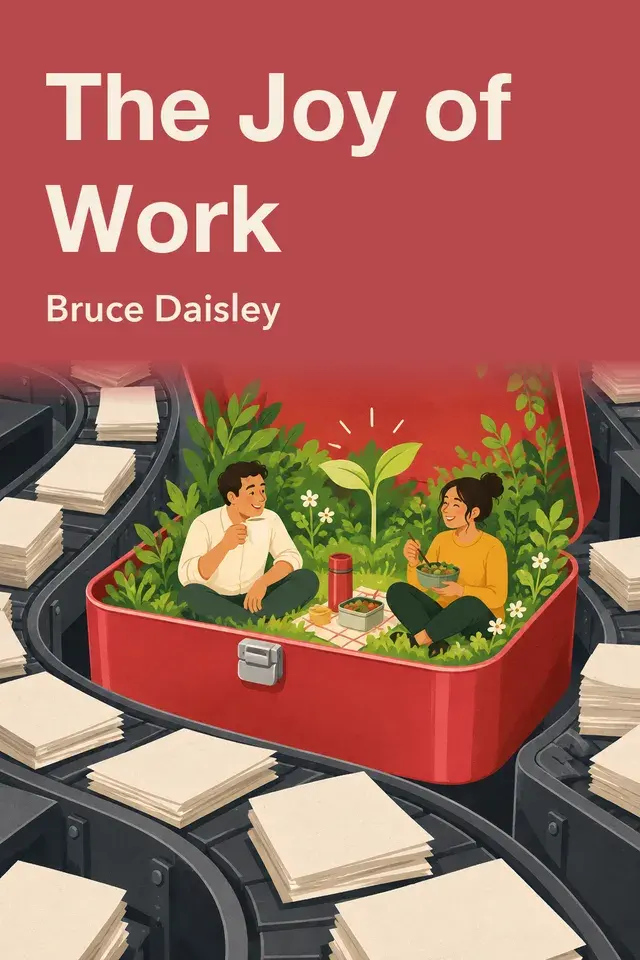
The Joy of Work, by Bruce Daisley.
Work is asked to produce fresh answers to unfamiliar problems while keeping people constantly available. That tension sits at the center of The Joy of Work. Daisley argues that creative problem-solving is harder to automate in the short term and needs to be nurtured. Yet the book describes working conditions that can drain the energy and attention those abilities need. The challenge is that workplaces may need invention while making recovery and sustained thought difficult.
Mobile email first seemed liberating: it let people work from anywhere. Daisley argues that it also stretched the workday into commutes, evenings, and weekends, blurring the line between paid work and time away. One cited British survey described an increase in the office day from seven and a half to nine and a half hours alongside the spread of mobile email. Longer hours do not automatically produce better output in his account; beyond a point, exhaustion can weaken creative thought. The point is not that every message harms every worker in the same way. Constant availability can quietly expand work and shrink the periods in which people regain energy.
The Strokes offer a cultural illustration of how pressure may narrow creative choices. After the success of their first album, the band faced its next record under pressure from critics, fans, family, and its own ambitions. Julian Casablancas seemed to return to a sound that had already worked, and Room on Fire received unfavorable reviews. Daisley asks whether stress left less room for invention. This is an interpretation of the episode, not proof that pressure alone caused the album’s reception. Still, it shows how high stakes can make repetition feel safer than experimentation.
Automation adds uncertainty to the stakes. The book warns that routine work, especially tasks based on recognizing patterns, may be vulnerable. But predictions do not all say technology will simply eliminate jobs. Matthew Taylor’s counterargument is that online retail may reduce shop employment while increasing warehouse and delivery roles by even more. That example does not settle who benefits from the shift. It shows why automation’s overall effects remain uncertain, even as workers are asked to bring more creativity to their roles.
Alexandra Michel’s study of investment bankers presents a more severe warning. It links extremely long hours in that industry with serious physical and psychological costs, including insomnia, panic, illness, and reduced empathy. The research also describes exhaustion as impairing self-control and creative thought. One participant said ideas that once came easily later took more effort and seemed less original. Investment banking is an unusually extreme case, with unusually high financial incentives, and most readers are unlikely to face the same hours. The study’s role here is to show how damaging depleted conditions can become, not to suggest every workplace causes the same harm.
Those examples raise a question of responsibility. Many workers do not control senior decisions or the expectations that set their workload. Employers shape those structural conditions, so personal effort cannot replace organizational responsibility. At the same time, Daisley argues that people can influence their immediate environment and how colleagues interact. A committed teammate may help shift a team’s habits, even without authority over the wider organization. Workplace culture is shaped by everyone’s behavior, not only by formal leaders. The aspiration to love work has limits, too: it can make workers feel at fault or obscure legitimate concerns about pay, workload, and stress.
The book organizes its proposed changes around three connected aims. Recharge concerns personal energy and the conditions that help people recover. Sync focuses on trust and connection among colleagues. Buzz turns to a wider culture that supports energy, creativity, and effective work. Together, these parts connect individual habits with team norms and organizational choices. Their starting point is that work can become more humane and effective when people and organizations change conditions that make recovery and creative thought difficult.
Chapter 2 of 15 · 6 min · Audio & textIn the app
Protect Focus, Invite Ideas
Creative work needs stretches of concentration, but the workday also benefits from conversation and fresh stimuli. The difficulty is that attention does not move cleanly between unfinished tasks.
Chapter 3 of 15 · 6 min · Audio & textIn the app
Replace Hurry With Recovery
Someone told Daisley about their father, who would come home from work and sit quietly to reflect. To someone who equates productivity with constant motion, that pause might look like wasted time.
Chapter 4 of 15 · 9 min · Audio & textIn the app
Set Boundaries That Restore Energy
Work does not become more creative simply because it feels urgent. Stress has a more complicated role: modest amounts of cortisol can supply energy and sharpen attention, and rare emergencies can provoke ingenuity.
Chapter 5 of 15 · 7 min · Audio & textIn the app
Belonging, Purpose, and Autonomy
Meaningful work begins with a need organizations can miss: belonging. The book argues that belonging is not a luxury people seek only after food and safety; it operates alongside basic physical needs.
Chapter 6 of 15 · 5 min · Audio & textIn the app
Make Connection Part of Work
Connection at work can sound like an admirable value, but it also has a practical shape. In this chapter, Sync is the connection that develops through shared rhythms and informal contact.
Chapter 7 of 15 · 6 min · Audio & textIn the app
Meet Less, Connect Better
Meetings can make work visible without making it productive. People may use them to solve a problem, but they can also use the room to display importance, claim authority, or establish whose ideas count.
Chapter 8 of 15 · 7 min · Audio & textIn the app
Use Laughter to Welcome People
At work, laughter is easy to misread. A room that sounds serious can look productive, while laughter can be dismissed as evidence that people have little to do.
Chapter 9 of 15 · 6 min · Audio & textIn the app
Lead With Empathy and Space
Few relationships shape daily work as strongly as the relationship with a manager. Yet management often appears as a source of strain rather than support.
Chapter 10 of 15 · 7 min · Audio & textIn the app
What Makes Work Buzz
A team can be candid without feeling energized, or cheerful without being able to speak honestly. The book calls the combination of both conditions Buzz: a workplace where people have positive affect and psychological safety at the same time.
Chapter 11 of 15 · 7 min · Audio & textIn the app
Make Candour Safe and Useful
A team learns from candour only when people can turn what they notice into useful action. That starts with how work is framed.
Chapter 12 of 15 · 7 min · Audio & textIn the app
Keep Teams Lean, Make Room
A team can lose time simply by becoming harder to coordinate. Every new person adds possible communication links: five people can have ten links between them, while ten people can have forty-five.
Chapter 13 of 15 · 6 min · Audio & textIn the app
Make Attention and Difference Matter
Effective collaboration depends on more than getting information into a room. People need to attend to one another well enough to notice a concern, a hesitation, or a meaning that is not on a slide.
Chapter 14 of 15 · 5 min · Audio & textIn the app
Turn Meetings Into Better Thinking
A meeting can give the impression of careful discussion while rewarding the person who presents most confidently. Daisley describes a format that changes the order: before anyone discusses a decision, the group reads a written narrative together.
Chapter 15 of 15 · 5 min · Audio & textIn the app
Work People Can Love
The practical question running through the book is what makes work worth caring about. It cannot be answered by requiring people to look happy.
Chapter 1 of 15 · 5 min · Audio & text: Work Can Feel Different
Wiseley supports reading and listening to summaries in the app.
Continue in WiseleyAbout Bruce Daisley

Bruce Daisley is the author of “The Joy of Work”. The book explores how work can stay humane and effective amid pressure, distraction, and demands for creativity.
Explore more books by Bruce Daisley