What you'll learn
Key ideas from The Joy of Movement
These ideas compress the book's argument without treating the author's view as settled fact. Use them as an orientation before reading the full work or listening in Wiseley.
A persistence high can reward sustained movement by easing stress and making continued action more inviting, but it is subjective, activity-wide, and not guaranteed.
Durable group belonging can be supported by accessible synchrony, shared participation, recurring contact, and meaningful contribution.
Music recruits movement systems before deliberate action and can change how effort and discomfort are interpreted.
Chosen challenges can revise self-stories by giving bodily evidence of capability, courage, and agency.
Natural movement can redirect attention from repetitive self-focus toward vivid sensory engagement without making ordinary self-reflection a problem.
Receiving encouragement and practical help can strengthen agency rather than cancel it.
Inside The Joy of Movement
Read the first chapter in full here. The other 5 continue in the Wiseley app.
Chapter 1 of 6 · 13 min · Audio & text
How Effort Becomes a Reward
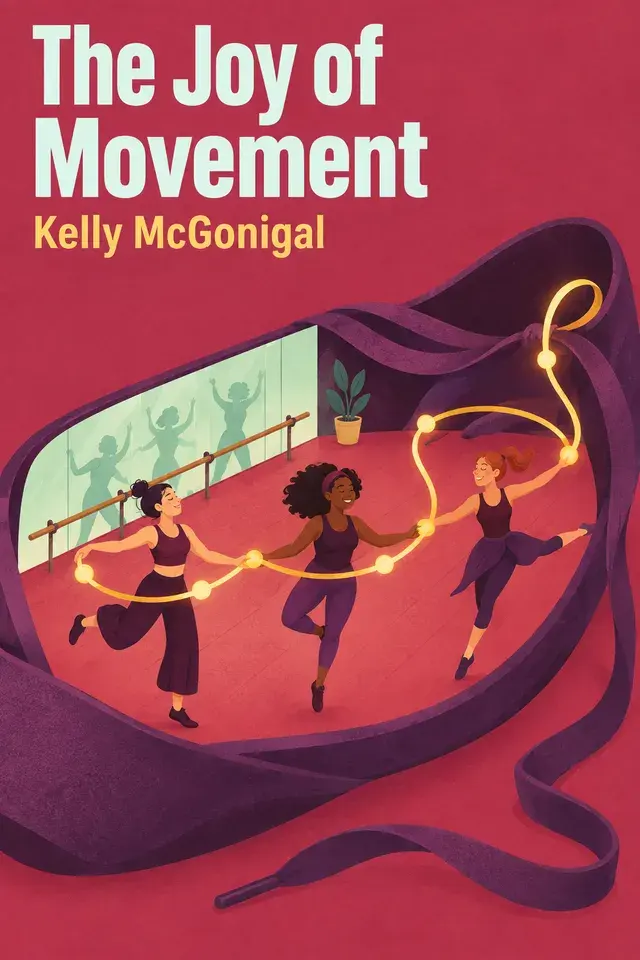
The Joy of Movement, by Kelly McGonigal.
The Joy of Movement begins with a reversal of the usual fitness story. Movement is not only a tool for preventing disease or changing the body. It is how people participate in life: exploring, working, playing, competing, celebrating, and caring for one another. That makes effort potentially meaningful before it produces measurable fitness. The book’s central question is why physical activity can make people feel more hopeful, connected, capable, and alive.
The introduction points to broad associations between activity and happiness, purpose, gratitude, hope, and belonging. These benefits are described across ages, cultures, health conditions, and physical abilities. Still, an association is not proof that exercise alone causes well-being. The author is looking for explanations rather than simply repeating that active people tend to report better lives. Movement may support mental health, but it is not presented as a replacement for treatment or as a cure for illness.
The most familiar explanation is the runner’s high. People describe it through comparisons with intoxication, spiritual connection, romantic love, optimism, and a heightened appreciation of life. The experience is not limited to running. Sustained hiking, swimming, cycling, dancing, or yoga may produce something similar after significant effort. These descriptions are personal reports, not objective diagnostic criteria, and the high is neither guaranteed nor necessary for movement to be valuable.
David Raichlen offers a biological and evolutionary hypothesis for why effort might become rewarding. Human bodies show traits associated with endurance, and the theory links those traits to ancestral hunting, scavenging, and foraging. Yet physical adaptation alone leaves a motivational problem. Hunting and gathering consume calories, take time, and can be painful, tiring, uncertain, or boring. If persistence helped people survive, evolution may also have favored a reward that encouraged them to continue. Raichlen proposes that endocannabinoids, chemicals involved in pain relief, mood, anxiety, and social reward, may help provide that incentive. This remains a theory about human evolution, not settled history.
Raichlen’s treadmill comparison clarifies the proposed mechanism. Thirty minutes of slow walking did not change participants’ endocannabinoid levels. Maximal-effort running did not change them either. Jogging, however, tripled the measured levels, and the increase tracked participants’ reports of a high. The result suggests that continuous, moderately difficult effort may matter more than the mechanical act of running or the greatest possible intensity. Related increases were also reported with cycling, incline walking, and outdoor hiking.
The finding is a clue, not a universal prescription. What counts as moderately difficult depends on the person and the activity. Animal comparisons point in the same direction: dogs, whose evolutionary history includes prolonged pursuit, showed an endocannabinoid increase after jogging, while ferrets did not. Such animal results can support a proposed mechanism, but they do not establish that animals have the same subjective experience as humans. The practical suggestion of at least twenty minutes of sustained, individual-level effort is a guideline, not an objective pace, distance, or performance requirement.
The persistence high is therefore not a prize people must chase. Its proposed function is to help a person keep pursuing a goal when the goal is demanding. Endocannabinoids may reduce anxiety and pain while increasing contentment and optimism; related reward activity may also make social contact more inviting. Jody Bender’s account after a hemorrhagic stroke illustrates the personal side of this idea. Intensive therapy took her from repeated falls to a mile, then to a treadmill five-kilometer effort and near-daily running. She described pride, reflection, and a changed sense of herself, while impaired sensation still created practical risks. Her experience shows what movement meant to one person, not what everyone should expect.
Immediate reward is only half the story. The book also explains how desire for movement can develop through repetition. In Frederick Baekeland’s early exercise-deprivation study, regular exercisers resisted stopping, and those who did stop reported worse sleep and serious psychological distress. Later work found anxiety, irritability, depressed mood, or insomnia after missed workouts. Yet only a small percentage of exercisers show signs of harmful psychological dependence. The addiction analogy helps explain reward learning, but it should not turn ordinary commitment, pleasure, or meaning into pathology.
Repeated exposure can make reward-system neurons more responsive to an activity and its cues. The process appears slower than the rapid reward-system takeover associated with addictive drugs. In one account, sedentary adults became more enthusiastic during high-intensity training, with enjoyment peaking around six weeks; another gym study associated four weekly sessions for six weeks with establishing a new habit. A fifty-three-year-old man who expected to hate exercise began with one weekly training session, added a second after three weeks, and eventually felt genuine happiness afterward. The first session had not predicted the pleasure that repetition made possible.
Learning also gives ordinary sensations a pleasurable gloss. Chlorine, cut grass, a yoga mat, cycling shoes, a familiar route, or the sound of equipment can become reminders of satisfying movement. After enough pairings, a cue can produce anticipation before the activity begins. Most exercise enthusiasts welcome these cravings because they point toward a valued relationship. Drug-related cues can instead trigger destructive craving, withdrawal, or the narrowing of attention around a substance. The similarity lies in learned reward, not in identical consequences.
The author argues that exercise may expand, rather than shrink, a person’s capacity to enjoy ordinary rewards. Drugs can produce an anti-reward response that dampens pleasure and reduces interest in other sources of satisfaction. Exercise produces a smaller stimulation and may gradually increase sensitivity to reward, including food, beauty, social connection, play, and bonding. This is one reason the author prefers to describe devotion to movement as a beneficial attachment or commitment when it remains compatible with health, relationships, and judgment. Continuing through injury, sacrificing essential responsibilities, or being unable to stop represents a different and harmful pattern.
Finding that beneficial relationship depends heavily on personal fit. The author’s own history makes the point. Competitive sports had left her feeling clumsy, but childhood aerobics videos offered rhythm, mirroring, and a form of physical intelligence she could access. The sounds of the video and the routine itself eventually became signals of anticipated pleasure. Her enjoyment was not evidence of superior athletic talent. It came from a setting and activity that matched how she learned, moved, and expressed herself.
Nora Haefele found a similar fit through a welcoming walking community. She first disliked an unsuitable treadmill routine, then discovered noncompetitive volkssporting, where she could choose flexible timing, set her own pace, enjoy scenery, travel, and walk with companions. She feared that a timed five-kilometer event would be filled with judgmental young athletes. Instead, she was welcomed, finished, and learned that she could participate. Later races brought alternating misery and exhilaration, but finishing came to represent strength, accomplishment, and joy. Her progression shows how encouragement, meaning, and belonging can change what effort feels like.
A useful approach follows from these examples. Start with an activity that is genuinely appealing, or at least less alienating, and choose a setting that supports participation. Make the effort personally manageable rather than borrowing someone else’s standard. Allow repeated experiences before deciding that enjoyment is impossible; adaptation can take time. Then notice which cues and rewards encourage returning: a route, a song, a welcoming class, a sense of competence, relief from worry, or the pleasure of seeing familiar people. The goal is not to force a high, but to learn what makes continued movement feel worthwhile.
The evidence remains mixed in kind and strength. Some conclusions come from treadmill experiments, some from animal studies, some from personal accounts, and some from evolutionary speculation. Mouse studies suggesting that reward-system differences can precede physical adaptations do not prove that humans are genetically destined to be active. Genetic studies may explain part of the variation in activity or enjoyment, but the field is emerging, many variants remain poorly understood, and population-level heritability does not determine an individual’s future. Psychology, environment, social support, health, and meaning also shape participation.
Exercise can be a constructive support for anxiety, depression, recovery, and everyday resilience, but reward chemistry is only one contributor to those effects. It does not make movement a universal treatment, and a new physical goal should be adapted to current ability, health, and circumstances, with professional guidance when needed. The larger lesson is more modest and more useful: effort can sometimes reward persistence immediately, then teach the brain to welcome the activity and the ordinary pleasures connected with it. Movement becomes something a person may seek not merely because it is good for them, but because it helps them take part in life.
Chapter 2 of 6 · 13 min · Audio & textIn the app
Moving Together Builds Belonging
Movement can reward a person for persisting, but belonging asks a different question: what happens when bodies act together? Kelly McGonigal’s answer is that coordination can change the felt boundary between self and others.
Chapter 3 of 6 · 11 min · Audio & textIn the app
Music Gives Emotion a Body
Music can give movement a head start. McGonigal uses the term groove for the strong human impulse to move with a beat.
Chapter 4 of 6 · 10 min · Audio & textIn the app
Turning Physical Action Into Hope
Hope can sound like a mood, but McGonigal gives it a physical structure. A chosen challenge can produce evidence that is difficult for old self-stories to dismiss: I acted, adapted, persisted, or became stronger.
Chapter 5 of 6 · 12 min · Audio & textIn the app
Nature Opens Attention Outward
Nature changes what movement asks of attention. A walk in a living environment gives the mind more than a route to follow: weather shifts, leaves move, light changes, and ground responds underfoot.
Chapter 6 of 6 · 12 min · Audio & textIn the app
Endurance Includes Receiving Help
Endurance becomes meaningful when the hard thing remains hard. Movement does not have to erase fear, pain, or depression before it can help.
Chapter 1 of 6 · 13 min · Audio & text: How Effort Becomes a Reward
Wiseley supports reading and listening to summaries in the app.
Continue in WiseleyWhat The Joy of Movement is about
Why can movement make life feel more rewarding, connected, and meaningful? Kelly McGonigal explores how sustained effort, shared rhythms, music, physical challenges, and nature influence emotion and belonging. The summary explains these mechanisms and offers ways to find personally meaningful movement, build confidence, and draw on support during hardship.