What you'll learn
Key ideas from The Invention of Nature
These ideas compress the book's argument without treating the author's view as settled fact. Use them as an orientation before reading the full work or listening in Wiseley.
Humboldt’s method combined measurement with perception, feeling, and imagination to understand relations among natural facts.
At Lake Valencia, Humboldt linked forest clearing and irrigation diversions to falling water, exposed soil, erosion, and destructive runoff.
The Naturgemälde arranged plant ranges beside environmental data to represent nature as a connected whole.
Malthusian population pressure and Humboldt’s examples of competition and predation helped Darwin develop natural selection.
Marsh paired forest protection and replanting with sustainable timber management, treating conservation as careful resource use.
Haeckel named ecology as the study of relations between organisms and their surroundings, building on an existing tradition of connected views of nature.
The Hetch Hetchy campaign set preservation against San Francisco’s water needs and lost, while teaching advocates how to organize nationally.
Inside The Invention of Nature
Read the first chapter in full here. The other 11 continue in the Wiseley app.
Chapter 1 of 12 · 8 min · Audio & text
How a Naturalist Learns to See
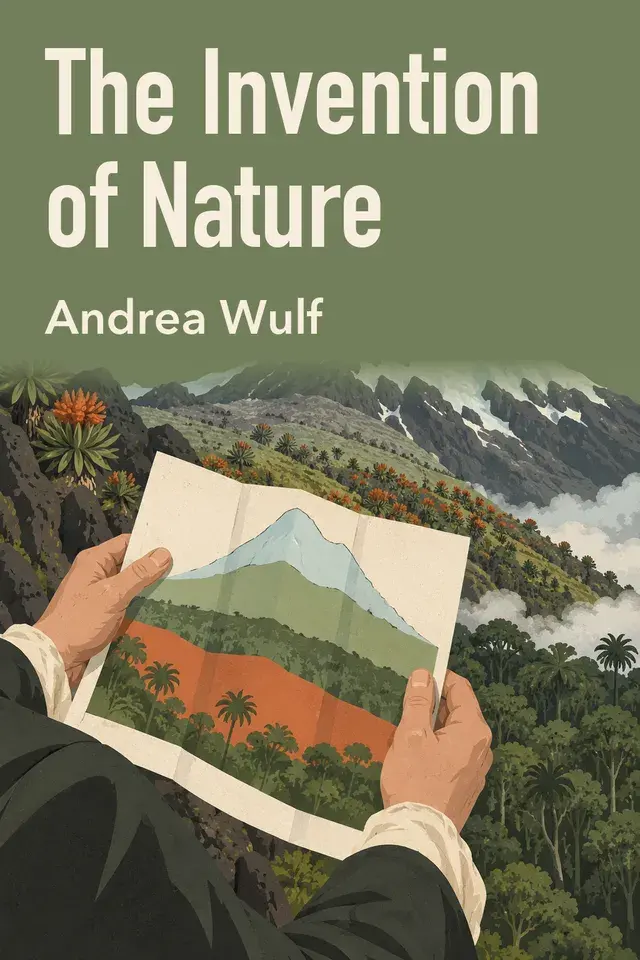
The Invention of Nature, by Andrea Wulf.
Alexander von Humboldt’s distinctive way of studying nature took shape over time. As a boy, he preferred roaming the countryside, collecting and sketching plants, animals, and rocks. The habit of looking closely stayed with him, but careful collecting alone could not explain how natural things were related. His method grew from joining precise observation to comparison and a search for the larger patterns behind individual facts.
He came of age amid Enlightenment confidence that reason and experiment could uncover nature’s laws. Telescopes, microscopes, and mathematical study seemed to make the world more knowable. A powerful image was the universe as clockwork, though thinkers disagreed about how God acted within it. Scientists exchanged findings across borders through correspondence, in a community sometimes imagined as a republic of letters. This faith in knowledge encouraged investigation, but it did not yet answer how living matter differed from a mechanism.
Mining gave Humboldt a practical education in observation. In 1791 he entered the Freiberg mining academy, completing its three-year course in eight months. He studied rocks and geological theories alongside the work of mines. As a mining inspector, he examined soils, shafts, and ores, and looked through old records for evidence about mineral deposits. His work also addressed miners’ conditions: he devised a breathing mask and a lamp for oxygen-poor shafts, wrote instructional books, and established a mining school. Scientific inquiry, for him, could produce knowledge useful to people doing dangerous work.
His early research nevertheless reflected a scientific world dividing into specialties. Humboldt’s first books treated basalt and plants growing underground, and his practice emphasized what could be observed and measured. He worked across subjects, but tended to keep their findings separate. The wider view for which he later became known was not already complete in these studies; it would depend on finding connections among kinds of evidence.
One difficult question concerned the forces that made living bodies move. Galvani’s experiments had shown that metals could make frog muscles contract, suggesting to him that nerves contained electricity. Humboldt pursued animal electricity in thousands of experiments, recording reactions and sensations, sometimes on his own body. The work joined a measurable effect to an open question: could a mechanical account of matter explain life, or did living organisms depend on other active forces? The formative drive proposed by his former teacher Blumenbach offered one possible explanation, not a settled answer.
Humboldt’s 1794 visit to Jena brought these questions into daily conversation with Goethe and other thinkers. Jena’s liberal university and nearby Weimar had drawn people interested in science, literature, and philosophy. Humboldt and Goethe discussed many subjects, walked, read, and experimented together. Goethe later credited Humboldt with renewing his scientific interests. Their exchange mattered because Goethe was not content simply to sort organisms into categories. He wanted to understand how living forms arose and changed.
In his essay on plant metamorphosis, Goethe proposed an underlying form, or urform, that could account for the variety of plants. He treated the leaf as a basic pattern from which other plant parts developed. The form was not a rigid blueprint: an organism’s internal pattern and its surroundings both helped shape its particular form. Goethe also argued that a living body’s parts function in relation to one another, with the whole shaping its parts. That differed from a machine, whose parts combine to make the whole. This approach encouraged Humboldt to compare differences and likenesses without losing sight of the organism and its setting.
The frog-leg experiment made the gap between observation and explanation especially clear. In Goethe’s presence, Humboldt arranged metals against a frog’s leg and saw it convulse. He thought moisture from his breath had completed an electrical circuit between the metals, as though he had breathed life into the leg. The contraction was an observed event; the account of what caused it was a theory. Wulf notes that Humboldt’s explanations of animal electricity were later disproved. The failed explanation did not make observation pointless. It shows why recording an effect and interpreting its cause are different tasks, and why interpretations must remain open to correction.
The Jena circle also debated how people can know the natural world. Empiricists stressed observation and experiment; rationalists gave greater weight to reason. Kant offered a middle position: the mind helps structure the world as people experience it, even though the thing-in-itself remains beyond direct knowledge. His geography lectures also emphasized that individual facts gain meaning within a larger system. Goethe, in turn, argued that reason and subjective perception could work together; senses supplied experience, though judgment might mislead. These ideas made perception part of the problem of knowledge rather than a distraction from it.
Humboldt carried this change into his own approach. Measurement and close observation remained essential, but he came to think they could not, by themselves, disclose nature’s meaning. Classification could name plants, animals, and rocks without bringing an observer close to their relations. Comparison helped connect similarities and differences, while perception, feeling, and imagination helped people grasp the whole those details belonged to. His aim was neither to replace evidence with emotion nor to treat numbers as an explanation on their own.
As he prepared for travel, Humboldt studied several sciences and tested instruments across European settings. He expected to collect specimens and make measurements, but he also wanted to investigate how organic and inorganic nature interacted. That preparation extended the habits formed in mines and conversations: gather specific evidence, then compare it across subjects and places. The field method that would follow rested on both parts of the work.
Wulf also takes care to distinguish the words Humboldt wrote from the words later readers encountered. She compared original German texts with English translations, sometimes choosing a newer translation or supplying one herself when existing versions were inadequate or incomplete. When discussing how later figures responded to Humboldt, she considered the editions those readers actually had. This matters because an idea’s influence depends partly on how it was translated and presented.
Humboldt’s early experience, his experiments, and his conversations with Goethe did not produce a finished theory of nature. They established a way of working: measure carefully, compare across differences, and use perception and imagination to look for relations that classification alone might miss. That combination prepared him to carry his questions into the field.
Chapter 2 of 12 · 6 min · Audio & textIn the app
Fieldwork Reveals Living Relations
In South America, Humboldt began to trace how conditions and living things acted on one another. Water depended on the ground and forest around it; animals were shaped by other animals; a single plant could support many lives.
Chapter 3 of 12 · 7 min · Audio & textIn the app
Mountains Become a World Map
Humboldt’s climb of Chimborazo brought observations from different places and elevations into one field of comparison. The route from Quito crossed tropical valleys and open grasslands before the mountain rose ahead.
Chapter 4 of 12 · 7 min · Audio & textIn the app
Publishing a Connected Nature
An expedition’s findings become shared science when others can inspect, compare, and use them. After returning from South America, Humboldt made Paris his base.
Chapter 5 of 12 · 9 min · Audio & textIn the app
Nature Enters Politics
In “My Delirium on Chimborazo,” written in 1822, Simón Bolívar imagines climbing the mountain in the footsteps of La Condamine and Humboldt, then leaving their tracks behind. At the summit, in a state of altitude-induced delirium, he encounters Time and looks across the sweep of past and future.
Chapter 6 of 12 · 8 min · Audio & textIn the app
Lectures, Russia, and Climate
By 1827, Humboldt had returned to Berlin with two ways to extend his connected view of nature. His free lectures brought scientific ideas to a broad public; his later Russian expedition gathered observations across distant regions.
Chapter 7 of 12 · 7 min · Audio & textIn the app
Distribution, Descent, and Selection
Humboldt’s comparisons of plants across regions revealed a pattern that was suggestive but not universal: related plants could appear in similar environments far apart, yet similar climates did not always contain similar plants or animals. Climate alone could not explain where species lived.
Chapter 8 of 12 · 9 min · Audio & textIn the app
Cosmos at Two Scales
Cosmos begins with a question of scale: how can an account range from the heavens to the smallest forms of life and still convey the character of nature as people encounter it? Humboldt chose a title that joined beauty with order.
Chapter 9 of 12 · 6 min · Audio & textIn the app
Science in Humboldt’s Later Years
In Humboldt’s later years, his work depended increasingly on people who gathered knowledge he could no longer collect himself. At the same time, his political commitments placed him between reformers and the Prussian court.
Chapter 10 of 12 · 5 min · Audio & textIn the app
Marsh Makes Human Impact Legible
Humboldt had taught George Perkins Marsh to understand nature through the relations between people and their surroundings. Marsh made that connected view a practical question: what happens when people alter land and living populations to meet immediate needs?
Chapter 11 of 12 · 7 min · Audio & textIn the app
Haeckel Names Ecological Relations
Haeckel’s distinctive contribution grew from a question that troubled him for years: could close scientific study and artistic feeling work together? Humboldt’s writings had given him a model of nature as a web of forces and relations.
Chapter 12 of 12 · 9 min · Audio & textIn the app
Muir Turns Wonder into Protection
John Muir carried Humboldt’s example into the Sierra Nevada. He went into the landscape to observe it closely, but he did not treat nature as a collection of separate specimens.
Chapter 1 of 12 · 8 min · Audio & text: How a Naturalist Learns to See
Wiseley supports reading and listening to summaries in the app.
Continue in WiseleyAbout Andrea Wulf
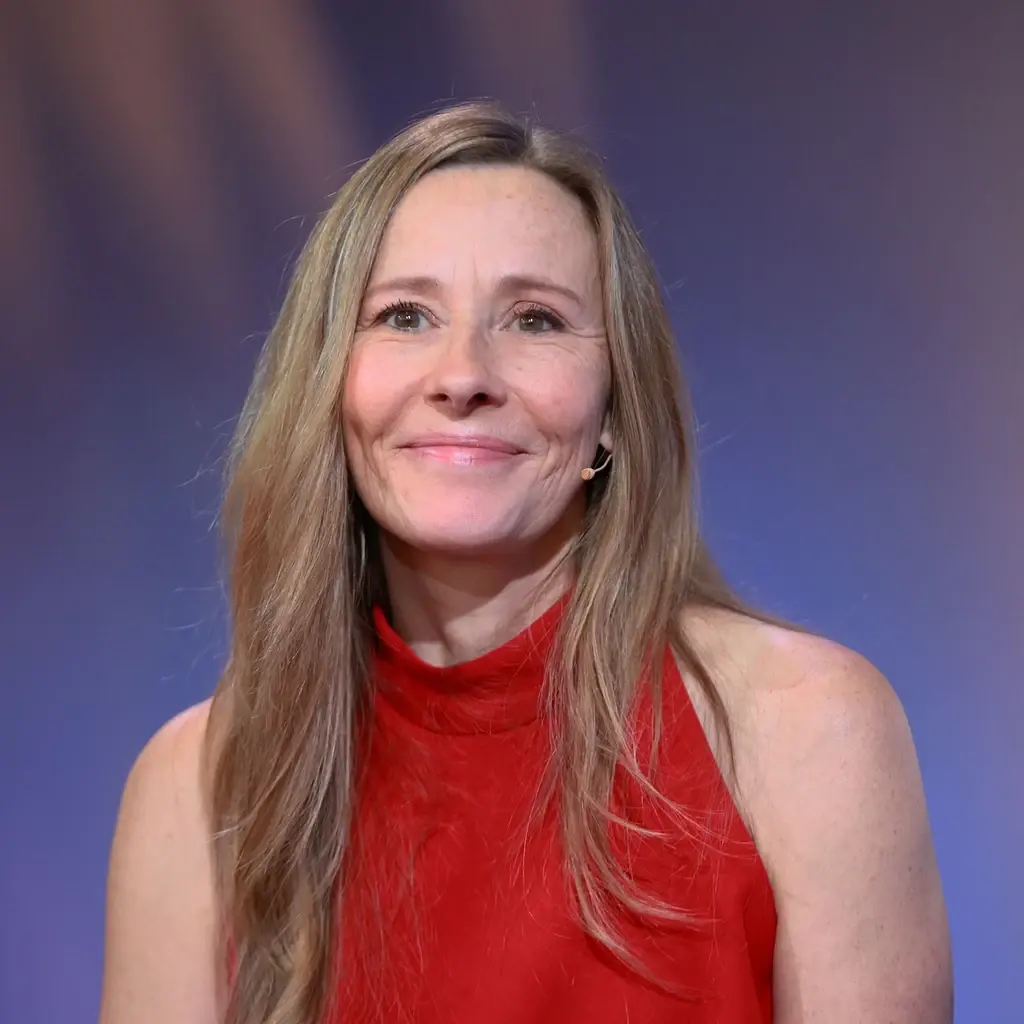
Andrea Wulf is a German-British historian and writer. “The Invention of Nature” explores how Alexander von Humboldt came to see nature as a connected, changing whole.
Explore more books by Andrea Wulf