What you'll learn
Key ideas from The Horse
These ideas compress the book's argument without treating the author's view as settled fact. Use them as an orientation before reading the full work or listening in Wiseley.
Horse evolution followed a branching path shaped by changing habitats, chance, and extinction, rather than a straight progression toward modern horses.
Taming changes an individual animal; domestication shifts a population through inherited traits and repeated breeding.
Horse keeping, riding, wagons, and dairying made steppe mobility a vehicle for migration, trade, and language change.
The chariot combined trained teams, a mobile platform, ranged weapons, skilled crews, and costly support into one weapons system.
Medieval farm gains came from a working system of harness, whippletree, plow, horseshoes, breeding, and crop rotation.
Horses supported colonial extraction and became entangled in slavery, while escape, theft, and illicit trade weakened restrictions on Indigenous access.
Steam transport still relied on horses; combustion engines, electric transit, cars, and tractors displaced horse power, aided by mass production and horse-built infrastructure.
Mustang policy weighs ecological limits and animal welfare against a powerful cultural ideal of wild freedom.
Inside The Horse
Read the first chapter in full here. The other 13 continue in the Wiseley app.
Chapter 1 of 14 · 9 min · Audio & text
How a Horse Was Made
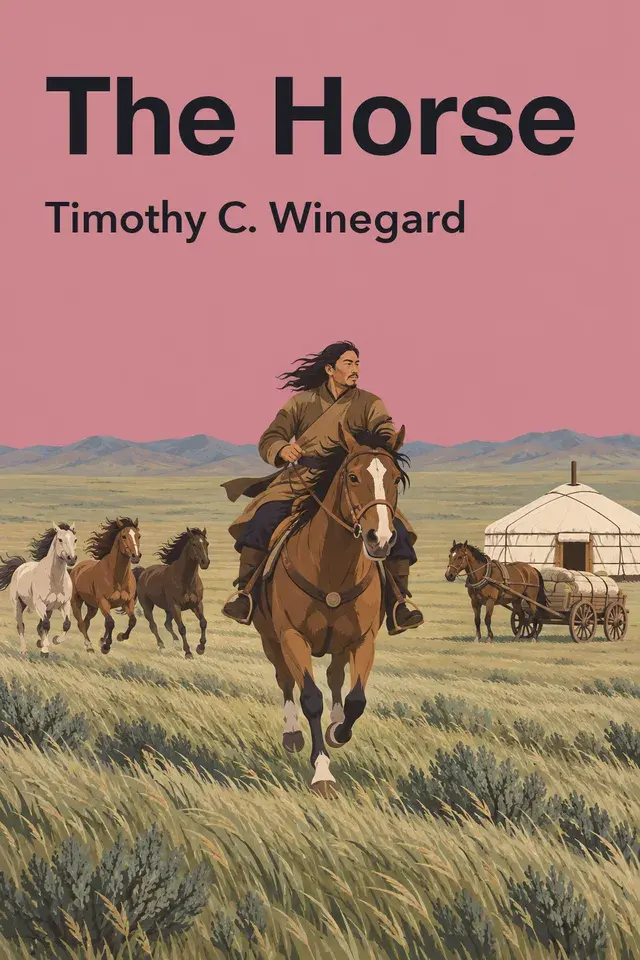
The Horse, by Timothy C. Winegard.
How did a grass-eating animal develop such large muscles, speed, and staying power? The answer lies in a long evolutionary history shaped by changing habitats and many linked adaptations. That history had no predetermined destination. The horse humans later came to rely on emerged from a branching family tree in which many lineages disappeared. And humans first encountered horses as prey, long before any partnership began.
The fossil record became central to this story during the nineteenth-century Bone Wars, when paleontologists Othniel Charles Marsh and Edward Drinker Cope competed for discoveries, fame, and influence. Their rivalry could turn scientific work into espionage and deception. Marsh assembled an unusually large collection of horse fossils and arranged specimens into a sequence, from small, multi-toed ancestors toward the one-toed modern horse. The display made evolution visible, but it also encouraged a simple picture: one species steadily changing into the next, as if evolution had a goal.
In 1876, Thomas Henry Huxley visited Marsh at Yale and compared American fossils with the British record. By working backward from known forms, the two men inferred an early horse with four toes, though they did not yet have a fossil example of it. Marsh’s collection helped Huxley connect forms and strengthen the evidence for evolution. Yet the sequence remained incomplete. Marsh later found a four-toed specimen called Eohippus, without recognizing that it was the same animal Richard Owen had named Hyracotherium. Researchers eventually reconciled the names, while later fossils and DNA evidence showed a much more tangled history. Many horse species lived at the same time; populations migrated, split, and vanished. Fossils and genomes support evolution, but not a straight ladder leading inevitably to the horse alive today.
The earliest horse described in this account lived in a world unlike the open plains people now associate with horses. Hyracotherium was about fox-sized, with padded feet, several toes, short limbs, and low-crowned teeth suited to soft leaves and fruit. It lived in warm, forested environments. As climates cooled and forests retreated, grasslands spread. Equids continued evolving in North America, while some populations moved into Eurasia and other regions. Their descendants took different paths, and many could not survive when their environments changed again.
Grass presented a new challenge. It was tough, low in nutrients, and abrasive: silica particles in the plant, along with soil and sand, wore down teeth. Grazing horses evolved wider cheek teeth and stronger jaws and chewing muscles for grinding. Their high-crowned teeth included layers that resisted wear, and their teeth continued to erupt as the exposed surfaces wore down. These changes made a sustained grass diet possible, though they did not make it easy.
Extracting nourishment from grass required another adaptation. Cattle and sheep ferment food in a multi-chambered stomach and chew it again as cud. Horses instead use microbes in the cecum, a large pouch in the hindgut, to ferment plant matter after it passes through the stomach and intestines. Food moves through the system quickly, so horses can continue grazing and moving without stopping to ruminate. The tradeoff is lower efficiency: horses must eat more to obtain enough energy. Their digestive system suited them to rough vegetation that other grazers could use differently, but it demanded abundant forage.
Over time, changes in diet and habitat went together with changes in body size and movement. A larger body helped horses retain heat and search across wider grazing ranges. On open, harder ground, weight first shifted onto the middle toe while the other toes remained. Over time, that weight-bearing toe enlarged and the others dwindled or disappeared, leaving a single hoof. Stronger ligaments helped transfer elastic energy to the foot with each stride, supporting a faster gait. A later alignment of tendons and bones let the legs lock while standing or grazing, conserving effort and leaving horses ready to move if danger appeared. They combined a large, strong body with sustained speed and endurance. Those traits were consequences of adaptation to ecological pressures, not a design for future human use.
Horses also had to detect danger while feeding in exposed country. Their eyes, set high and far to the sides of an elongated head, gave them a very wide field of view. That allowed them to watch for predators while grazing. Their bodies were better suited to flight than combat: they could run, and they retained the ability to kick or bite when threatened, but they lacked the horns or claws of animals built to fight. Quick sensory responses and a social life in mobile herds supported vigilance. Herds moved opportunistically as forage changed; mares often led, while a stallion guarded from behind. This way of life answered the demands of sparse and shifting food and the ever-present threat of predators.
Taken together, these traits show why the horse’s evolution cannot be reduced to one advantage. Teeth handled abrasive food; hindgut fermentation extracted some of its nutrients; body size and limbs supported travel and escape; vision and herd behavior helped detect danger. Each trait addressed immediate pressures, and each depended on what earlier generations had inherited. Natural selection produced branches, experiments, and dead ends. It did not move toward a modern horse as its intended result.
For humans, the relationship began within the same food web. People hunted horses for food, sometimes stalking individual animals and sometimes using terrain to intercept migrating herds. At Solutré in France, limestone ridges created a corridor where hunters could funnel horses toward an ambush. The site records repeated use over roughly twenty thousand years and contains remains from as many as one hundred thousand horses. This was not simply a matter of driving herds off a cliff. The landscape channelled their movement and gave hunters a place to attack. Paleolithic images show that people observed horses closely, though hunting appears to have been a central concern and any claim about their feelings must remain an interpretation.
The horse later disappeared from most of the Americas. As the planet warmed after the Ice Age, grasslands and tundra contracted as woodlands expanded, reducing the open habitat horses depended on. The source describes horse populations as already declining before people reached the Americas. Archaeological evidence confirms hunting across a vast range, including cut and burn marks on bones and residues on tools. Yet these sites generally represent one or a few horses, not evidence of continent-wide mass kills. Human hunting may have added pressure, but the evidence does not establish people as the sole cause. Habitat loss, changing climate, natural predators, hunting, and wider food-web changes may all have contributed. The exact weight of each remains uncertain.
The prehistory of the horse is therefore a story of contingent survival, not an inevitable march toward domestication. Before humans made horses partners, they were hunters and hunted animals sharing a changing landscape. The capacities later useful to people had first evolved to meet the horse’s own needs for food, movement, and escape.
Chapter 2 of 14 · 6 min · Audio & textIn the app
The Steppe Domesticates the Horse
Agriculture created conditions in which animal management could become a durable practice. Harvests, especially where irrigation increased yields, could leave food beyond immediate needs.
Chapter 3 of 14 · 6 min · Audio & textIn the app
Mobility Becomes a Language
Reconstructing a society without written records begins by treating language as evidence. A people’s vocabulary reflects what they regularly do, make, and notice.
Chapter 4 of 14 · 7 min · Audio & textIn the app
From Chariots to Cavalry
A chariot was a coordinated weapons system. Two to four trained horses pulled a light, spoke-wheeled platform carrying a driver and specialized fighters.
Chapter 5 of 14 · 6 min · Audio & textIn the app
Macedonia Turns Horses into Strategy
Philip II turned cavalry into one part of a disciplined army. Infantry could hold an opponent in place while mounted troops maneuvered, and supply arrangements helped the whole force keep moving.
Chapter 6 of 14 · 6 min · Audio & textIn the app
China Pursues the Heavenly Horse
For the Han court, horses had become a question of whether China could defend its independence. The Xiongnu confederacy could move quickly across the northern grasslands, strike, and withdraw.
Chapter 7 of 14 · 7 min · Audio & textIn the app
Faith, Feudalism, and Mounted Power
Islamic expansion joined horse power to a widening political and religious world. Horses were scarce in Arabia, so early conquests had limited cavalry.
Chapter 8 of 14 · 6 min · Audio & textIn the app
Plows, Surplus, and Horse Power
On medieval European farms, the horse became a source of greater productivity through a working package, not by animal substitution alone. Harness, plow, hoof protection, breeding, and crop methods had to complement one another.
Chapter 9 of 14 · 6 min · Audio & textIn the app
Mongol Networks Across Eurasia
In 1220, Chinggis Khan entered Bukhara, a major Central Asian trading city. He presented the conquest as divine punishment.
Chapter 10 of 14 · 6 min · Audio & textIn the app
Horses Return to the Americas
When Spanish voyages returned horses to the Americas, the animals were domesticated imports, not a surviving local population. Their crossing was punishing.
Chapter 11 of 14 · 8 min · Audio & textIn the app
Plains Societies Remake Horse Power
The horse did not spread across the Great Plains simply as a European possession passed from one community to another. Indigenous people acquired, traded, and raided for horses, then adapted them to their own economies and political aims.
Chapter 12 of 14 · 6 min · Audio & textIn the app
The Horse-Powered City Gives Way
At the turn of the twentieth century, horses were not relics beside the new machines. Teams moved passengers and freight, carried food and fuel from stations, and loaded or unloaded ships at ports.
Chapter 13 of 14 · 8 min · Audio & textIn the app
Horses in Industrial War and Medicine
World War I made the cavalry charge increasingly untenable, but it did not remove horses from industrial war. Trenches, barbed wire, machine guns, poison gas, and artillery made mounted attacks exceptionally vulnerable.
Chapter 14 of 14 · 8 min · Audio & textIn the app
The Horse After the Horse Age
By the postwar decades, engines had displaced horses from the ordinary work of farms, roads, and armies. Winegard’s final turn asks what the relationship becomes after that infrastructure fades.
Chapter 1 of 14 · 9 min · Audio & text: How a Horse Was Made
Wiseley supports reading and listening to summaries in the app.
Continue in WiseleyAbout Timothy C. Winegard

Timothy C. Winegard is a historian and professor at Colorado Mesa University. “The Horse” explores how a grassland animal became a partner in the making of civilization.
Explore more books by Timothy C. Winegard