What you'll learn
Key ideas from The Hitchhiker's Guide to the Galaxy
These ideas compress the book's argument without treating the author's view as settled fact. Use them as an orientation before reading the full work or listening in Wiseley.
The Vogons cite a fifty-year-old Alpha Centauri notice to justify Earth’s destruction, leaving no meaningful chance to appeal.
The Babel fish makes speech understandable, while the Guide’s comic theology and war claim show that translation does not guarantee agreement.
The Infinite Improbability Drive turns a dismissed impossibility into propulsion, but chance still resists reliable prediction.
Marvin’s vast intelligence coexists with depression and menial duty, while the doors enact cheerfulness without evidence of well-being.
Magrathea’s luxury trade enriches its planet, while the Guide’s account makes the wider Galaxy’s poor easy to omit.
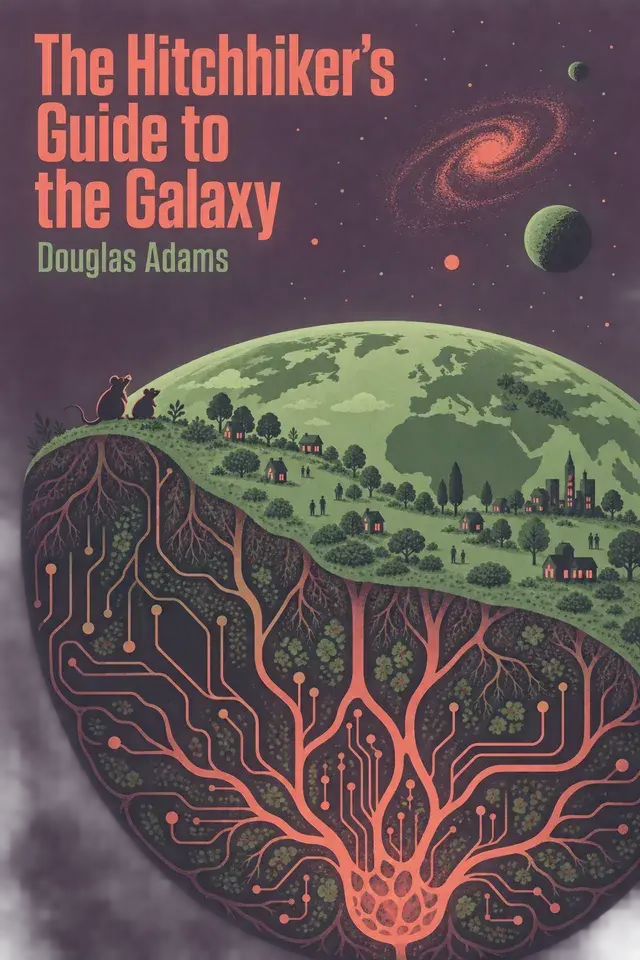
Earth and its people formed an organic computer intended to find the Ultimate Question in a ten-million-year program.
Deep Thought’s verified answer, 42, cannot guide anyone until the missing question gives it meaning.
The mice tire of the long search, try to buy Arthur’s brain, then invent a question to pair with Forty-two for a lucrative media deal.
Inside The Hitchhiker's Guide to the Galaxy
Read the first chapter in full here. The other 6 continue in the Wiseley app.
Chapter 1 of 7 · 6 min · Audio & text
A House at the End
The Hitchhiker's Guide to the Galaxy, by Douglas Adams.
The prologue first places Earth in a remote, unfashionable corner of the galaxy, then turns to a familiar trouble: most people are unhappy much of the time. Its jokes about proposed remedies point to money changing hands, as though shifting money could cure misery. Money itself is not unhappy, the narrator observes, so unhappiness and meanness persist. The contrast makes Earth look both small in cosmic terms and recognizably troubled in ordinary ones.
One woman in Rickmansworth suddenly realizes how the world could be made good and happy. She knows her solution is right and will work, without anyone having to be nailed to anything. Before she can share the idea, catastrophe interrupts her. The prologue never tells us her solution; the lost possibility belongs to the frame around the story, not an answer the reader can recover. The other frame is the Hitchhiker’s Guide to the Galaxy, an extraterrestrial reference book that has become popular in some civilizations. It is cheaper than the older encyclopedia and wears “Don’t Panic” on its cover, yet the narration also warns that it has omissions and wildly inaccurate entries. Its appeal rests alongside its limits.
From this planetary preface, the story settles on Arthur Dent’s ordinary brick house, at the edge of a village overlooking farmland. Arthur works in local radio, and the house matters to him because it is his home. One Thursday morning, still hungover, he sees a yellow bulldozer outside before fully connecting it to the council’s plan to demolish his house for a bypass.
Arthur has heard about the bypass, but assumed the dispute would be sorted out: nobody wanted the road, and the council seemed to have no sound case. Now he lies in the bulldozer’s path. Prosser, the council worker sent to clear the house, tells him he cannot stay there indefinitely. When Arthur asks why the bypass must be built, Prosser’s answer comes down to this: it is a bypass, and bypasses have to be built. The narrator sketches the road’s logic through points A and B, which travelers want to reach quickly, and point C, where residents bear the disruption. Their own wishes barely enter the plan.
Prosser says Arthur could have made suggestions or protested at the proper time. He says the plans had been available in the local planning office for nine months. Arthur’s account shows what that availability meant in practice: he learned of the demolition from a workman who had arrived the previous day. The man first charged Arthur to clean the windows, then revealed the plan. To find the notice, Arthur says, he had to search a cellar with a torch. Prosser suggested that the lights had probably gone; Arthur replied that the stairs had gone too. The notice sat in a locked cabinet inside a disused lavatory marked “Beware of the Leopard.”
The exchange offers a way to judge whether public access is meaningful. A notice can be formally available while remaining practically hard to discover. For affected people to respond, they need a chance to find the information before the decision becomes an immediate threat. Prosser can point to nine months on display, but Arthur’s experience shows how little that fact helped him. The procedure makes the bypass appear settled before he has a real opportunity to challenge it.
At this standoff, Arthur’s friend Ford Prefect arrives, oddly more concerned with the sky than the bulldozer. Arthur knows him as a harmless eccentric and an out-of-work actor from Guildford. In fact, Ford is from near Betelgeuse, has spent fifteen years stranded on Earth, and works as a roving researcher for the Guide. His outlandish behavior has helped him pass unnoticed while he tries to find a way off the planet.
Ford first urges Arthur to leave the house and go to the pub. He then arranges an absurd temporary exchange: while Arthur lies in the mud, the bulldozer crew is waiting, so Prosser can take Arthur’s place and let the two friends go for a drink. Prosser asks Ford to promise that he will take Arthur to the pub, and Ford agrees. After Prosser takes Arthur’s place, Ford asks him not to knock the house down while Arthur is away. Prosser responds obliquely, saying he had not even begun to consider the possibility, rather than giving a clear assurance. This solves the immediate standoff without changing the bypass decision. Arthur still worries about trusting Prosser; Ford says he would trust him to the end of Earth, then adds that this is about twelve minutes away.
The warning shifts the scale of the story, but Arthur can barely absorb Ford’s claim that he is from Betelgeuse. At the pub, Ford tells the barman the world is about to end, and the barman answers with ordinary talk about the weather and football. Arthur, too, keeps trying to understand his usual Thursday rather than the emergency Ford sees. The chapter stops at that gap in knowledge: Arthur is fighting for his home, while Ford knows the danger reaches far beyond it. The public decision that felt final at the village level is about to give way to a crisis on a much larger scale.
Chapter 2 of 7 · 6 min · Audio & textIn the app
Procedure Across the Galaxy
The Guide’s towel advice offers a practical, comic account of what preparedness can mean. A towel can keep a traveler warm, serve as a place to lie or sleep, or help as a raft.
Chapter 3 of 7 · 7 min · Audio & textIn the app
Translation, Poetry, and Chance
Aboard the Vogon ship, Ford gives Arthur a Babel fish so he can understand the captain’s announcement. The small, yellow creature lives in the ear and draws energy from nearby brainwaves.
Chapter 4 of 7 · 7 min · Audio & textIn the app
An Ensemble Built by Chance
The Heart of Gold brings Ford and Arthur aboard in a way nobody has quite chosen. Trillian says the ship itself picked them up during its passage through Infinite Improbability; she had not arranged the rescue.
Chapter 5 of 7 · 8 min · Audio & textIn the app
Magrathea, Legend, Luxury, and Missiles
The Heart of Gold reaches the world Zaphod came looking for, and the crew must decide what the view proves. Ford calls Magrathea a myth; Zaphod says it is the planet beneath them.
Chapter 6 of 7 · 8 min · Audio & textIn the app
The Answer Without Its Question
The destruction of Earth turns out to have interrupted a project far larger than its inhabitants could imagine. The revelation also unsettles a familiar assumption: that humans can confidently rank the intelligence of other species.
Chapter 7 of 7 · 7 min · Audio & textIn the app
Meaning Becomes a Commodity
Careless talk can cost lives in this part of the story. A freak wormhole carries Arthur Dent’s casual remark into a diplomatic exchange in a distant galaxy.
Chapter 1 of 7 · 6 min · Audio & text: A House at the End
Wiseley supports reading and listening to summaries in the app.
Continue in WiseleyAbout Douglas Adams

Douglas Adams was an English writer and humorist. “The Hitchhiker's Guide to the Galaxy” explores an absurd universe where bureaucracy can erase worlds, following Arthur Dent after the demolition of Earth.
Explore more books by Douglas Adams