What you'll learn
Key ideas from The Great Gatsby
These ideas compress the book's argument without treating the author's view as settled fact. Use them as an orientation before reading the full work or listening in Wiseley.
The Valley of Ashes puts industrial waste and obscured labor along the route wealthy travelers use between West Egg and New York.
Gatsby’s abundance attracts crowds, but their attendance does not give them genuine knowledge of their host.
Daisy’s return dims the green light’s enchantment and exposes the gap between Gatsby’s accumulated dream and the woman herself.
At seventeen, James Gatz chooses the name Jay Gatsby, giving an imagined future a deliberate identity.
Daisy’s admission that she loved both Tom and Gatsby defeats Gatsby’s demand for a past without contradiction.
Wilson turns grief and circumstantial clues into certainty; his route to Gatsby’s house is partly unobserved, and the fatal shootings are inferred from the aftermath.
Nick’s final image joins persistent striving to the pull of the past, while his judgment holds the damage and carelessness in view.
Inside The Great Gatsby
Read the first chapter in full here. The other 8 continue in the Wiseley app.
Chapter 1 of 9 · 7 min · Audio & text
Nick's Lens and the Green Light
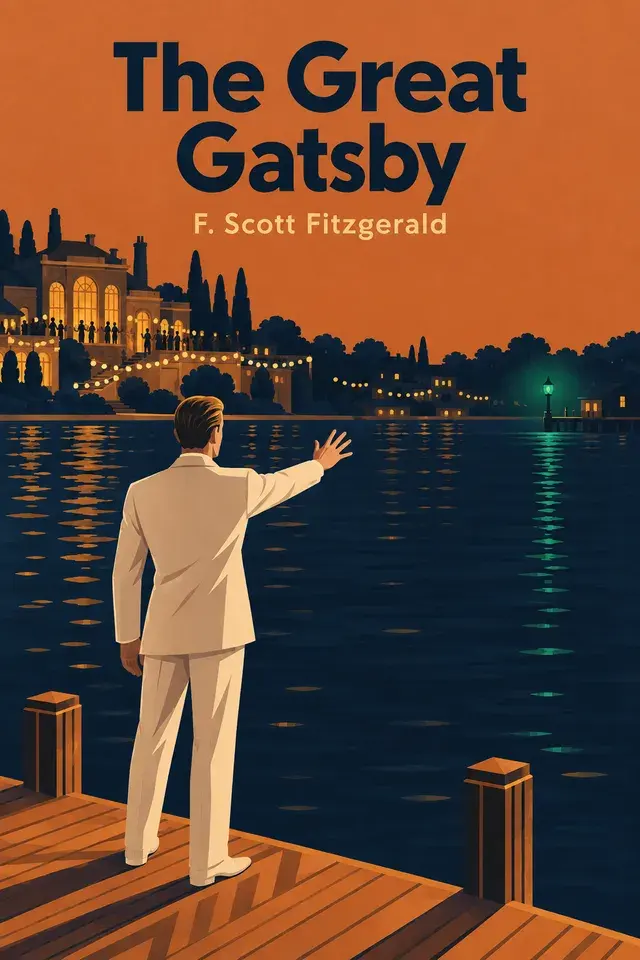
The Great Gatsby, by F. Scott Fitzgerald.
Nick opens by explaining why he has tried to reserve judgment. His father taught him not to criticize people who had not enjoyed the same advantages, and Nick says that lesson made others willing to confide in him. The habit also attracts bores and unwanted secrets. After coming back from the East, he says, he wanted a more orderly world and no further intimate glimpses into people’s hearts. His tolerance has a limit, whatever the reason for someone’s conduct. He admits that his suspicion that people differ in their share of basic decency may be snobbish. This is a self-aware account, not a claim to impartiality: Nick tells us both the rule by which he listens and the boundary where it fails.
Gatsby gets a striking exception. Nick says Gatsby represents things he usually scorns, yet he sees in him a rare sensitivity to life’s promises and an unusual capacity for hope. Nick’s later judgment that Gatsby turned out all right is shadowed by the corrupting residue he says followed Gatsby’s dreams. The contrast matters: Nick’s admiration does not make him an objective guide. It shapes the story from the start, combining fascination with unease and leaving the reader to notice how much of Gatsby remains unknown.
In the spring of 1922, after returning from the war, Nick leaves the Midwest for the East to enter the bond business. He says he came back restless, and the Middle West no longer seemed like the warm center of the world. He thought the move East would be permanent. He also planned to study finance and read widely. Alongside those plans, he offers a broader observation: life may be seen most successfully from one window. That image fits the account he is about to tell. Nick has access to the people around him, but his view is still particular, shaped by where he stands and what he can infer.
His rented house is in West Egg, beside the immense mansion of his neighbor, Gatsby. Across the water lies East Egg, where Nick visits his cousin Daisy and her husband, Tom Buchanan. The two Egg-shaped stretches resemble each other in outline, Nick says, but differ in nearly everything else. West Egg is less fashionable; the Buchanans’ East Egg estate suggests established wealth and social standing. Nick’s small house pressed among costly properties makes the contrast visible, but proximity does not mean equality. The two communities occupy the same landscape while belonging to different social worlds.
Tom’s presence gives the Buchanans’ privilege a physical force. He was a powerful football player, comes from a very wealthy family, and carries himself with muscular confidence and contempt. His grand estate stretches toward the beach, yet the atmosphere inside first feels light and buoyant. Daisy greets Nick with laughter and a musical voice that makes him feel specially welcomed. Jordan Baker, sitting coolly nearby, seems more self-contained. Then Tom shuts the windows, and the breeze that had animated the room dies. The shift is small, but it shows how quickly Tom’s force can determine the mood around him.
The conversation soon reveals what Tom considers worth fearing. When the talk turns casually to crops, he launches into a warning that civilization is collapsing. He cites a book that claims white people will be submerged by other races and argues that the dominant group must defend its control. He dresses racist alarmism in the language of science, even claiming that Nordics created civilization. Daisy mocks his pretensions to profundity, then responds with exaggerated agreement that makes his speech sound absurd. Nick finds Tom’s solemn concentration pathetic. The exchange exposes both Tom’s need to perform authority and the anxieties beneath it.
Daisy’s own performance is harder for Nick to read. Her voice makes ordinary stories feel intimate, and her warmth draws him in even when he recognizes that some of her compliments are improvised. In private, she says she has had a bad time and become cynical, but does not explain why. She recalls waking after childbirth to find Tom absent, then crying when told her baby was a girl. She says she hoped the child would grow up beautiful and foolish, which she calls the best fate for a girl. The remark gives her charm a troubled edge, though Nick cannot know exactly what she means or how fully she believes it. When her captivating voice stops working on him, he senses insincerity and feels the evening asking him for an emotional response.
The affair intrudes on that polished evening through the telephone. While Tom is away, Jordan tells Nick that Tom has a woman in New York. The phone rings again after the couple returns, and Daisy signals Tom not to answer. The planned conversation about visiting the stables disappears. Nick is unsure where to look as everyone adjusts to the interruption. The call makes plain that the household’s smooth manner does not prevent betrayal; it lets the people around it carry on through the discomfort. Nick leaves touched by the Buchanans’ interest in him, but confused and disgusted. He is less surprised by Tom’s affair than that Tom had been depressed by a book. Nick speculates that something was making him nibble at the edge of stale ideas, as if his sturdy physical egotism no longer nourished his peremptory heart.
That night, back in West Egg, Nick sees a figure emerge from Gatsby’s mansion and stand alone under the stars. He thinks it may be Gatsby, though he does not call out. Gatsby stretches his arms toward the dark water and seems to tremble. Nick can make out only a tiny green light in the distance, which might be at the end of a dock. When he looks again, Gatsby has disappeared. The gesture invites attention, especially through Nick’s prior belief in Gatsby’s hope, but Nick cannot yet say what the light is or what Gatsby wants from it.
Chapter 2 of 9 · 6 min · Audio & textIn the app
Ashes, Affairs, and Unequal Power
The motor road from West Egg to New York runs beside a nearby railroad as Nick passes through a landscape where ash seems to replace ordinary geography. It forms ridges and hills, and even gathers around houses, chimneys, and dimly moving figures.
Chapter 3 of 9 · 7 min · Audio & textIn the app
Parties, Rumors, and Social Distance
Gatsby’s parties make him famous, but being famous does not mean being known. His guests arrive in crowds to consume what he provides, then fill the gaps in their knowledge with stories.
Chapter 4 of 9 · 7 min · Audio & textIn the app
Gatsby's Past and Daisy's Choice
Gatsby’s account to Nick shifts attention from what other people say about him to the identity he wants Nick to accept. He raises the subject because he does not want rumors to leave Nick with the wrong impression.
Chapter 5 of 9 · 5 min · Audio & textIn the app
The Reunion and Its Limits
One night, Nick finds Gatsby’s mansion blazing with light but silent and apparently empty. Gatsby says he had been looking into some rooms.
Chapter 6 of 9 · 6 min · Audio & textIn the app
Self-Invention and the Demand to Repeat
Nick tells Gatsby’s origin story as an account Gatsby gave him much later. Nick says he put it down to dispel wild rumors about Gatsby’s antecedents, which he says were not even faintly true.
Chapter 7 of 9 · 8 min · Audio & textIn the app
Heat, Confrontation, and Broken Certainty
By late summer, Gatsby’s crowded house has gone quiet. The Saturday lights no longer come on, and curious cars soon leave his drive.
Chapter 8 of 9 · 8 min · Audio & textIn the app
The Crash, Vigil, and Final Violence
After the confrontation in New York, Gatsby and Daisy are sent home in Gatsby’s car. Nick, Jordan, and Tom travel back in Tom’s blue coupe.
Chapter 9 of 9 · 6 min · Audio & textIn the app
Funeral, Reckoning, and the Green Light
After Gatsby’s death, the house fills with police, photographers, reporters, and curious boys. Newspapers turn the deaths into sensational stories.
Chapter 1 of 9 · 7 min · Audio & text: Nick's Lens and the Green Light
Wiseley supports reading and listening to summaries in the app.
Continue in WiseleyAbout F. Scott Fitzgerald
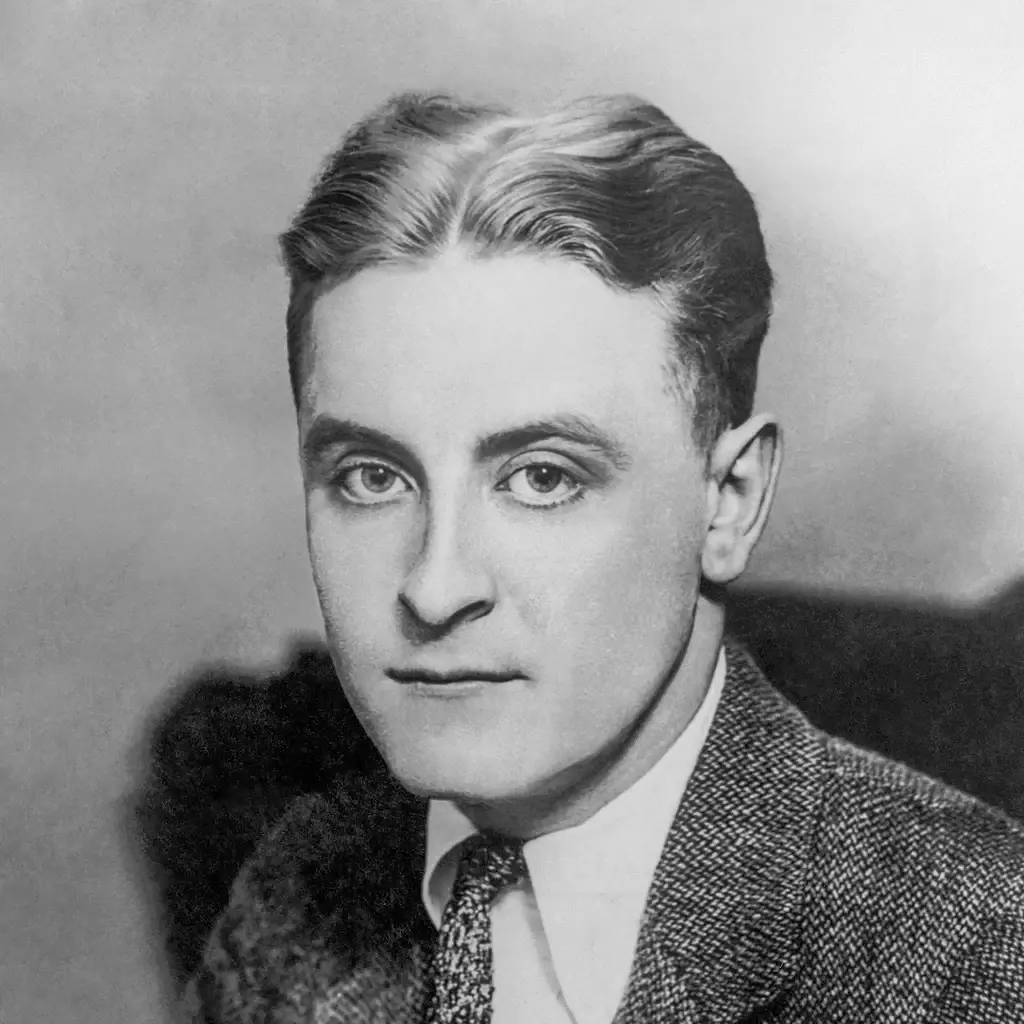
F. Scott Fitzgerald was an American writer. “The Great Gatsby” explores longing, class, and privilege through Jay Gatsby’s attempt to reclaim Daisy Buchanan.
Explore more books by F. Scott Fitzgerald