What you'll learn
Key ideas from The Good Enough Job
These ideas compress the book's argument without treating the author's view as settled fact. Use them as an orientation before reading the full work or listening in Wiseley.
Workism asks a job to provide income, identity, community, purpose, and fulfillment, even when those aims do not align.
Several meaningful roles can make identity more resilient while leaving room for ambition and meaningful work.
Passion-based careers can transfer risk to workers with fewer financial safety nets and disguise unequal pay as personal choice.
Union recognition and collective bargaining translated worker solidarity into negotiated protections and formal procedures.
Leisure has value beyond its ability to restore workers or raise productivity; time for relationships, creativity, citizenship, and rest matters in itself.
Personal boundaries cannot solve overwork when staffing, workloads, or incentives make constant labor the expectation.
A good enough job meets a person’s needs and leaves room for identity, relationships, community, and interests beyond work.
Inside The Good Enough Job
Read the first chapter in full here. The other 8 continue in the Wiseley app.
Chapter 1 of 9 · 6 min · Audio & text
When Work Becomes More Than a Job
The Good Enough Job, by Simone Stolzoff.
Wanting work to matter is understandable. The difficulty begins when a job is expected to provide nearly everything: income, identity, community, purpose, and fulfillment. Simone Stolzoff calls this workism. It treats professional life as more than a way to earn a living, asking one job to satisfy both material needs and the desire for meaning. Those aims can coexist, but they do not always align. A job may provide security without feeling meaningful, or feel meaningful without providing the security someone needs.
In the United States, the question “What do you do?” often means “What is your job?” How a person earns money can become shorthand for who they are. Stolzoff describes a culture that treats economic output as evidence of worth, making productivity seem like a moral good. He reports that Americans named careers as sources of meaning nearly twice as often as spouses, and ranked work above faith and friends. He also reports that ninety-five percent of American teenagers considered having an enjoyable career or job very or extremely important.
The workday itself has a history. Two centuries ago, most Americans were farmers whose work followed sunlight and seasonal cycles. Industrialization allowed production to continue beyond those natural rhythms, with factory schedules that could run ten or twelve hours a day, six or seven days a week. The eight-hour day, forty-hour week, and two-day weekend were achievements of organized labor, not timeless arrangements. For much of the twentieth century, unions and productivity gains helped reduce average working hours. That history shows that work schedules have changed through economic and collective forces; they are not simply facts of life.
Cultural expectations shifted as well. Work moved, in Stolzoff’s account, from being seen mainly as a chore, to a marker of status, to a route to self-actualization. A newer ideal asks people to treat work as an expression of personal passion and identity. When work became meaningful, more work could begin to seem desirable. That expectation adds a cultural pressure to economic and political pressures that already shape how much people work.
The book focuses mainly on American white-collar workers, for whom professional culture often makes the search for meaning through work especially visible. That focus cannot describe everyone’s circumstances. Many people around the world work primarily to survive, and the freedom to choose a fulfilling occupation or control one’s hours is not universal. Workism is especially associated with the United States and privilege, but Stolzoff does not present it as exclusive to one country or class. People across class lines can feel pressure from a culture that ties work to self-worth.
Sufficiency offers a way to think about work without demanding that it be perfect. Stolzoff borrows “good enough” from the British pediatrician and psychoanalyst Donald Winnicott, whose parenting ideal valued support while leaving room for a child’s resilience. Applied to work, the idea does not mean being careless or refusing fulfillment. It means allowing a job to matter without requiring it to define a whole person or deliver every form of satisfaction. A good enough job can provide livelihood, purpose, or enjoyment, while other parts of life also carry value.
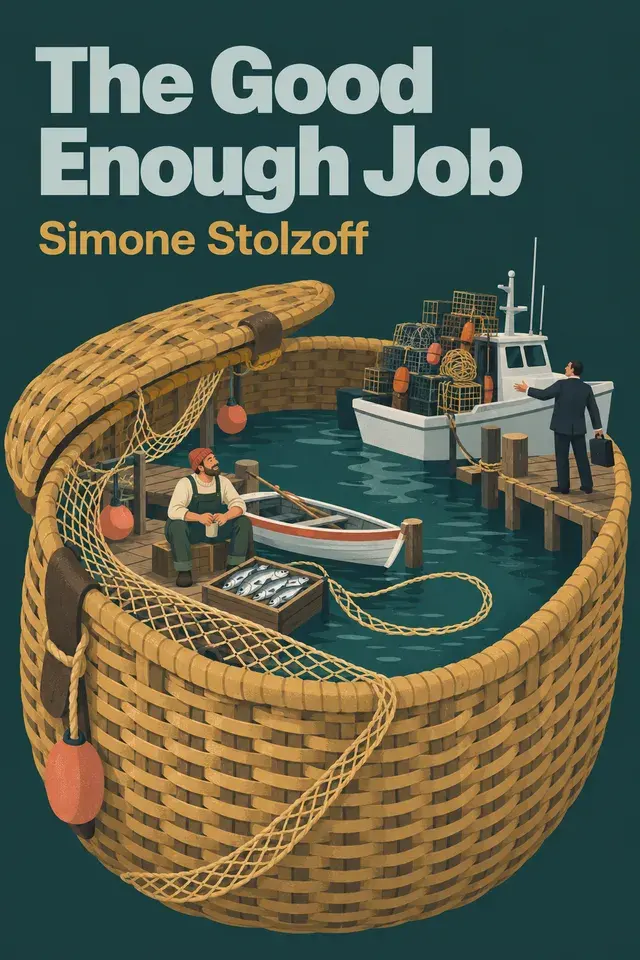
A familiar parable makes the difference vivid. A businessman meets a fisherman who seems content with what he has. The businessman imagines expanding the fisherman’s work, accumulating wealth, and eventually retiring to enjoy life. His plan assumes that enjoyment must wait until after more growth and accumulation. The fisherman’s contentment challenges that sequence: it asks whether the life being postponed is already available in some measure. The story questions the idea that success means organizing the present around work so that a better life can begin later.
Poet Anis Mojgani offered Stolzoff another challenge. Stolzoff expected a successful poet to endorse the familiar advice to follow one’s passion. Mojgani instead said that work remains work, and that earning a living through what one loves is no nobler than working to support what one loves outside the job. His point leaves room for people who find deep meaning in their occupation, while showing that paid work need not be everyone’s primary passion. A person can care for art, relationships, or another pursuit by earning the means to sustain it.
The book’s central question is therefore not whether work should matter, but how much of a life it should be asked to hold. A good enough relationship preserves work’s value without making employment the measure of a person or the meaning of an entire life. It makes room for daily bread and daily meaning, while recognizing that neither has to come from one source alone.
Chapter 2 of 9 · 9 min · Audio & textIn the app
Identity Beyond the Job
As religious and civic participation declines, people still need belonging, purpose, and a sense of who they are. Work is one place those needs can be met: it occupies much of daily life and offers roles, relationships, and a shared set of values.
Chapter 3 of 9 · 10 min · Audio & textIn the app
Dream Jobs and the Price of Passion
Once work is expected to offer more than a paycheck, another expectation can follow: the right job should express a person’s passion. Simone Stolzoff traces the dream-job ideal to career advice that made personal satisfaction central to professional success.
Chapter 4 of 9 · 9 min · Audio & textIn the app
Worth Beyond What We Produce
A person’s value does not have to be measured by what they make. An artist, for example, may matter through the way their work touches someone else, or through what making it brings to their own life.
Chapter 5 of 9 · 10 min · Audio & textIn the app
Belonging Without Corporate Family
Work friendships can make a job more enjoyable and give people a sense of belonging. They can also complicate the work itself.
Chapter 6 of 9 · 11 min · Audio & textIn the app
Leisure Is Part of a Full Life
Long hours can look like evidence of commitment. In many workplaces, being busy signals ambition, while an open afternoon can feel like time that should have been put to use.
Chapter 7 of 9 · 8 min · Audio & textIn the app
Boundaries Need Deliberate Design
Work can follow people beyond the place they call an office. A campus can supply meals, exercise, medical care, and recreation, while a laptop or phone carries messages into the evening.
Chapter 8 of 9 · 8 min · Audio & textIn the app
Choose Your Own Scorecard
Status offers a ready-made scorecard. It turns the vague question “Am I doing well?”
Chapter 9 of 9 · 9 min · Audio & textIn the app
Make Good Enough Possible
A person can decide to stop answering messages after dinner, but that boundary is hard to keep when a team is understaffed, deadlines require excessive hours, or pay rewards time spent rather than work completed. In those conditions, advice to set limits shifts responsibility to the worker without changing what creates the overwork.
Chapter 1 of 9 · 6 min · Audio & text: When Work Becomes More Than a Job
Wiseley supports reading and listening to summaries in the app.
Continue in WiseleyAbout Simone Stolzoff

Simone Stolzoff is the author of “The Good Enough Job”. The book explores how work can matter without becoming a person’s whole identity.
Explore more books by Simone Stolzoff