What you'll learn
Key ideas from The Extended Mind
These ideas compress the book's argument without treating the author's view as settled fact. Use them as an orientation before reading the full work or listening in Wiseley.
The book frames intelligence as a shifting capacity shaped by available supports and their deliberate arrangement.
Bodily patterns can guide rapid choices before conscious reasoning, but their usefulness depends on learning how sensations relate to outcomes.
Gesture offloads thought, complements speech, and reveals emerging ideas before they are fully formed in words.
Natural settings can reduce stress and rumination, freeing attention for memory, focus, and judgment.
The strongest work settings balance social access with private withdrawal, personal control, and zones for alternating collaboration and focused effort.
Writing, sketching, and diagramming deepen observation, expose omissions, and let ambiguous marks generate new possibilities.
Expert learning becomes more accessible when hidden perceptions and procedures are made visible through models, scaffolding, micro-steps, and guided practice.
Shared artifacts, transactive memory, visible discussion, and aligned incentives make distributed knowledge usable.
Inside The Extended Mind
Read the first chapter in full here. The other 7 continue in the Wiseley app.
Chapter 1 of 8 · 4 min · Audio & text
Beyond the Brainbound Mind
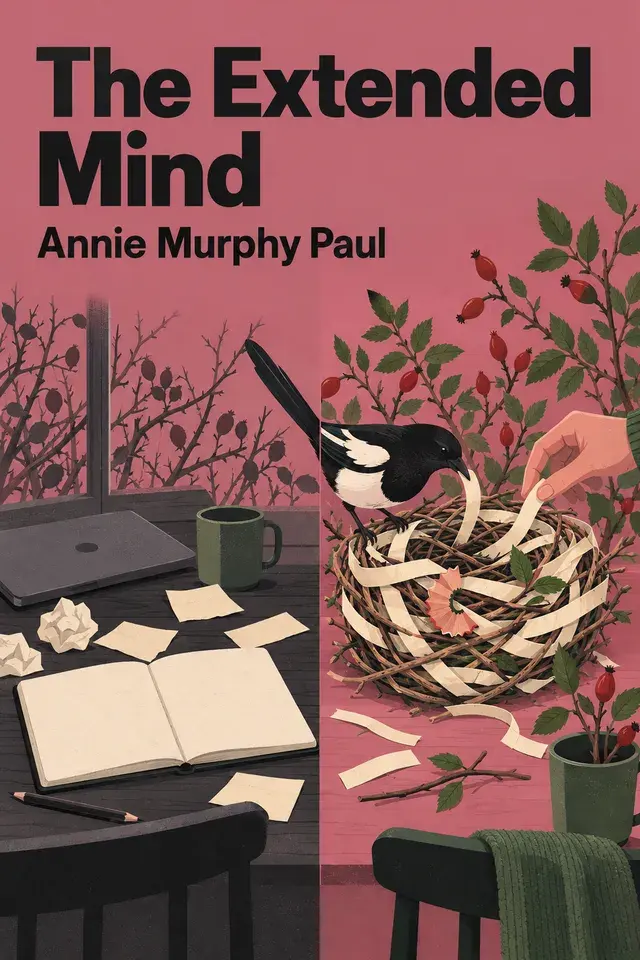
The Extended Mind, by Annie Murphy Paul.
Much advice about thinking assumes the decisive work happens inside the skull. When attention or reasoning fails, the usual remedy is more internal effort: discipline, grit, memory, or rational control. Annie Murphy Paul asks whether this diagnosis misses the supports human thinking naturally recruits. Perhaps the problem is not simply insufficient brainpower, but failure to arrange those supports deliberately.
She encounters this problem in her own writing. After a morning of stalled work at her keyboard, she walked and returned with sharper attention and a path through a difficult conceptual problem. She treats this as personal experience alongside research, not proof; she even wonders whether her brain might have solved it unaided. Tversky and Kahneman’s walks offer a related illustration, joining bodily movement, conversation, and theoretical work.
Paul calls this the extended mind. Things outside the brain do not merely influence a sealed mental process. Under suitable conditions, bodily signals, physical places, tools, written representations, and other people can become parts of thinking itself. Andy Clark and David Chalmers challenged the idea that skin and skull are sacred boundaries. Their early argument emphasized technology, but Paul’s broader account includes bodies, environments, and relationships.
The book connects three research traditions that often developed separately. Embodied cognition studies the body’s role in thought. Situated cognition studies how places and environmental cues shape performance. Distributed cognition studies how thinking spreads across people and how coordinated expertise can exceed one person’s contribution. Together, they create the book’s route from body to surroundings to social coordination.
This framework also exposes limits in two familiar metaphors. The brain-as-computer image, reinforced by early machines such as ENIAC, pictures cognition as internal information processing with measurable capacity. The brain-as-muscle image, linked with growth mindset, grit, and cognitive fitness, emphasizes strengthening that capacity through effort. Both preserve a deeper assumption: intelligence is an individual possession sealed inside the head, ready to be measured and ranked.
That assumption is restrictive in a complicated world. Modern education and work demand information, speed, specialization, and abstraction beyond abilities humans evolved to acquire automatically. The book also notes that commercial brain training often improves practiced exercises without reliably transferring to everyday cognition. This is not an argument against the brain, learning, or effort. Its biological limits describe the species, not the intelligence or grit of any individual.
The alternative is not to enlarge the brain, but to enrich the system around it. A magpie builds with materials it finds; Paul uses the image to show that intelligence is assembled from bodily, spatial, material, technological, and social resources. People already extend their minds, though institutions reward sitting still and keeping thought internal. The practical question is: what can the body sense, what can spaces reveal, what can tools hold, and what can other people contribute? The later chapters move from body to nature, built spaces, and external representations, then to social learning and collective intelligence. Thinking well partly means designing conditions that can outperform isolated, brainbound effort.
Chapter 2 of 8 · 5 min · Audio & textIn the app
Listen to the Body
The body is constantly changing, yet much of that change remains below conscious awareness. Interoception is the capacity to notice internal signals such as heartbeat, breathing, muscle tension, and general bodily feeling.
Chapter 3 of 8 · 6 min · Audio & textIn the app
Move and Gesture to Think
The bodily argument now turns from sensing to doing. Movement is not merely an output of thought; it can regulate thought itself.
Chapter 4 of 8 · 4 min · Audio & textIn the app
Let Nature Restore Attention
The book now turns from the body to the surroundings that help thought. Nature is not merely a backdrop; it can be a restorative cognitive resource.
Chapter 5 of 8 · 5 min · Audio & textIn the app
Build Spaces for Focus
Buildings are often treated as neutral containers for thought. In Paul’s account, they are closer to cognitive equipment: they direct attention, define who can approach us, and cue how we should act.
Chapter 6 of 8 · 5 min · Audio & textIn the app
Put Ideas in the World
Thinking is often described as something the brain does internally. Paul asks us to notice that we can also think by putting parts of a problem into the world.
Chapter 7 of 8 · 6 min · Audio & textIn the app
Learn Through Other Minds
Learning through other minds extends cognition in a distinctive way. Experts, teachers, peers, conversation partners, and storytellers expose knowledge that is hard to discover alone.
Chapter 8 of 8 · 7 min · Audio & textIn the app
Build Collective Intelligence
The book’s movement from body to surroundings to other people ends with a change in the unit of analysis. Intelligence is not only something a person possesses.
Chapter 1 of 8 · 4 min · Audio & text: Beyond the Brainbound Mind
Wiseley supports reading and listening to summaries in the app.
Continue in WiseleyAbout Annie Murphy Paul

Annie Murphy Paul is the author of “The Extended Mind”. The book explores how bodily signals, movement, surroundings, and other people extend the way we think.
Explore more books by Annie Murphy Paul